Free agent in soccer: what it means and how a deal works
By Mariano David Pérez Co-founder

A free agent in soccer is a player whose contract has ended and who can sign for any other club without that club paying a transfer fee. FIFA does not use the phrase, but the rule behind it is written down: a professional is free to conclude a contract with another club if his contract has expired or is due to expire within six months (article 18, paragraph 3 of the Regulations on the Status and Transfer of Players).
This article is current as of November 2026. It cites the RSTP in its July 2025 edition, which is the one in force today, and compares it with the January 2027 edition, which the FIFA Bureau of the Council approved on 10 June 2026 and which enters into force on 1 January 2027.
What does it mean for a player to be a free agent?
It means there is no club to pay for his registration. “Free agent” is market language, not regulatory language: the phrase appears in neither the RSTP nor FIFA’s agent regulations. What does appear is the condition that creates it, a contract that has expired or is about to.
In practice there are two situations, and they should not be mixed up:
- Free now: the contract has ended. The player can sign wherever he likes, the former club has no fee to collect, and it cannot hold up the registration.
- Free next summer: six months or less remain. He can agree terms with another club, and the deal starts only when his current contract ends. That is a pre-contract agreement, covered in its own article.
One thing that gets confused: a free transfer is not a cheap signing. The club saves the fee, but the player, who leaves nothing on the table for his old club, will usually ask for part of that saving as wages or a signing-on fee. That is where the negotiation happens.
What does FIFA say about signing a player whose contract is ending?
Three rules organize most of it. The article numbers are those of the July 2025 edition, and they are the same in the 2027 one.
- Six months (article 18, paragraph 3). A club that wants to sign a professional must inform his current club in writing before entering into negotiations, and the player is only free to conclude a contract with another club if his contract has expired or is due to expire within six months. Breaches are subject to sanctions.
- Registration after the window has closed (article 6, paragraph 3 b). A professional whose contract has naturally expired, or been mutually terminated, before the end of the registration period of the engaging club may be registered with that club even after the period has ended. Mind the detail: the rule covers a contract that ended before the window closed, not one that ends after it.
- No permission from the old club (article 6, paragraph 5). Where a player’s employment contract has expired, the consent of the former club is never required to register him.
Article 18, paragraph 2, also sets a maximum contract length of five years, and bars a player under 18 from signing for more than three, unless national law allows otherwise. That is why academy players’ first professional contracts are the first ones to reach this point.
What the regulations do not settle on their own: collective bargaining agreements and national rules can add conditions. Check the local rule as well before closing anything.
What happens to the agent’s fee when the player is a free agent?
The basis for the calculation changes. Under the FIFA Football Agent Regulations, the fee of an agent who represents a player or an engaging club is calculated on the player’s remuneration, not on transfer compensation, which a free agent does not carry. The cap (article 15) is 5% of annual remuneration up to USD 200,000 (or equivalent) and 3% on the part above it; where the same agent acts for both sides, in the cases where that is permitted, the caps double (10% and 6%). Conditional payments do not count towards the calculation.
Two more rules matter in a free-agent negotiation:
- Who pays. As a general rule, the agent’s client pays. The exception (article 14, paragraph 3) is a player whose negotiated annual remuneration is below USD 200,000: the club may pay the fee on his behalf, without deducting it from his pay and without making the agent dependent on the club.
- The representation agreement. It may not run for more than two years, and an automatic renewal clause is void (article 12). We cover it in our article on the representation agreement.
How fees are paid and tracked is in our piece on how much soccer agents earn. The caps and exceptions are in the text cited; this article does not analyze how they apply in each country.
How is a free agent’s deal negotiated?
The table is different from a transfer, because there is no selling club on the other side. The only parties are the player (with his agent) and the buying club:
| What is negotiated | What to be clear about |
|---|---|
| Wages | They are the base for the agent’s fee and the main point of tension. |
| Signing-on fee | This is where a club’s saving on the transfer fee tends to land. See our article on the signing-on fee. |
| Length | Five years at most under the regulations, less for players under 18. |
| Bonuses and clauses | Release clauses, extension options, a percentage of a future sale. |
| Start date | If there is a pre-contract, when it starts and what happens with the registration window. |
Four things help before sitting down:
- Check the calendar. If the player comes from another league, it matters when the window opens and closes where he will be registered. The dates, country by country, are in our article on transfer window dates.
- Tell the current club in writing before talking, if there is still a contract. Article 18.3 requires it, and it avoids a sanction that can sink any negotiation.
- Put what replaces the fee into the offer. A club that is not paying for the registration has room to offer more in wages or a signing-on fee, and the player knows it.
- Keep the player’s paperwork up to date, because a player signing as a free agent has to be registrable without delay.
How do you avoid losing a player by not watching the date?
Most free agents who get away get away earlier, when nobody was looking at the calendar. For a club, the valuable player leaves for nothing; for an agency, the client becomes free without anything having been negotiated on his behalf, and the representation agreement runs out at the same time.
What helps is lining the deadlines up end to end: the club contract, the representation agreement and the commission still owed. In The Football Club, expiry alerts put those three in one traffic-light view, with an email in the morning whenever something has come into range.
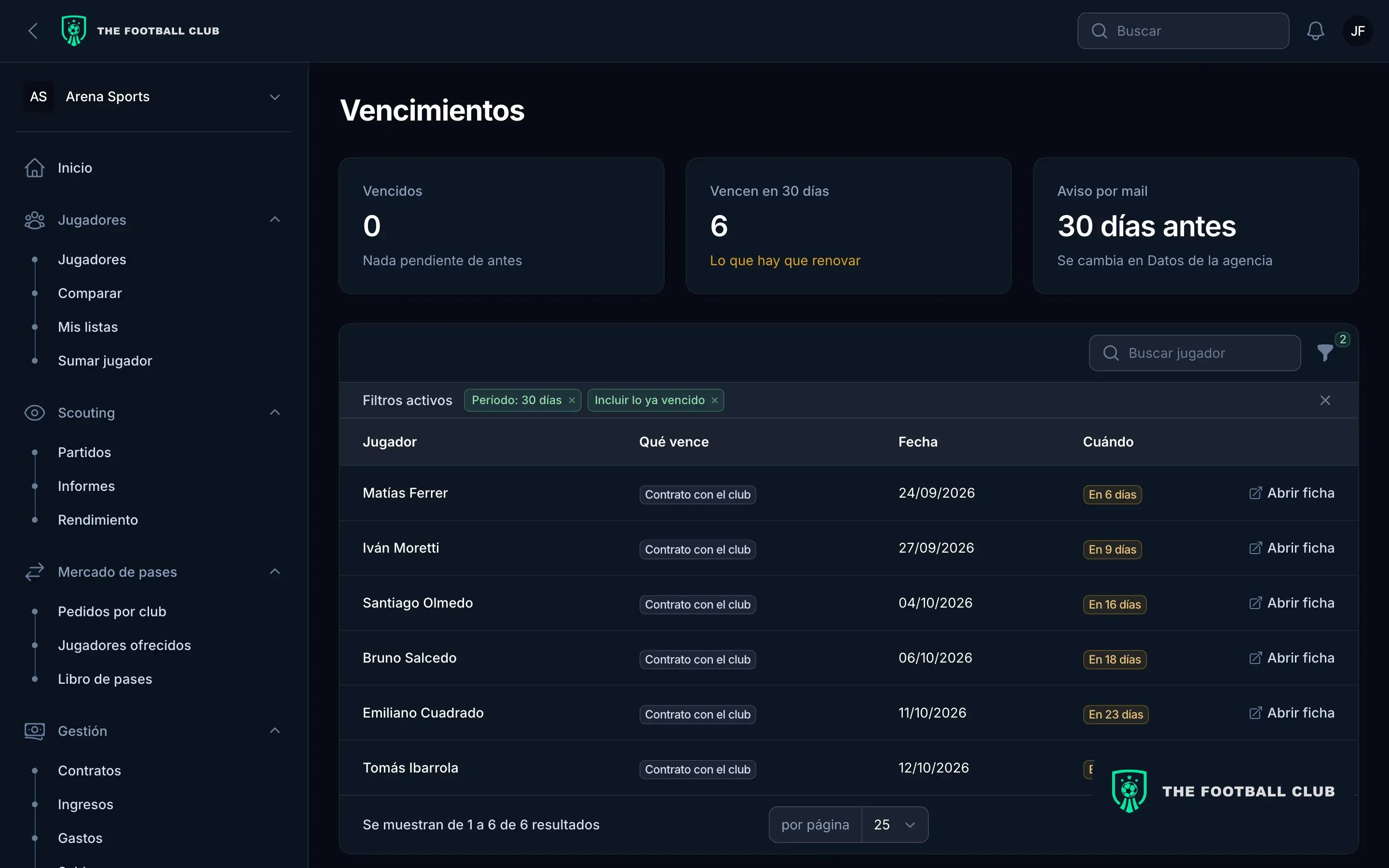
Every line leads to the player’s profile, where the club, the date and the agreed terms are. The data in the screenshot belongs to a demonstration agency.
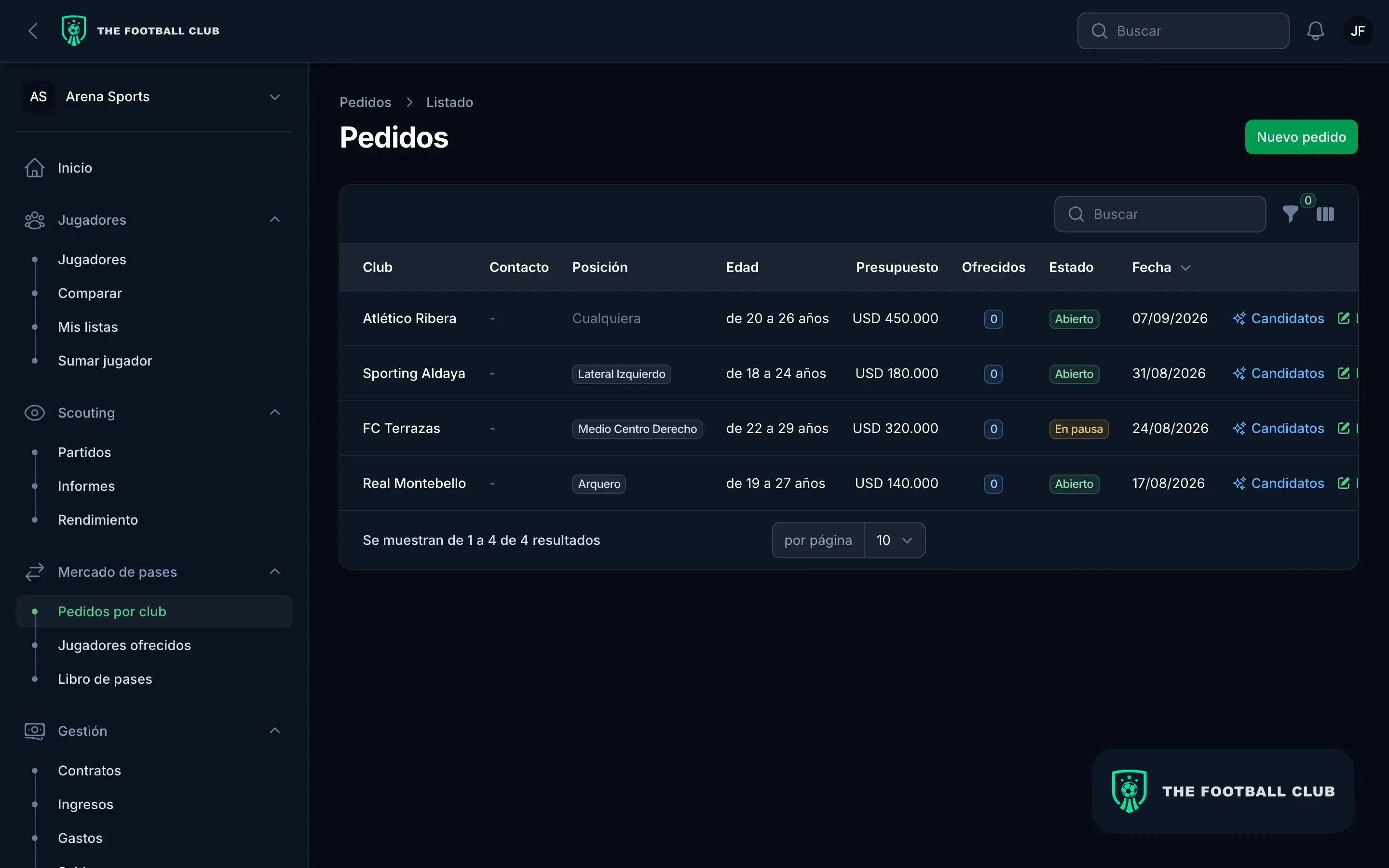
And for whoever is looking for players to sign, the platform’s transfer market lets you log what each club is looking for and cross it with your roster: when a player on your books enters his last six months, you already know which clubs to offer him to. The app for managing players shows how that works day to day.
In short
A free agent is a player who can sign for another club without a transfer fee because his contract has ended or is within six months of ending. FIFA does not call him that, but article 18.3 allows it, with a written notice to the current club before talks, and article 6 lets him be registered without his old club’s consent once the contract has expired. For the agent the basis of the fee changes; for the club, what it saves on the fee is fought over in wages and the signing-on fee. And it all starts earlier: with the date.
Sources
- FIFA Regulations on the Status and Transfer of Players, July 2025 edition (articles 6 and 18).
- FIFA Regulations on the Status and Transfer of Players, January 2027 edition (articles 6 and 18; in force from 1 January 2027).
- FIFA Football Agent Regulations (articles 12, 14 and 15).
- FIFA: Bureau of the Council approves new regulatory framework, 10 June 2026.
This article is for information and does not replace legal advice. National rules and collective bargaining agreements may add conditions of their own. Updated November 2026.