What is a signing-on fee and how is it paid?
By Mariano David Pérez Co-founder

A signing-on fee is a sum a club pays a footballer simply for signing their employment contract, on top of wages. It is agreed when the contract is negotiated, has to be written into it and, although it is described as a lump sum, it is nearly always paid in installments over the life of the contract. It is also called a sign-on fee or signing bonus; in Spanish, prima de fichaje.
What is a signing-on fee, according to the rules?
There is no single definition for the whole game: each league regulates it in its own way. These three sources say much the same thing.
- England. The Premier League Rules for the 2026/27 season (Section A, definitions) describe it as “a lump sum payment” due under the contract between a club and a player and expressed in it to be a signing-on fee.
- Spain. The collective agreement for professional soccer, signed by LaLiga and the players’ union AFE and published in the official gazette in 2015, defines the prima de contratación o fichaje in Article 22 as the amount agreed between club and player for the act of signing the employment contract. Article 20 lists it among the components of pay, alongside the monthly wage and match bonuses.
- FIFA. The Football Agent Regulations include “any sign-on fee” in their definition of remuneration, next to base salary and amounts payable if conditions are met.

How is a signing-on fee paid?
It is paid as the contract says. Each league’s rules set the floor:
| England (Premier League Rules) | Spain (AFE–LaLiga agreement) | |
|---|---|---|
| What the contract must say | That the payment is a signing-on fee (Section A definition) | The amount and the payment periods, in writing (Art. 22) |
| How it is spread | In contracts longer than one year, in equal annual installments (Rule T.16) | If no payment date was set, in four installments spread proportionally over the season (Art. 31) |
| Limits and multi-year deals | Only allowed in contracts of three months or more (Rule T.15) | If the share for each year cannot be worked out, the total is divided by the years agreed (Art. 22) |
Rule T.17 also settles what happens if the player is transferred before the fee has been paid in full: the selling club must pay the unpaid balance straight away, unless, among other exceptions, the transfer follows the player’s written request or the contract was terminated for the player’s breach.
A caveat on Spain: the 2023 amendment extended the agreement to 30 June 2026 and allows for renewals. For a later contract, check the text currently in force.
How does it differ from wages, performance bonuses and the transfer fee?
- Wages: paid every month for playing for the club. A signing-on fee is paid for having signed.
- Performance bonuses: depend on something happening (appearances, promotion). A signing-on fee does not depend on any result.
- Transfer fee: goes to the club releasing the player, not to the player.
Why it matters to the agent
Because it counts towards the agent’s commission: FIFA’s definition of remuneration, on which the regulations calculate the service fee, includes the sign-on fee. How that is worked out, and which rules are currently suspended, is covered in how much soccer agents earn; what to put in writing, in the guide to the representation agreement.
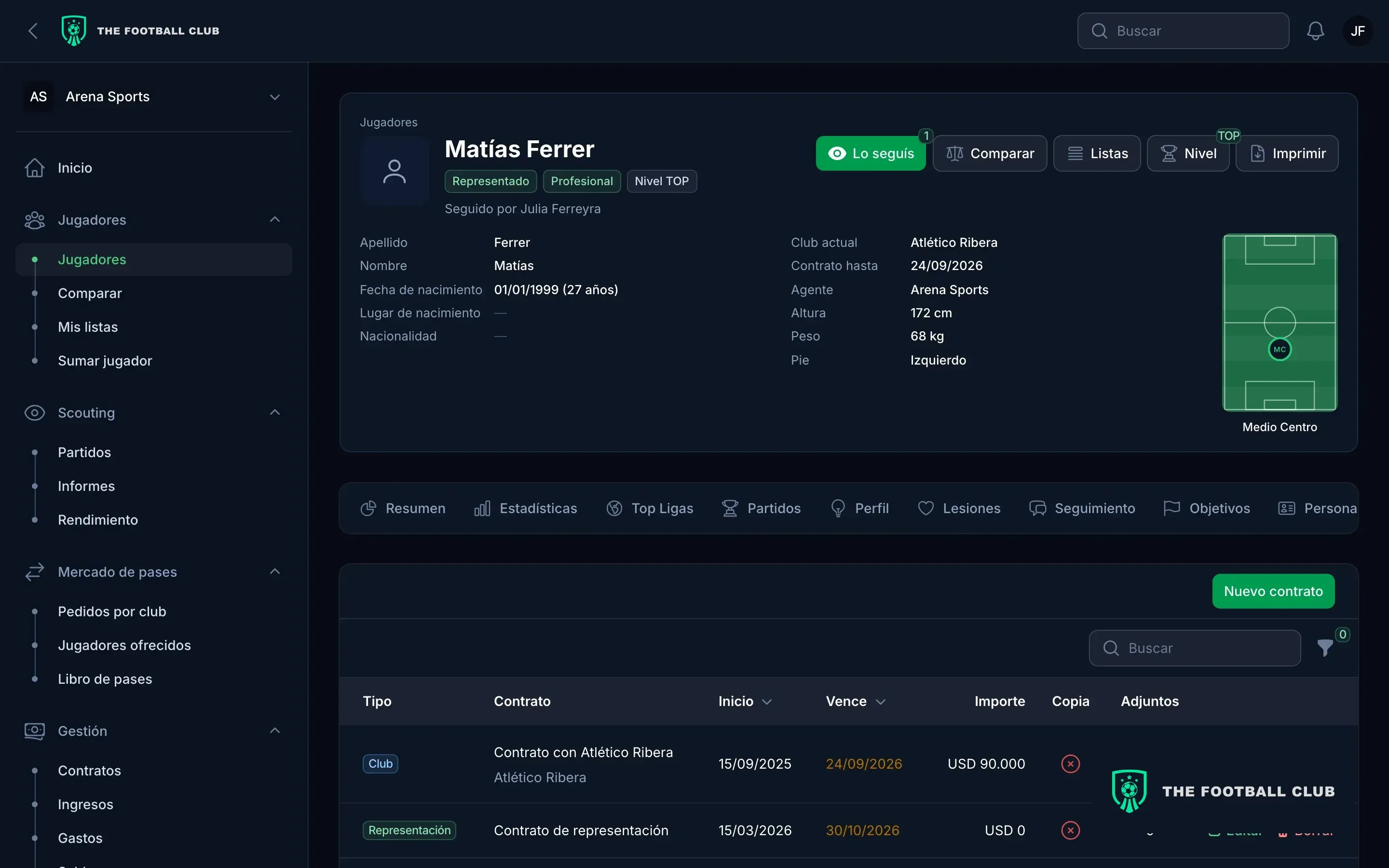
Since the fee arrives in installments, someone has to track them. In The Football Club each contract is stored with its club, its term, its remuneration and its clauses, it shows on the player profile, and agreed commissions are recorded with their due date until they are marked as collected.
Sources
- Premier League Handbook, Season 2026/27 (PDF): definition of “Signing-on Fee” and Rules T.15 to T.17.
- Collective agreement for professional soccer in Spain (BOE, 8 December 2015, in Spanish), Articles 20, 22 and 31, and its 2023 amendment.
- FIFA Football Agent Regulations, definition of “Remuneration”.
This article is for information only and is not legal or tax advice. Updated November 2026.