Soccer pre-contract agreement: what it is, when to sign
By Mariano David Pérez Co-founder

A soccer pre-contract agreement is a deal a player signs with a new club, before his current contract has ended, to play there once it does. FIFA does not use the word “pre-contract”, but it makes the arrangement possible through its six-month rule: a professional is only free to sign with another club if his contract has expired or is due to expire within six months (article 18, paragraph 3 of the Regulations on the Status and Transfer of Players).
This article is current as of November 2026. It cites the July 2025 edition of the regulations, which is the one in force today, and compares it with the January 2027 edition, which the FIFA Bureau of the Council approved on 10 June 2026 and which comes into force on 1 January 2027.
What is a pre-contract in soccer, and where does FIFA mention it?
In the language of the market, a pre-contract is a contract that is signed but not yet running: the player agrees terms with club B for the next stage of his career while he is still tied to club A, and the deal starts to apply when his contract with A ends. The word is jargon. It does not appear in the FIFA regulations, in either the 2025 or the 2027 edition.
What the regulations do say, and what makes the whole thing possible, is article 18, paragraph 3. It has three parts: a club that wants to sign a professional must tell his current club in writing before it starts negotiating with him; the player is only free to sign with another club if his contract has expired or is due to expire within six months; and any breach is subject to “appropriate sanctions”. The paragraph is word for word the same in the January 2025 edition, the July 2025 edition and the January 2027 edition.
When can a pre-contract be signed?
A pre-contract can be signed once six months or less remain on the player’s contract. Before that, the player is not free to sign with another club: anyone who wants him has to deal with the club that holds his contract and, in most cases, pay a transfer fee.
The start of that window depends on when each contract ends, which varies with the league calendar. Two examples with made-up contracts:
| If the contract ends on… | The player is free to sign elsewhere from… | Typical calendar of… |
|---|---|---|
| 30 June | late December or early January | leagues that finish their season in summer |
| 31 December | late June or early July | leagues that play a calendar-year season |
The rule speaks of six months, not of a calendar date, so what counts is the expiry date written in the contract. That is why it has to be recorded correctly, and why it is the centre of how not to lose a renewal to a contract expiry.

What does a club have to do before signing a pre-contract?
The first step is not the signature but a notice: under article 18.3, the interested club has to inform the player’s current club in writing before it starts negotiating with him. That applies even when the player is already inside the last six months.
In order, a club that wants a player with an expiring contract goes through this:
- Confirm the expiry date and that the player is inside the final six months.
- Notify the current club in writing, before talking conditions with the player or his agent.
- Negotiate and sign, with the agent’s name, their client, their FIFA license number and their signature in the contract when an agent was involved: article 18, paragraph 1 requires it.
- Mind the length: article 18.2 sets a maximum of five years, unless national law allows another length, and a maximum of three years for players under 18; the 2027 edition adds an exception for young players who have already been at the club for some time.
- Do not make the contract conditional on a medical or a work permit: article 18.4 says its validity may not depend on either.
Order matters because the regulations do not put a figure on the penalty for skipping the notice: they say “appropriate sanctions”. What a tribunal or committee would do with them cannot be guessed from an article, which is why the sensible course is not to get there.
What happens to the player while the pre-contract is waiting?
Until his contract expires, the player still belongs to the current club and has to honour it. Article 13 is clear: a contract between a professional and a club may only be terminated upon expiry of its term or by mutual agreement. Signing a pre-contract neither terminates nor suspends it.
The same goes for registration. Article 6 says players may only be registered during one of the two annual registration periods fixed by their association, so the player can only be registered at the new club inside one of those windows.
Two more things to keep in mind:
- Two agreements for the same period. If a professional signs more than one contract covering the same period, article 18.5 says the provisions of Chapter IV of the regulations apply, the one on contractual stability. A player with two offers has to close only one, and his agent has to know which.
- The current club improving its offer. Until the player signs, nothing stops his club from putting a renewal on the table. That is why the written notice and the date matter to both sides.
What changes in the 2027 edition?
The paragraph that makes the pre-contract possible does not change: article 18.3 of the January 2027 edition repeats the 2025 text. What moves around it is different, and worth knowing when a contract is meant to start after 1 January 2027:
- Article 18.2 adds an exception for players under 18 who have been registered at the club for at least 20 months, or two consecutive competition periods, whichever is shorter: their contract may then run up to five years, with limits on how many such contracts a club may sign per season and mandatory wage increases in the fourth and fifth years.
- The protected period is redefined, going from three seasons or years to a length that depends on the player’s age at signing, and the sanctions for breaching a contract inside it are rewritten.
The 2027 transitional provisions (article 26) say the regulations apply to cases whose facts arise after they come into force, and that article 17 paragraph 1 and article 21bis apply only to contracts concluded from that date. How that applies to a pre-contract signed in 2026 for a contract that starts in 2027 is a question for the player’s or the club’s lawyer.
What is worth putting in writing in a pre-contract?
The regulations give no template, and each association and country adds its own layer (labour law, collective agreements, league forms), so what follows is a practical checklist and not a rule:
- The parties and the start date, tied to the date on which the previous contract ends rather than to a fixed day that could be wrong if that contract is extended.
- Length, salary and bonuses, with currency and payment terms.
- The agent involved, with their FIFA license, as article 18.1 requires.
- What happens if the player cannot be registered, without making validity depend on a medical or a work permit (art. 18.4).
- Proof of the notice to the current club, because it is the first thing anyone will ask for in a dispute.
For an agency, the pre-contract is also the moment the commission changes: the representation agreement defines who is paid and when, and the installments depend on the new contract existing. How that sum works is in how much soccer agents earn.
How to track pre-contract deadlines in The Football Club
What fails an agency or a club is rarely the rule itself: it is finding out late that a contract has entered its last six months. In The Football Club each contract is recorded on the player’s profile with its term, amount and clauses, and the expiry dates section sorts them with a traffic light by deadline (what expires in 30, 90 and 180 days) and sends an email every morning with what is coming due.
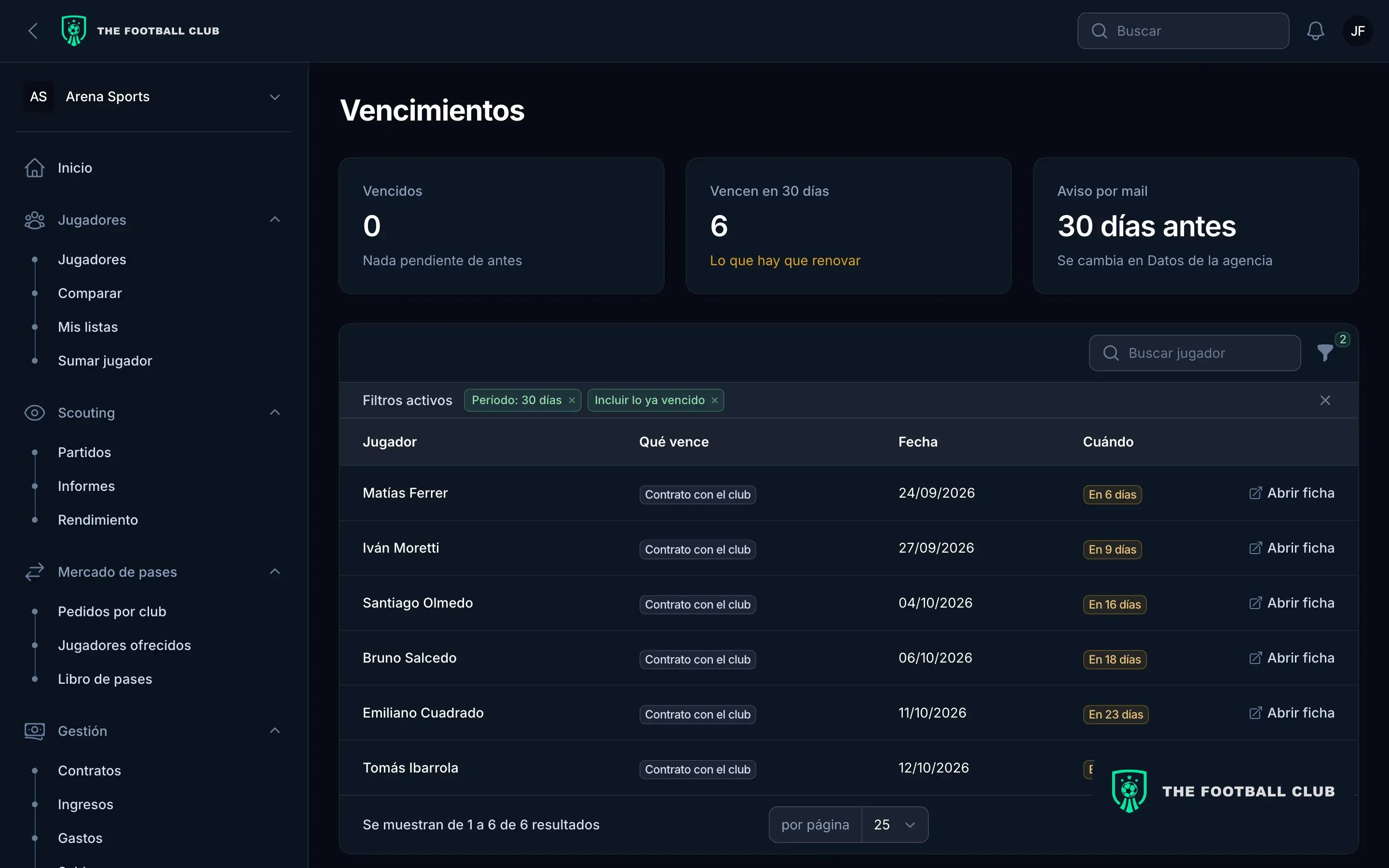
The tracking works for both sides: for the club, which knows when the renewal offer has to be on the table; and for the agency, which knows from when it can open talks with other clubs. What it does not do is sign or notify anyone for you: that stays with the club, the agent and their lawyer.

In short
A pre-contract is a contract signed before it starts to run. FIFA allows it in the final six months of a player’s contract (article 18.3), requires written notice to the current club before negotiating, and keeps the existing contract in force until it expires. The rule is the same in the 2025 and 2027 editions; what changes in 2027 are other things, such as the length of contracts for under-18s and the protected period.
Sources
- FIFA Regulations on the Status and Transfer of Players, July 2025 edition (articles 6, 13 and 18).
- FIFA Regulations on the Status and Transfer of Players, January 2027 edition (articles 6, 13, 18 and 26; approved on 10 June 2026, in force from 1 January 2027).
- FIFA Regulations on the Status and Transfer of Players, January 2025 edition, to compare article 18.
- FIFA on the approval of the new regulatory framework, June 2026.
This article is informational and does not replace legal advice. National rules and collective agreements may add conditions of their own. Updated November 2026.