How to pitch a player to a club without being ignored
By Mariano David Pérez Co-founder
How to pitch a player to a club: answer something the club is actually looking for, send a short message with what decides it (position, age, contract situation, a video and the data) and keep a record of who you sent it to. Before any of that comes something the club never sees but FIFA’s rules demand: a written representation agreement with the player.
Clubs receive dozens of pitches and reply to the ones that save them work. This article sets out what must be in order, what the first message should contain, how to follow up and which obligations start the moment the club replies.
What must be in order before you pitch a player?
A signed, written representation agreement. FIFA’s Football Agent Regulations (in force since 1 January 2025) define football agent services as any negotiation, communication or preparatory activity carried out for a client with the aim of concluding a transaction, and article 12 says an agent may only perform them after signing a written representation agreement. Pitching a player to a club is part of that communication.
Three things to check before you write:
- The agreement is in force and says which services it covers. Article 12 requires the names of the parties, the duration, the fee, the nature of the services and the signatures. If the player is a minor, or you are not sure how he was signed, start with how players are found and signed.
- The player knows whom you will pitch him to and on what terms. This is practice, not a rule: agree in advance which clubs are fine, which are not and how he feels about a loan or a move abroad. It spares you a pitch the player later disowns.
- You are not pitching him to push him out of his contract. Article 16 (paragraph 3) prohibits an agent from negotiating or facilitating talks aimed at inducing a player to terminate his contract without just cause. A player under contract is pitched with his club in the loop, not behind its back.
Why do clubs ignore most pitches?
Usually because the message does not answer anything the club was asking itself. There is no official statistic on this; what follows is professional judgement, not data. The common reasons:
- Anyone is pitched to any club. A 28-year-old striker sent to a club that wants youth players is noise.
- Five links to open before you know who he is. The decision-maker looks for a few seconds.
- Adjectives instead of data. “Very good, high potential” cannot be checked; minutes, appearances and a video can.
- The contract is missing. If the club has to ask when his deal ends or what he expects to earn, half the messages die there.
- It arrives again, unchanged. Forwarding the same message with nothing new burns the contact.
What should the first message contain?
What someone needs to say “yes, send more” or “no, thanks” in under a minute. An order that works:
- Why you are writing to this club: “I saw you are looking for a left-back up to 24” or “Your side plays with wide wingers and this player thrives there.”
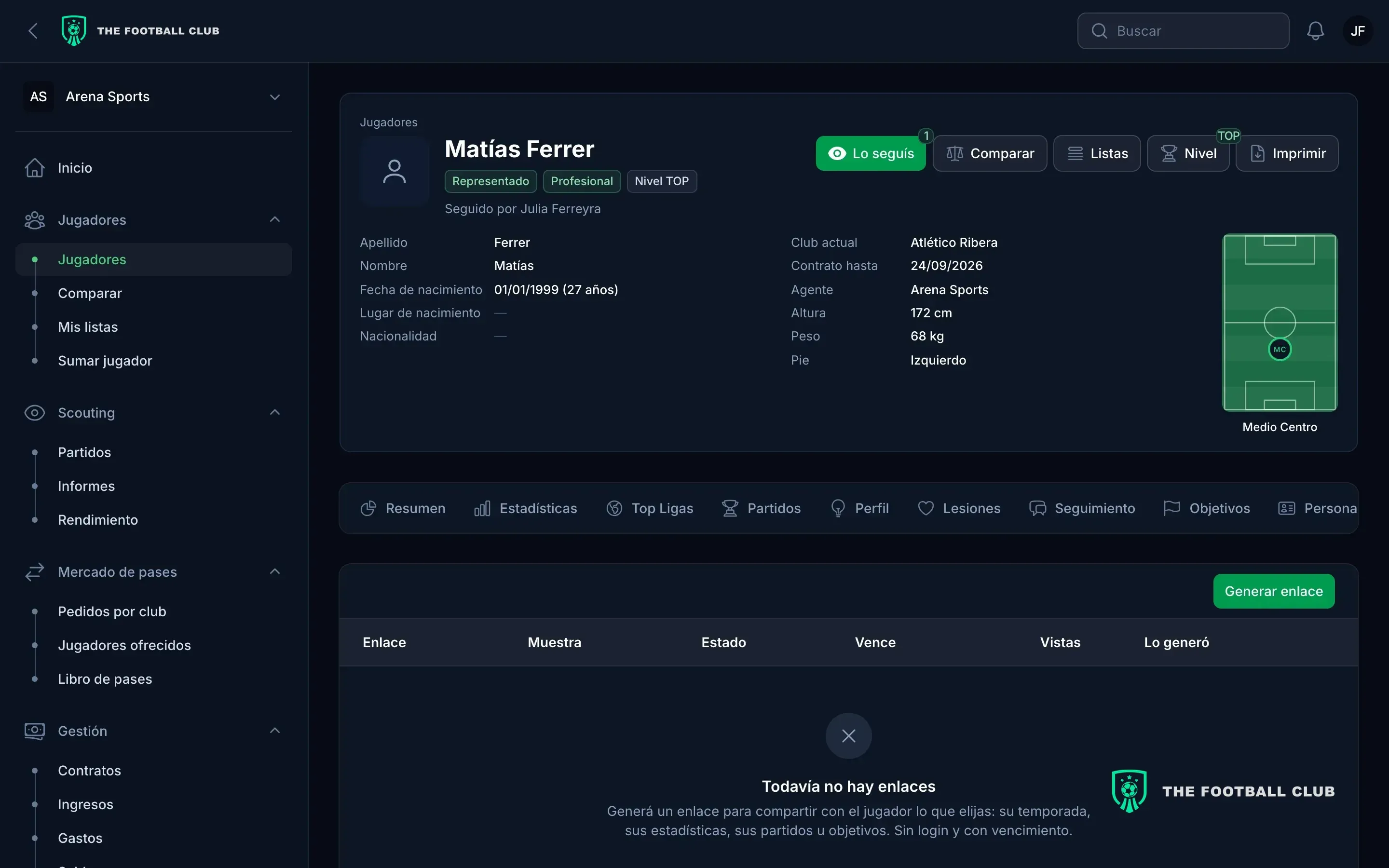
- The player in one line: name, age, position, current club and nationality.
- The contract situation: when it ends and whether any clause or loan is in force. It lives in the player profile if you keep it up to date.
- Two or three figures that matter for that position, with season and competition. How to pick them is in football metrics by position.
- A short video of his actions and, if possible, a full match.
- What you propose and what comes next: “If you are interested, I will send the full report and we can set a call.”
Everything you claim has to be true and checkable: the regulations oblige you to act in your client’s best interests and to avoid conflicts of interest (article 16, paragraph 2), and an inflated figure is found out on the first call. If your report comes from a match you watched, here is how to write a scouting report a club will read.
Whom do you send it to, and when?
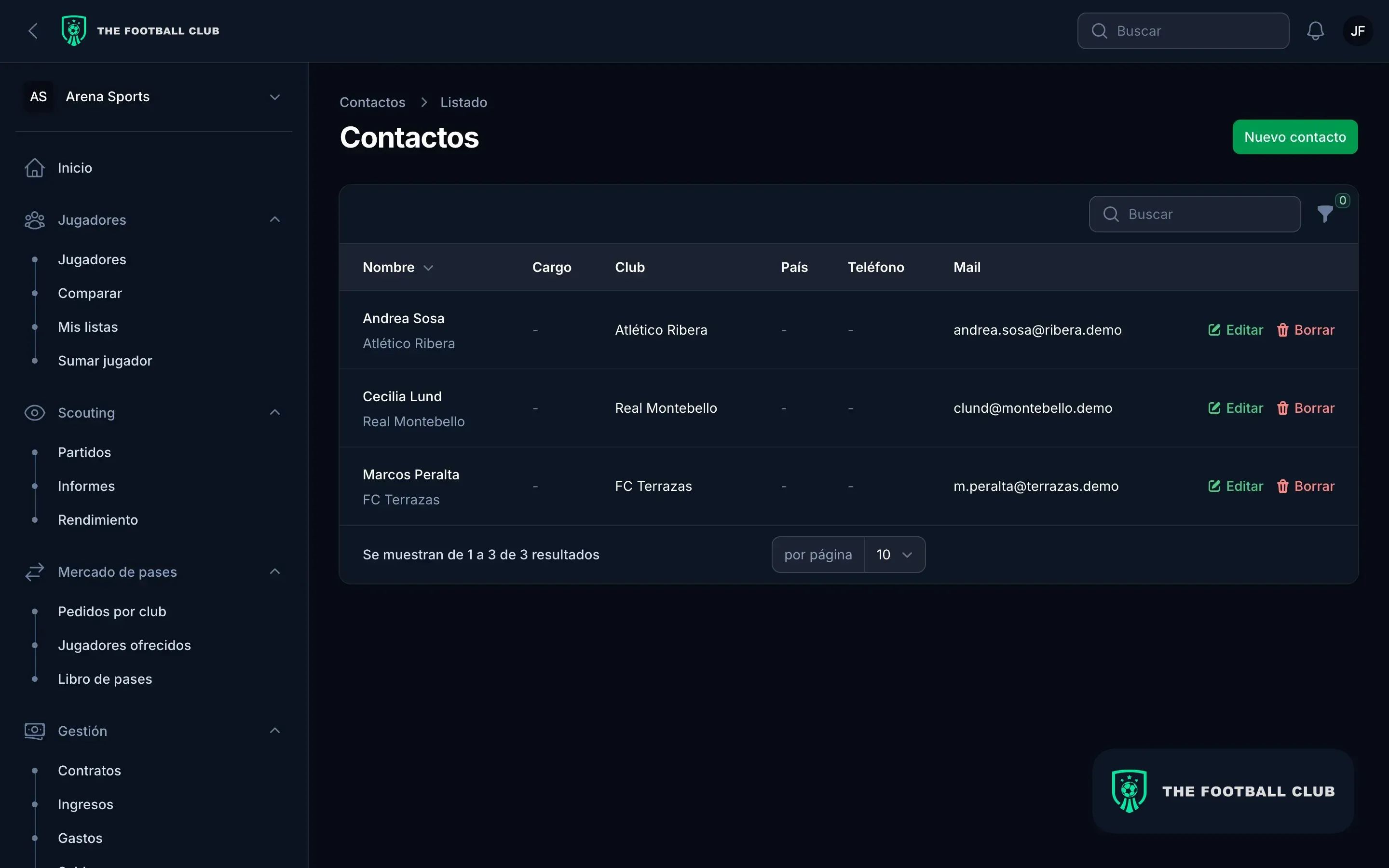
To the person who decides that position, not the club’s general inbox: at many clubs that is the recruitment department or the sporting director (how a recruitment department is organised). If you do not know who it is today, ask; roles change between seasons. Keeping the name, the role and what that person asked for is exactly what the note on club contacts covers.
On timing: the best moment is when the club already has the gap. A pitch with no prior request has lower odds than one answering a concrete search, and the calendar matters: transfer window dates differ by country, and writing a week before the close rushes everyone. A pitch outside a window can still be useful to put the player on the radar.
One point of conduct: offer nothing to the decision-maker beyond your service. Article 16 (paragraph 3) prohibits an agent from offering or paying any undue advantage, directly or indirectly, to an official or employee of a club in connection with their services. An invitation or gift meant to soften a pitch is exactly that.
What happens when the club replies?
Your disclosure duties kick in. Article 16 (paragraph 4) obliges an agent to inform the client immediately of any written offer received by any means, and paragraph 3 treats concealing material facts, such as not telling the client about a written offer, as prohibited conduct. A WhatsApp message from a sporting director saying “we offer X” counts.
Three more things change once the club answers:
- One side only. Article 12 (paragraph 8) says an agent may work for only one party in a transaction; the sole exception is dual representation, with prior written consent from both. If the club asks you to advise it as well, read the article in full before replying: without both written consents, it is not allowed.
- Your name, licence and client in the contract. If the work ends in a contract, article 12 (paragraph 11) requires your name, your client, your licence number and your signature to appear.
- Everything is declared. Agreements and fee payments are reported on the FIFA platform within 14 days (article 16, paragraph 2 j), and FIFA publishes which agents represent which clients, whether exclusively and when the agreement expires (article 19). A club can check your licence and your mandate; keep the number to hand.
How do you avoid pitching the same player twice?
With a record in which every club request has its offered players and every offered player has a date, a recipient and a reply. In an agency of more than one person the classic mistake is two colleagues sending the same club the same player on different terms.
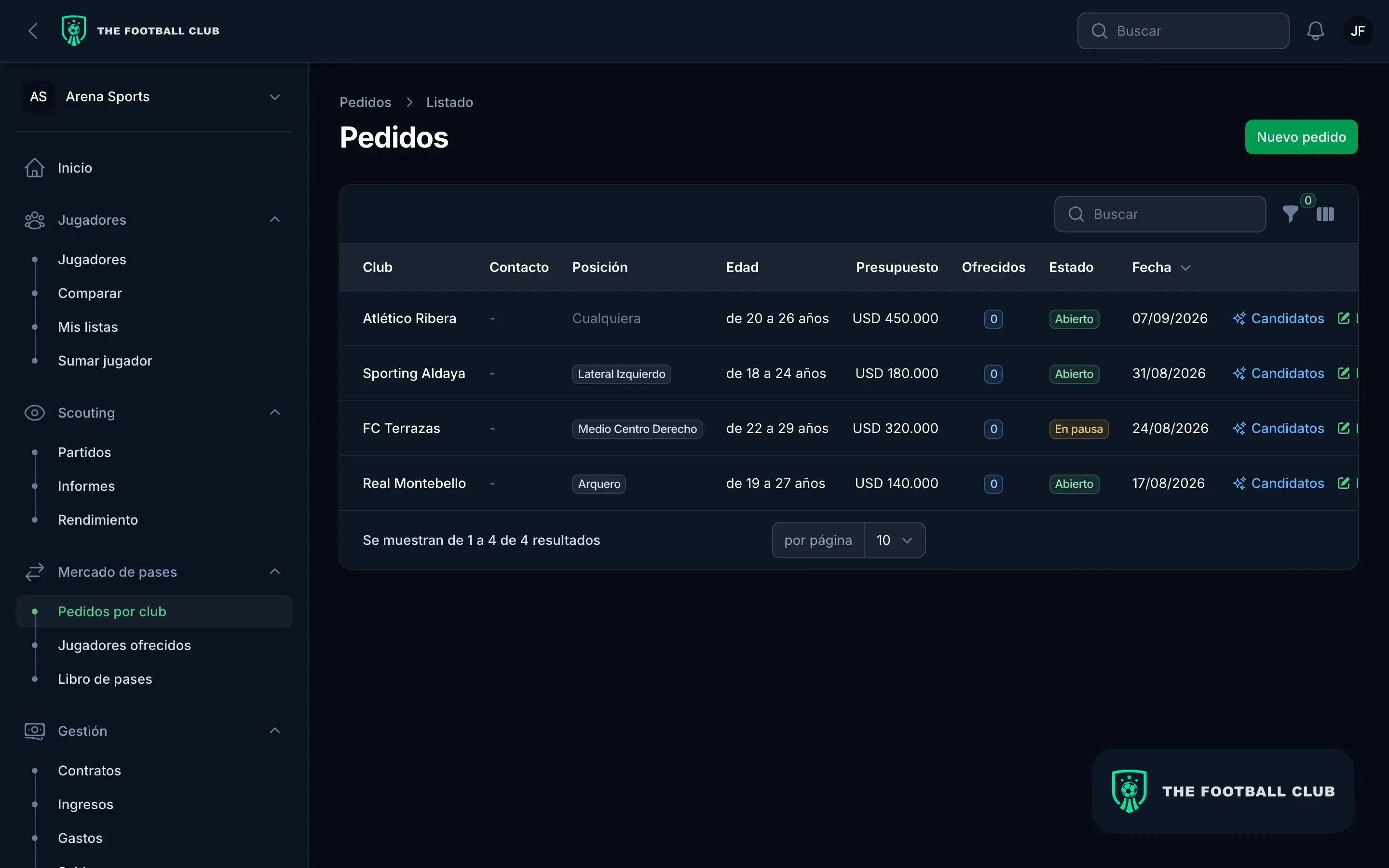
The Football Club keeps this in the panel: each club’s request is logged with the position, age and budget it wants; from there the “Candidatos” (candidates) button suggests whom to pitch, and the “Ofrecidos” (offered) column counts the players already pitched to that request. It also keeps each club’s contacts with their role, and the player profile exports as a PDF or a link with your agency’s logo, so you can send it without assembling anything by hand.
What if the club does not reply?
One follow-up, with something new: a recent match, an updated figure, a change in his contract. Two follow-ups without news is a reasonable limit. If the club says no, note the reason (position filled, budget, age), because that no is information for the next request. And remember the regulations oblige you to tell the player what happened: silence is also an answer your client deserves to hear. Keeping track of who pitched what, to whom and what came back is part of how to organise a football agency.
In short
Pitching a player well means doing three things in order: have the representation agreement signed, answer what the club is looking for with a short, checkable message, and keep a record of who was pitched what and how they replied. Whatever the club answers in writing goes to the player at once.
This article is informational and is not legal advice. It is based on FIFA’s Football Agent Regulations, in force since 1 January 2025, as of November 2026. National associations may add rules. What is said about wording and timing is common practice, not a rule.
Sources
- FIFA Football Agent Regulations, 2025 edition (PDF): definition of “football agent services”, articles 12, 16 and 19
- FIFA: national football agent regulations