How to organise a football recruitment department
By Mariano David Pérez Co-founder
A football recruitment department is the part of a club that turns sporting decisions into paperwork and deadlines: it finds and follows players, keeps contracts and registrations up to date, receives offers from agents and gives the sporting director what is needed to decide. The set-up differs from club to club, but the job is nearly always the same: who watches, who records, who decides and who keeps an eye on the dates.
This note describes one common way to build it: the usual roles, the path a player takes from first report to the squad, and the FIFA deadlines no department can leave to chance. Updated November 2026. In Spain and much of Latin America the same area is often called the secretaría técnica.
What does a recruitment department do?
It sits between the sporting side and the administrative side. The sporting director and the coaching staff decide what the squad needs; the recruitment department makes it happen: candidates exist, their information is complete, contracts are signed and in force, players are registered to play, and nobody hears about an expiry after the agent has already phoned.
The work falls into five areas:
- Scouting and follow-up: a list of players being watched, with match reports and the status of each.
- The market: offers from agents and the club’s own requests, kept side by side.
- Contracts and documents: start and end dates, clauses, loans, passports and each player’s paperwork.
- Registrations and federation procedures: players registered or removed within the permitted windows.
- Information for decisions: reports for the sporting director and the board on cost, performance and expiries.
Who is in a recruitment department?
There is no required structure: it depends on the size, level and budget of the club. At a small club two people may cover everything; at a large one each area has an owner. A common split looks like this:
| Role | What is expected | What they need to see |
|---|---|---|
| Sporting director | Sets priorities, negotiates, decides signings and renewals | The whole squad, contracts and what each player costs |
| Head of scouting | Assigns matches, reviews reports and builds the shortlist | Every scout’s reports and the status of each follow-up |
| Scouts and analysts | Watch players and file reports | Their assigned matches and the players they follow |
| Academy coordinator | Follows the youth ranks and proposes promotions | Fixtures, performance and contracts for each age group |
| Administration | Expenses, balances, documents and registrations | Contracts and documents, without sensitive sporting notes |
The job titles matter less than a simple principle: everybody sees what concerns them. A scout does not need a player’s salary and administration does not need the private notes in a match report. Settling this early avoids leaks and arguments later.
How does a player move from first report to registration?
A player goes through six stages, and the department’s job is to make sure he is not lost on the way. This is a common order, not a regulation:
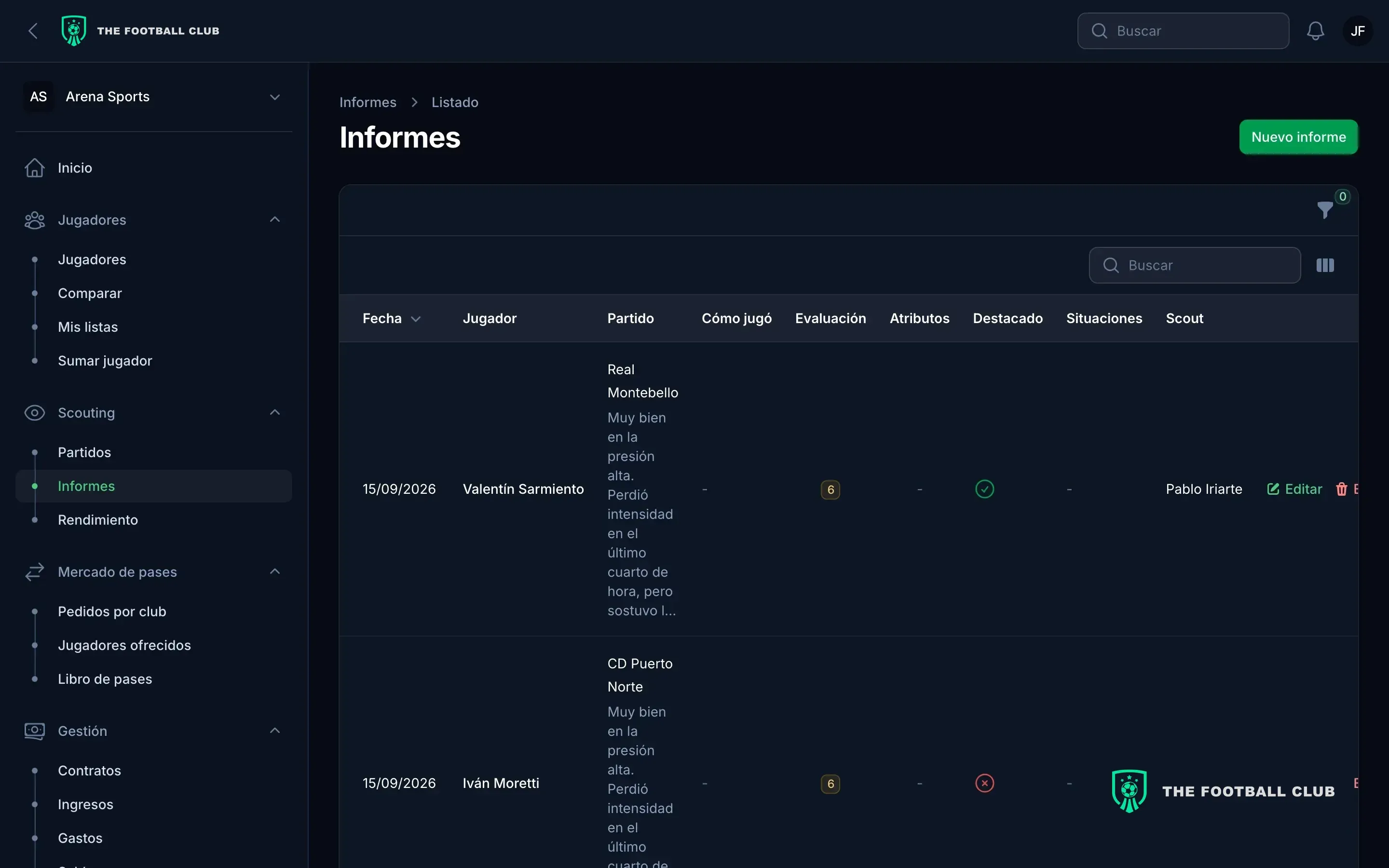
- He appears: a scout sees him, an agent offers him or the club asks for his profile. The first step is to record him and where he came from.
- He is watched: one or more scouts see him play and file reports. One match rarely settles it; the sequence of reports does.
- He is compared: he is set beside the other candidates for the position and the players already at the club.
- A decision is made: the sporting director drops him, keeps him on the list or moves forward. Whoever decides needs to see the same information as everyone else.
- Terms are negotiated: the player’s club and his agent are contacted, terms are agreed and a contract is signed.
- He is registered: the player is registered with the association and joins the squad.
FIFA’s rules set a condition for stage 5: a club that wants to conclude a contract with a professional must inform the player’s current club in writing before entering into negotiations with the player, and the player is free to sign with another club if his contract has expired or will expire within six months (FIFA Regulations on the Status and Transfer of Players, art. 18(3), July 2025 edition; the link is the Spanish-language text, which is the version we checked). Keeping a record of every approach is the department’s job: a club that cannot show when it gave notice has a problem.
Which FIFA deadlines can a recruitment department not miss?
Two above all: the registration windows and the last six months of each contract.
Registration periods. Under the same regulations (art. 6), a player may be registered during one of two annual registration periods set by the association. The first lasts between eight and twelve weeks and the second between four and eight, with a combined maximum of sixteen weeks; transfers take place inside those periods apart from the exceptions the article itself lists. Each association sets its own dates, and our guide to transfer window dates by country shows them.
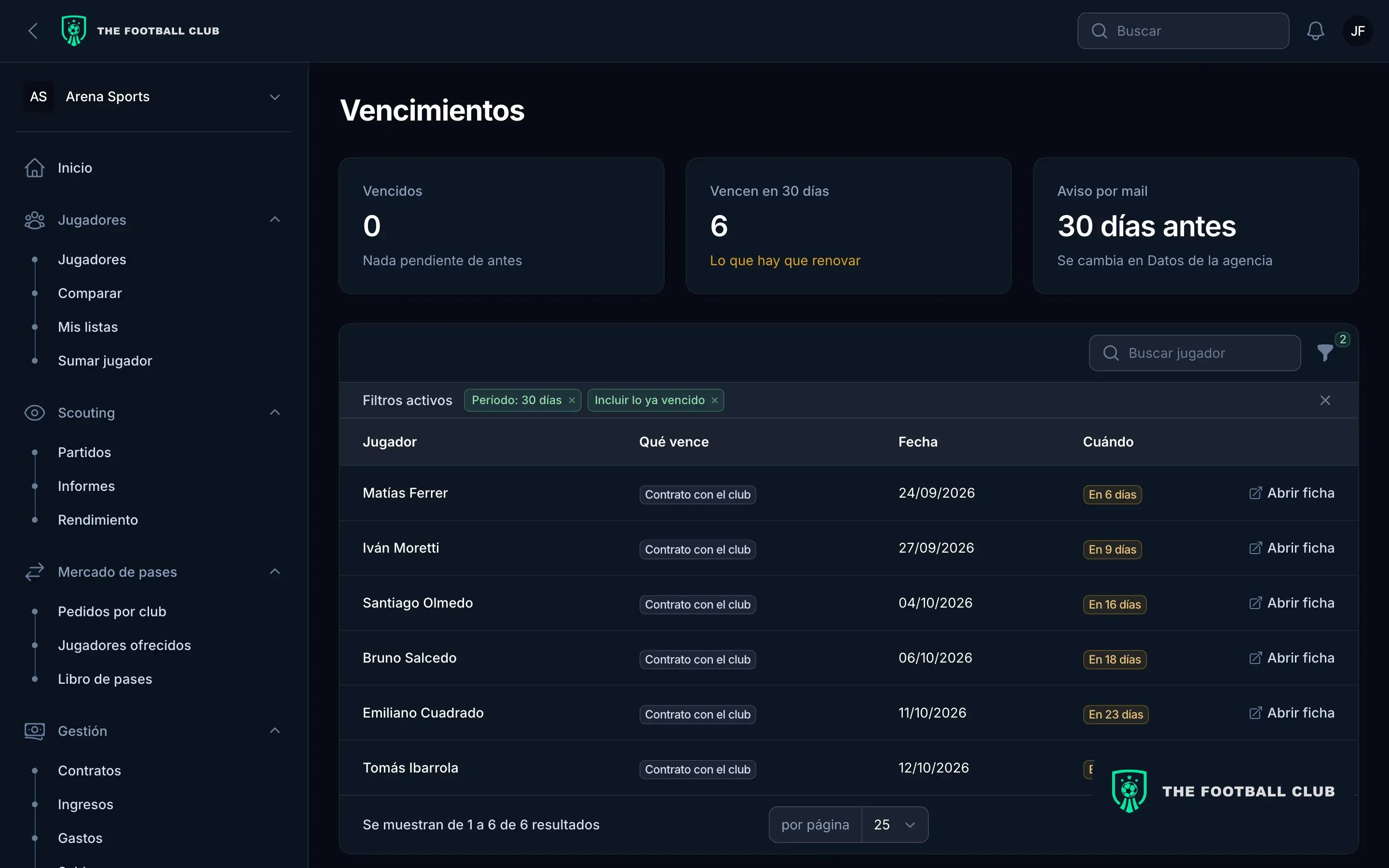
The final six months. This is the same art. 18(3) rule: once a contract has six months left, the player may sign with another club. For a recruitment department that becomes a decision calendar: which renewals are settled early, who is offered an extension and who will walk away for nothing if nothing is done. We cover it in how to avoid losing a player to a contract expiry.
What data on minors and health does the department hold?
A lot: dates of birth, identity documents, family details and, often, medical information. Under European law data concerning health is a special category whose processing is prohibited in principle, subject to the exceptions in the article itself (GDPR, art. 9), and personal data must be adequate, relevant and limited to what is necessary for its purpose (art. 5(1)(c); link to the Spanish text of the Regulation).
In practice the rule of thumb is simple: if you do not need a piece of data, you do not see it. That is why the per-role permissions in the table above are not a detail. Outside the EU each country has its own rules, and this note is not legal advice.
What mistakes does a recruitment department keep making?
Almost always the same four:
- Scattered information: reports in a chat, contracts in a folder, the shortlist in one person’s head. When that person leaves, so does the knowledge.
- Nobody owns the dates: everyone assumes someone else is watching the expiries.
- Deciding on different information: the director has one spreadsheet, the scout another and administration a third, and none of them match.
- No history of each contact: an agent offered a player six months ago and nobody remembers the answer.
The fix is three decisions before any tool: one place for each piece of data, one owner for each date, and permissions by role.
How does The Football Club help a recruitment department?
A spreadsheet works while the squad is small and the team is two or three people. Once the department has several people and an academy, the problem is getting everyone to read and write the same thing. The Football Club for clubs is management and scouting software built around four roles for a club (sporting direction, recruitment, administration and coaching staff with scouts):
- Match reports are filed from a phone and stay on each player’s profile.
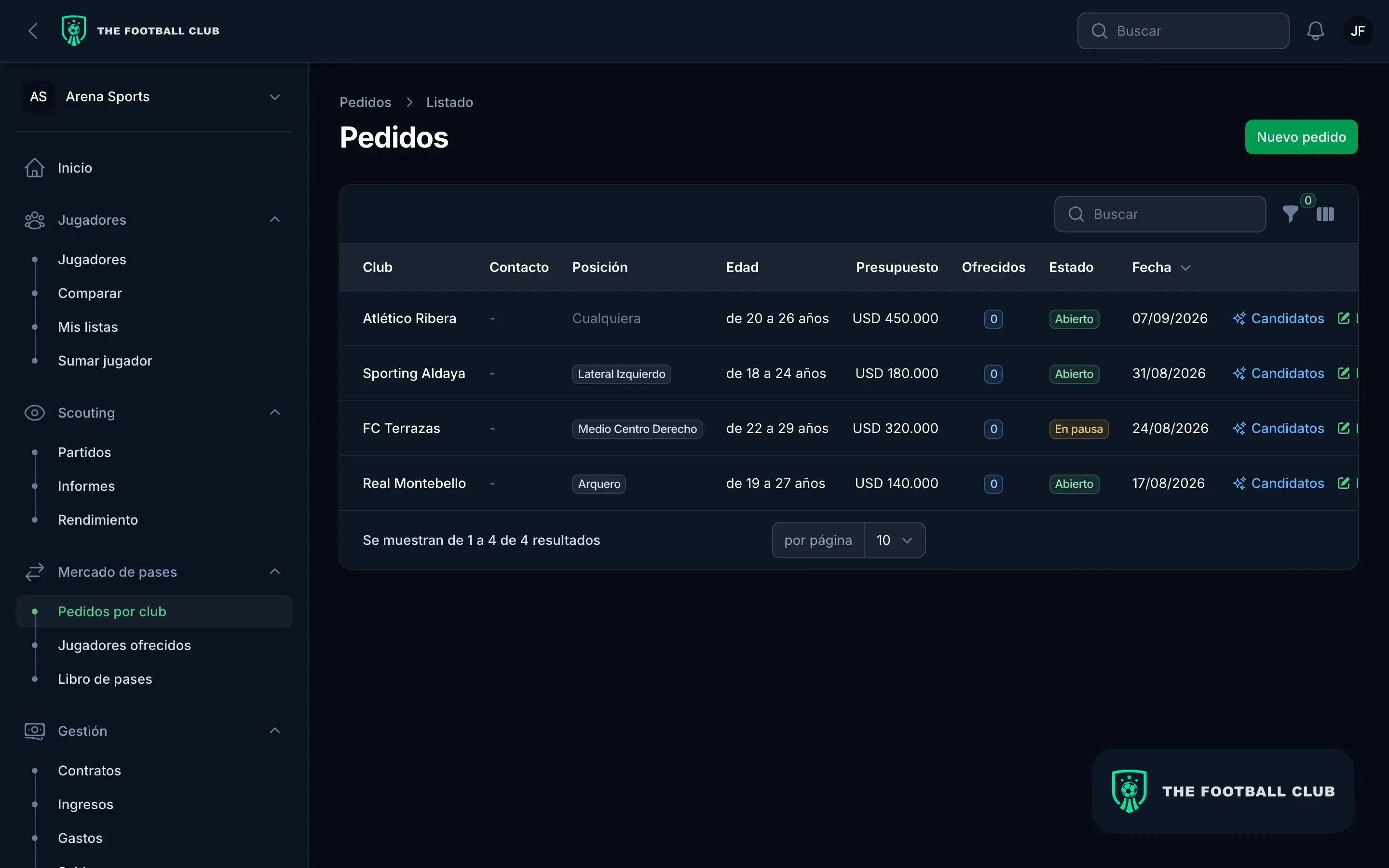
- The club’s requests and the players agents offer live in one place, so you can match them up.
- Contract expiries arrive by email every morning, with a traffic light by deadline.
To see how it looks with your own squad you can request a demo. And if you are comparing tools, read what to ask before choosing a club management app first.