What is a soccer loan deal and how does it work?
By Mariano David Pérez Co-founder

A soccer loan deal is an agreement under which a club sends a professional player to another club for a fixed period without selling him. The player is registered with, and plays for, the club that takes him, and when the period ends he goes back to his parent club, where he is still under contract. FIFA regulates loans in article 10 of its Regulations on the Status and Transfer of Players (RSTP).
What does FIFA require for a loan?
Article 10 of the RSTP, July 2025 edition, asks for two documents and sets one effect:
- A written loan agreement between the two clubs that defines the duration and the financial conditions. The player may also be a party to it.
- A contract between the player and the new club covering the whole loan, which states that he is on loan. Without the player’s signature there is no loan.
- The contract with the parent club is suspended for the duration of the loan, unless otherwise agreed in writing.
Only professionals can be loaned, and a loan goes through the same registration procedures as any other transfer.

How long can a loan last?
At least the time between two registration periods, and at most one year. The end date has to fall within a registration period of the parent club’s association, which is why loans end when a transfer window opens, and the regulations do not recognise any clause that stretches it further. A loan can be extended, within those limits, with the player’s written consent.
Two more limits apply. The club that takes the player cannot sub-loan him or transfer him to a third club. And since 1 July 2024 a club may have no more than six professionals out on loan and six in on loan at any one time, with exemptions for young club-trained players.
These rules cover international loans. According to FIFA’s explanatory notes on the loan provisions (November 2022), each association sets up its own system for loans inside the country and may set a different cap on numbers.
Who pays the wages, and what does the parent club get?
The regulations do not decide it: they say the financial conditions belong in the loan agreement. That is where the clubs settle whether there is a loan fee and how the salary is split. Because the parent club’s contract is suspended, by default the wages are paid by the club that takes the player, under the contract it signed with him; if the parent club covers part of them, it has to be in writing.
The same agreement can carry other clauses, an option or an obligation to buy among them, which the RSTP does not mention: they are arrangements between the clubs. FIFA’s notes also point out that the solidarity mechanism and training compensation apply to loans as well.
What happens when the loan ends?
The player returns to his parent club and the suspended contract comes back to life, with whatever time is left on it. If the contract with the new club is unilaterally terminated before the end, article 10.4 gives the player the right to go back: he must tell the parent club immediately, and the parent club must reintegrate him and pay him.
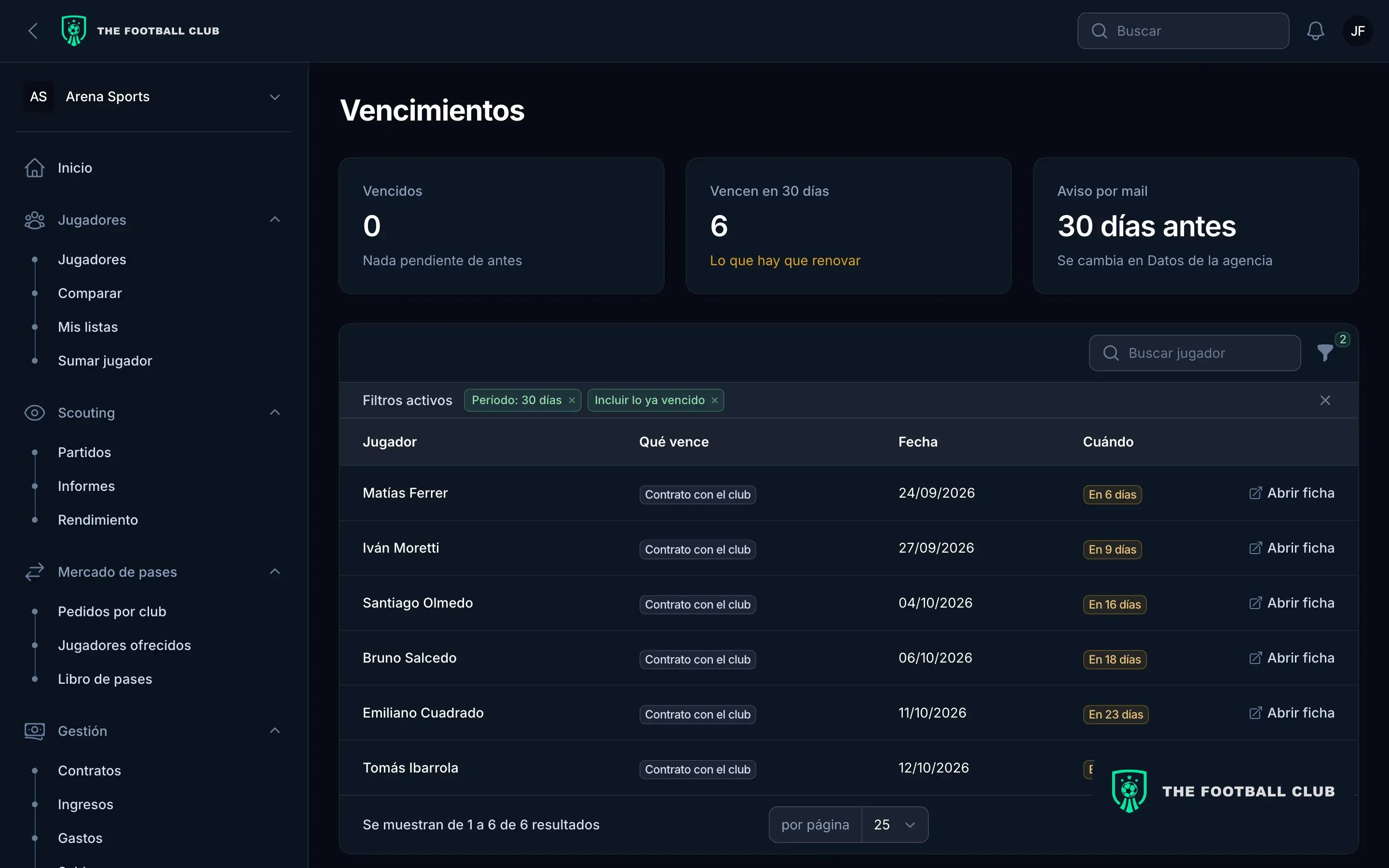
For whoever manages the player’s career, a loan means two contracts and two dates: the end of the loan and the expiry at the parent club. In The Football Club each contract is recorded with its club, dates and amount under contracts and commissions, and those about to end show up in contract expiry alerts, with an email reminder.
Sources
- FIFA: Regulations on the Status and Transfer of Players, July 2025 edition (PDF): article 10.
- FIFA: Explanatory Notes on the New Loan Provisions in the Regulations on the Status and Transfer of Players, November 2022 (PDF).
This article is for information only and is not legal advice. Current as of November 2026.