FIFA agent license: requirements and how to keep it
By Mariano David Pérez Co-founder
The FIFA agent license is the personal authorisation to represent players and clubs anywhere in the world, and it has no expiry date: you keep it for as long as you meet the eligibility requirements, pay the annual fee and complete your continuing education. If you fail any of those, FIFA suspends the license automatically and, if you do not fix it within 60 days, withdraws it, under the FIFA Football Agent Regulations (2025 edition, articles 8, 9 and 17).
This article covers what most people stop looking at once they have passed the exam: what you need to hold the license and, above all, what you must do each year so you do not lose it. The full path to getting one is in our guide to becoming a soccer agent, and the exam has its own article.
What is the FIFA agent license and what does it allow?
It is a license FIFA grants to an individual. Under article 8 of the regulations, it has three features:
- it is granted for an indefinite period, subject to continued compliance with article 17;
- it is strictly personal and non-transferable: it cannot be inherited, sold or shared with an agency;
- it allows you to provide representation services worldwide.
The license belongs to the person, not the company. An agency can employ several agents, but each answers for their own license.
What are the requirements to get a license?
There are four steps, according to FIFA’s guide to the licensing process (January 2026 edition):
- Submit an application on the FIFA Agents Platform, together with payment of the exam fee.
- Meet the eligibility requirements in article 5.
- Pass the FIFA exam, which is held once a year; the application window lasts 45 days, according to FIFA’s page on how to obtain a license.
- Pay the annual license fee within 90 days of passing; otherwise the application is automatically void (article 7).
The eligibility requirements are the most underestimated part, because they are not checked just once: the regulations require them when you apply and again after you hold the license. In broad terms, you cannot have:
- criminal convictions (including out-of-court settlements) for offences such as corruption, bribery, money laundering, tax evasion, fraud or match-fixing;
- a suspension of more than two years for breaching ethics or professional-conduct rules;
- a position or employment at FIFA, a confederation, a member association, a league or a club;
- an interest, personal or through your agency, in a club, an academy or a league;
- in the last five years, a personal bankruptcy or a senior role in a bankrupt or liquidated company;
- in the last twelve months, an interest in a sports-betting business.
You also cannot have provided representation services without a license in the 24 months before applying. The full detail is in article 5.
How much does the FIFA agent license cost?
The regulations say the fee is annual but do not set the amount: FIFA announces it every year by circular (article 7, paragraph 2). Check the current figure on the platform before paying rather than relying on numbers in older articles. On top of that fee, the exam has its own entry fee, paid when you submit your application.
What do you have to do every year to keep the license?
There are four standing obligations. Article 17 lists them, and if any one fails the license is automatically and provisionally suspended:
| Obligation | What it requires | What happens if you miss it |
|---|---|---|
| Eligibility | Keep meeting the article 5 requirements | Provisional suspension and referral to FIFA’s Disciplinary Committee |
| Annual fee | Pay it by the deadline set on the platform | Provisional suspension; 60 days to put it right |
| Continuing education | Complete the credits for each year | Provisional suspension; 60 days to put it right |
| Reporting | Upload to the platform what the regulations require | Provisional suspension; 60 days to put it right |
In the last three cases, if you do not fix the breach within 60 days of the suspension, FIFA withdraws the license. Eligibility follows a different route: the Disciplinary Committee decides.
How many continuing-education credits do you need?
According to FIFA’s continuing professional development page, the rules are:
- A new agent must earn 20 credits per year for 10 years. From the eleventh year the requirement drops by 25% (15 credits).
- Agents who held a license under a previous version of the regulations must earn 40 credits per year for 5 years, then move to the general regime.
- The CPD year runs from 1 October to 30 September, so the deadline falls just before the next year begins.
- Credits come from online courses on the platform, each ending in an assessment you must pass with 80 or more.
- Courses include the agent regulations themselves, player registration, training compensation, anti-trafficking and the representation of minors.
One detail matters: to represent a minor you must first complete the specific course on minors (article 13). What you can and cannot do with a minor is covered in another article.
What do you have to report on the platform?
The transparency obligation sits in article 16, and nearly all the deadlines are 14 days:
- the representation agreement, from the day it is signed, amended or terminated;
- any other contract signed with a client;
- fees, from the day they are paid;
- agreements between agents to cooperate or share income;
- any information that affects your eligibility.
If you work through an agency, you must also declare its ownership structure and how many agents operate through it, and report changes within 30 days.
This is where agencies slip, because it is not a single date: it is a steady trickle of deadlines that start running with every signature and every payment.
What happens if the license is suspended or lost?
While a license is suspended you should not provide representation services, because the regulations reserve them for licensed agents (articles 11 and 12). There is also a consequence that follows you: anyone who has provided representation services without a license cannot submit a new application until 24 months have passed (article 5).
You can also ask for your own license to be suspended, temporarily or permanently, with a reasoned request on the platform. But anyone who ends their license and wants to practice again has to go through the whole process once more, exam included (article 10).
Does FIFA recognise other licences?
The regulations provide two exceptions to the exam, both with strict conditions:
- Earlier FIFA licences (the 1991, 1995, 2001 and 2008 versions): holders were exempt from the exam if they applied for the new license by 30 September 2023 (article 23). That door is now closed.
- National licensing systems: FIFA may recognise a national system if it requires eligibility checks and an exam on soccer regulations, and the national association applies for it (article 24).
Separately, some associations ask for their own registration to operate in their territory. Check yours.
How do you avoid letting the license lapse?
None of the obligations is hard on its own. What fails is that there are four calendars running at once, each with its own date, and nobody keeps them in the same place as the rest of the work. A minimal routine:
- At the end of September, check how many credits you have and how many are missing before the 30th; do not leave it to the last day, because every course ends in an assessment.
- When the fee notice arrives, pay it and keep the receipt with your other documents.
- Every time you sign, amend or terminate a contract, note the 14-day deadline and upload it within that window.
- Once a year, review the eligibility requirements: if something has changed in your situation (a position, a shareholding, a company), the regulations oblige you to report it.
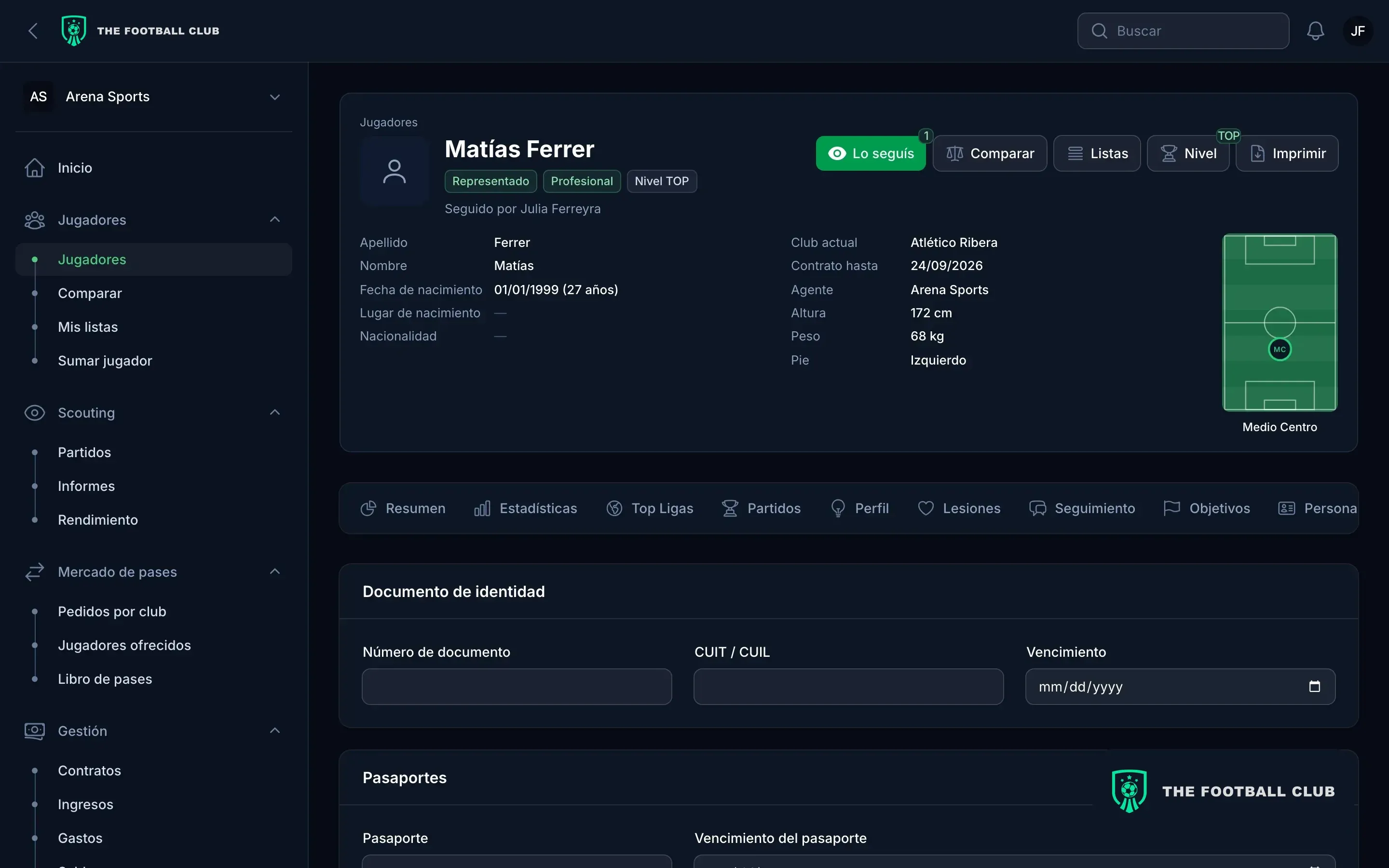
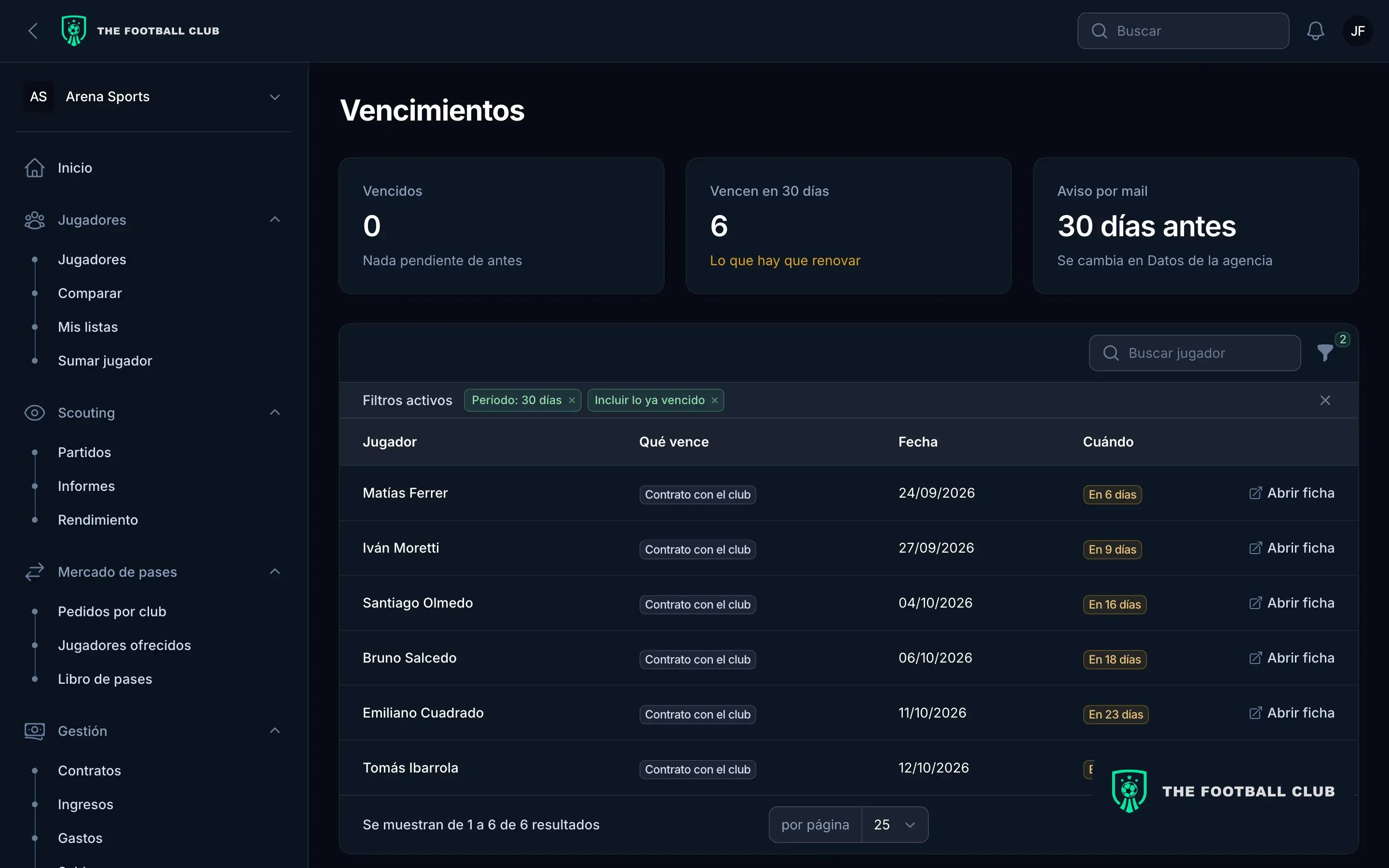
The Football Club does not replace the FIFA platform: reports and credits are filed there. What it does is gather the deadlines of your work in one place. Expiry alerts show what is expiring across contracts, representation agreements, documents and passports, with a traffic light by deadline and an email notice, and each player has a profile with their contract and documents. It is built around how a soccer agency works, where every signature opens a deadline that has to be met.
In short
The FIFA agent license does not expire with the calendar, but it does not look after itself either: you keep it with the annual fee, continuing education, reporting to the platform and permanent compliance with the eligibility requirements. If any of that fails, suspension is automatic and you have 60 days to fix it.
This article is for information only and is no substitute for reading the regulations or taking legal advice. It is based on the FIFA Football Agent Regulations (2025 edition) and the information FIFA had published as of November 2026; amounts, credits and deadlines can change by circular.