FIFA agent exam: what it's like and how to prepare
By Mariano David Pérez Co-founder

The FIFA agent exam is an online test of 20 multiple-choice questions, answered in 60 minutes, with a pass mark of 75%. It is held once a year, taken from your home or office under remote invigilation, with FIFA’s regulations open on screen. Passing it is the standard route to a soccer agent license, according to FIFA’s official guide to the licensing process and the exam (January 2026 edition).
This article is about the exam itself: how it is built, what it covers, when it is held and how to prepare. The full path —eligibility, the license fee and continuing education— is in our guide to becoming a soccer agent.
What is the FIFA agent exam like?
It is short, has no partial credit and is an electronic open-book exam. These are the rules set out in FIFA’s January 2026 guide:
| Questions | 20 multiple-choice; each may have one or more correct answers |
| Scoring | Each question is worth 5%; it only counts if you select all the correct answers, with no half marks |
| Duration | 60 minutes, with no breaks (not even toilet breaks) |
| Pass mark | 75%, which means 15 fully correct answers out of 20 |
| Format | Online only, with invigilators watching through your cameras; there is no exam venue to travel to |
| Materials | The official study materials, in electronic form on the exam platform |
| Languages | English, French, German and Spanish |
| Attempts | One per edition; if you fail, you submit a new application for the next one |
Each candidate gets a unique set of questions, drawn automatically from the same FIFA database in the language they chose. All twenty are shown on a single page.
You don’t need any degree or prior experience to sit it, and FIFA is explicit that there are no exemptions by profession: lawyers, accountants, former players and coaches all sit the same exam. The only exemption is for people licensed under a national licensing system governed by the law of their country, and only if FIFA approves a request made by their national association.
Which regulations does the FIFA agent exam cover?
The questions test how well you know the FIFA regulations that govern the transfer system. The official guide lists six:
- the FIFA Football Agent Regulations;
- the Regulations on the Status and Transfer of Players;
- the FIFA Clearing House Regulations;
- the FIFA Statutes;
- the FIFA Code of Ethics;
- the FIFA Disciplinary Code.
On top of these come other materials: case studies, the FIFA Guardians Child Safeguarding Toolkit for member associations and the FIFA Ethical Recruitment Guide. FIFA can add regulations from one edition to the next, which is why it asks candidates to always work from the latest version of the study materials on the FIFA Agent Platform. The study materials are available in English, French and Spanish.
If you are starting from scratch, the agent regulations are the way in: they are summarised, article by article, in our guide to the FIFA Football Agent Regulations.

When is the next FIFA agent exam?
Since 2025 FIFA has held a single edition of the exam per year, and only accepts applications during a fixed window, according to its page on how to become a licensed soccer agent. This is how the 2026 edition —the sixth— ran, as announced in FIFA Circular 1956 of 21 January 2026:
| Stage | Date (Central European Time) |
|---|---|
| Applications | 20 January to 6 March 2026 |
| Medical accommodation requests and changes of slot or language | Until 29 March 2026 |
| Mandatory technical check | Until 14 April 2026 |
| Exam | 28, 29 and 30 April, plus 5, 6 and 7 May if the first sessions filled up |
| Results | 4 June 2026 |
As of November 2026, FIFA has not yet published the dates for the 2027 edition. In 2026 the circular came out on 21 January, with applications already open and barely six weeks to go, so it pays to have your platform account set up and your documents ready by December. Miss the window and there is no way to sit the exam until the following year.
How many candidates pass the FIFA agent exam?
The only official pass rate we found is for the very first exam, held on 19 April 2023: 3,800 candidates sat it and 52% passed, according to FIFA’s announcement. For the 2025 edition, the first held online, FIFA reported that 7,745 people sat the exam worldwide, but not how many passed. Lower pass rates for the online editions circulate; we could not confirm them against an official source.
What does follow from the rules: with 20 questions and no half marks, six incomplete answers are enough to fail.
How to prepare for the FIFA agent exam
FIFA offers no mock exams and does not organize or endorse preparation courses: it considers its study materials the only resource candidates need. With that in mind, this is what helps most:
- Study the official materials, in your language. Third-party summaries go out of date between editions; the platform’s materials don’t.
- Learn where things are, not just what they say. The open-book format is deceptive: you get three minutes per question, which is not enough to read a set of regulations from the contents page. You need to know which regulations, and which part of them, deal with each topic.
- Practice with cases. Questions tend to describe a concrete deal: who represents whom, who pays, which deadline applies. Take each rule and apply it to an invented transfer.
- Don’t assume a single answer. A question can have two or three correct options, and missing one scores zero. Read every option before you select.
- Do the technical check on time. The platform’s pre-exam readiness check is mandatory: if you don’t complete it by the deadline, your application is rejected. It is also your chance to see the exam screen beforehand.
- Get the room ready. It must be private and quiet, with nobody coming in during the exam. You need a compatible computer, a smartphone that acts as a second camera, and the ID you used when you applied.
Apart from the computer and the phone, the only things allowed on your desk are a blank sheet of paper, a pen, your glasses if you need them and a non-alcoholic drink. Printed notes, summaries or dictionaries are prohibited and count as a breach of the rules.
What happens if you fail the exam?
Along with the results, FIFA sends the correct answers and a link to review your attempt for three days. If you believe a question contains a fundamental error in how the regulations were applied, you can ask FIFA for a review within the deadline, identifying the question and setting out clear arguments; technical problems are not grounds for review. If that fails, you submit a new application for the next edition.
What happens after you pass?
Passing is not the same as holding the license: you then have 90 days to pay the annual fee, and FIFA only issues the license once it is paid. The amounts and next steps are in our guide to becoming a soccer agent. From then on, every relationship with a player starts with a written representation agreement, which lasts two years at most and is uploaded to the FIFA platform.
That is where the work the exam doesn’t measure begins: making sure no contract expires without you noticing, and that every commission gets paid.
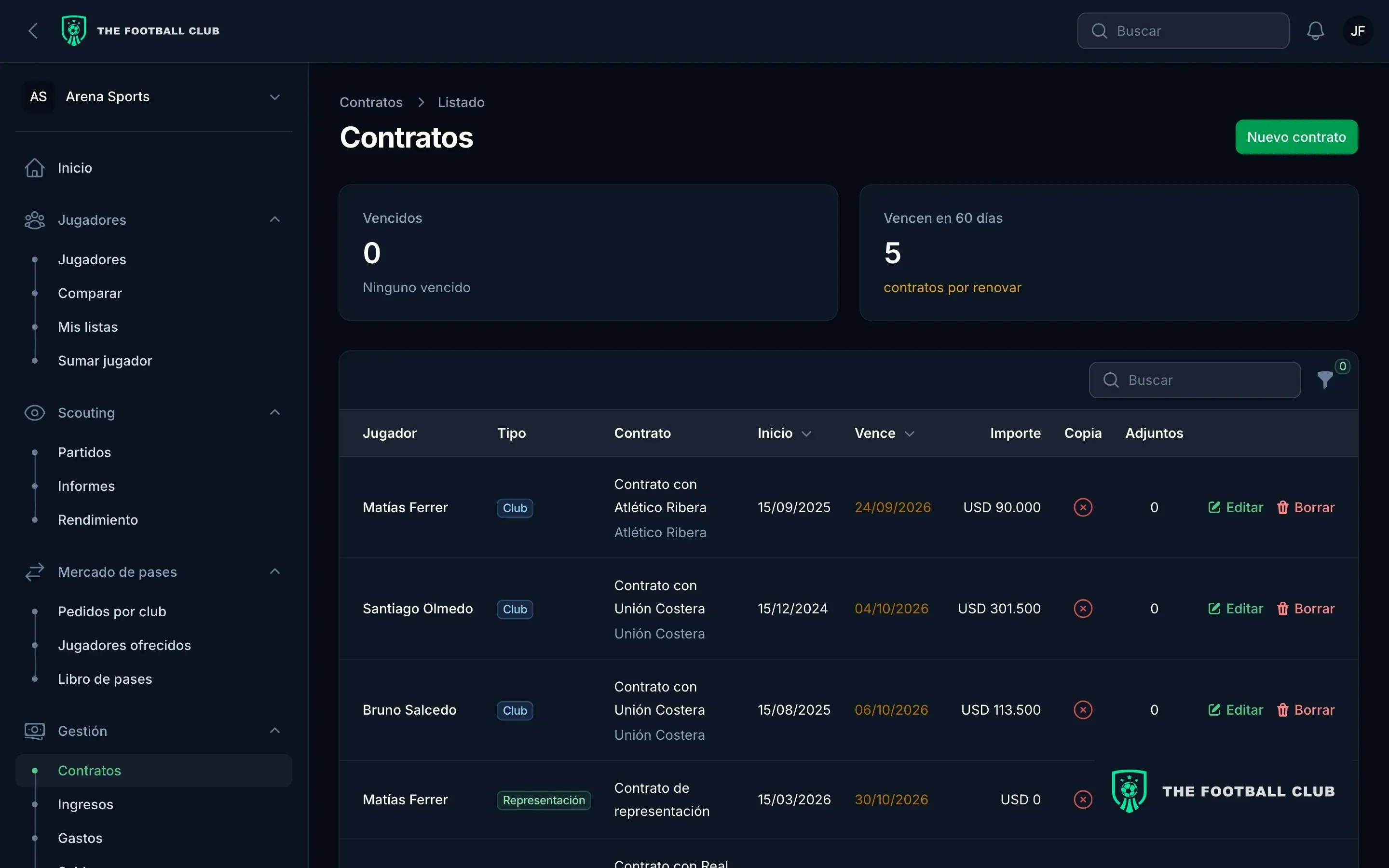
The Football Club keeps each player’s contracts and commissions with their terms, and emails you when one enters its final months. It is built around how a soccer agency works, from the agent who has just passed the exam and is signing a first player.
This article is for information only and is no substitute for reading the official materials. It is based on information published by FIFA about the agent exam and license as of November 2026; the rules, topics and dates may change from one edition to the next.
Sources
- FIFA: information on the licensing process and the soccer agent exam, January 2026 edition (PDF)
- FIFA: how to become a licensed soccer agent
- FIFA Circular 1956: soccer agent exam, 2026 edition (PDF)
- FIFA: fifty-two per cent of candidates pass the first FIFA football agent exam (2023)
- FIFA Football Agent Regulations, 2025 edition (PDF)