Third-party ownership in football (TPO) explained
By Mariano David Pérez Co-founder

Third-party ownership in football (TPO) is an arrangement in which an investor, a company or an individual who is neither the player nor his club pays money today in exchange for a share of the value of a future transfer. FIFA has banned it since 1 May 2015 under article 18ter of its Regulations on the Status and Transfer of Players (RSTP): no club or player may enter into an agreement that entitles a third party to part of the compensation payable on a future transfer.
The text in force is in the RSTP, July 2025 edition. FIFA has approved a new edition that comes into force on 1 January 2027; I did not check whether it changes anything in article 18ter, so look at the final text once it is published. This article is current as of November 2026.
How did third-party ownership work?
A club short of cash, or one that wanted to sign a player without paying up front, would sell an investment fund a percentage of the player’s “economic rights”. If the player was later transferred, the fund collected its percentage of whatever the buying club paid. If he never was, the club had given up money for nothing, or the investor lost its stake.
Two points to avoid confusion:
- Economic rights are not the player’s contract. The player stayed registered with his club and played wherever the club decided. What was being shared was the value of a future sale.
- It is not the same as a share between clubs. The clubs that trained a player are paid through other routes, training compensation and the solidarity mechanism, which are FIFA rules and not a deal with an investor.
What exactly does article 18ter say?
Paragraph 1 of article 18ter reads: “No club or player shall enter into an agreement with a third party whereby a third party is being entitled to participate, either in full or in part, in compensation payable in relation to the future transfer of a player from one club to another, or is being assigned any rights in relation to a future transfer or transfer compensation.” The remaining paragraphs handle the transition:
| Paragraph | What it sets out |
|---|---|
| 1 | The ban: no third party may share in a future transfer or be assigned rights over it. |
| 2 | The ban comes into force on 1 May 2015. |
| 3 | Agreements that predate 1 May 2015 may stay in place until they expire, but cannot be extended. |
| 4 | Agreements signed between 1 January and 30 April 2015 could last no more than one year beyond their effective date. |
| 5 | Existing agreements had to be recorded in TMS (FIFA’s transfer system) by the end of April 2015, in full and with the third party’s details. |
| 6 | The FIFA Disciplinary Committee may impose measures on clubs or players that do not comply. |
The wording “club or player” matters: it is not enough for the club to stay clear. The player cannot agree with a third party to share in the value of his own future transfer either.
Who counts as a “third party” for FIFA?
Definition 14 of the RSTP works by exclusion: a third party is any party other than the player being transferred, the two clubs transferring him from one to the other, or any previous club with which he has been registered. The FIFA TMS help centre gives as examples a company, an individual, an intermediary, or a club with which the player has never been registered and to which he is not being transferred.
By that definition, a percentage in favour of a player’s former club is not third-party ownership under 18ter. One in favour of a club that never had him is.

Why does FIFA ban it?
The regulations do not carry a statement of reasons. What sits in the same chapter is article 18bis, which stops clubs from signing contracts that give another club or any third party the ability to influence, in employment and transfer matters, its independence, its policies or the performance of its teams. The two articles sit in the same chapter of the regulations, and the best-known TPO case, Seraing, was decided under both.
The underlying concern discussed in legal writing is a conflict of interest: if an outsider profits when the player is sold, it has an incentive to see him sold even when that does not suit the club or the player. The Court of Arbitration for Sport (CAS) accepted aims of that kind in 2017 as justifying the rule: protecting the regularity of competitions and the independence of clubs and players (see the case below).
What happened in the Seraing and Doyen case?
It is the occasion on which the ban was tested in court. According to the Kluwer Arbitration Blog summary:
- In 2015 the Belgian club RFC Seraing signed two contracts with the investment fund Doyen Sports under which Doyen acquired the economic rights to certain players for a fixed fee.
- On 4 September 2015 the FIFA Disciplinary Committee banned Seraing from registering players for four consecutive registration periods and fined it CHF 150,000.
- On 9 March 2017 CAS rejected the club’s arguments (free movement, competition law, human rights) and held articles 18bis and 18ter valid under European and Swiss law; it cut the ban to three registration periods.
- On 20 February 2018 the Swiss Federal Supreme Court dismissed Seraing’s appeal (decision 4A_260/2017) and upheld the award.
That is the only source I used for this sequence, a lawyers’ analysis rather than a court document, so confirm the decision number and the dates against the ruling before quoting them.
What happens today if a club has such an agreement?
TMS already asks the question on every transfer. According to the official TMS help page:
- When entering a transfer, the club must declare “yes” or “no” to whether it has ever entered into a third-party ownership agreement, including past ones.
- A releasing club that answers yes must name the third party, say whether the payment is a fixed amount or a percentage, and upload the full agreement. That information is confidential: only the club and FIFA can see it.
- Missing or incorrect mandatory information is an offence subject to the administrative sanction procedure.
What awaits a club that signs one today is paragraph 6: disciplinary measures, and Seraing shows these can include registration bans.
What does this mean for an agent or a club?
The ban does not depend on what the agreement is called. What counts is what the contract does: if a third party collects part of the value of a future transfer, or is given rights over it, it falls under 18ter. Some practical consequences:
- Read any resale-percentage clause in any contract, whether financing, loan or “support” for a youngster, and ask who the counterparty is. A player’s former club is not a third party; an investor is.
- Do not sign a player’s contract with a third party that lets it share in his own transfer: the ban reaches him too.
- Keep the paperwork together. If TMS asks for the full agreement with its annexes, it helps to have them in one dated place, not scattered across email.
- Agents’ fees have their own rules. The TMS help page names an intermediary as an example of a third party, but how that applies to an agent’s fees is also governed by FIFA’s agent regulations, which I did not verify for this article. The basics of what an agent earns are in how much football agents earn; for a specific case, ask a football lawyer.
How does keeping contracts organised help?
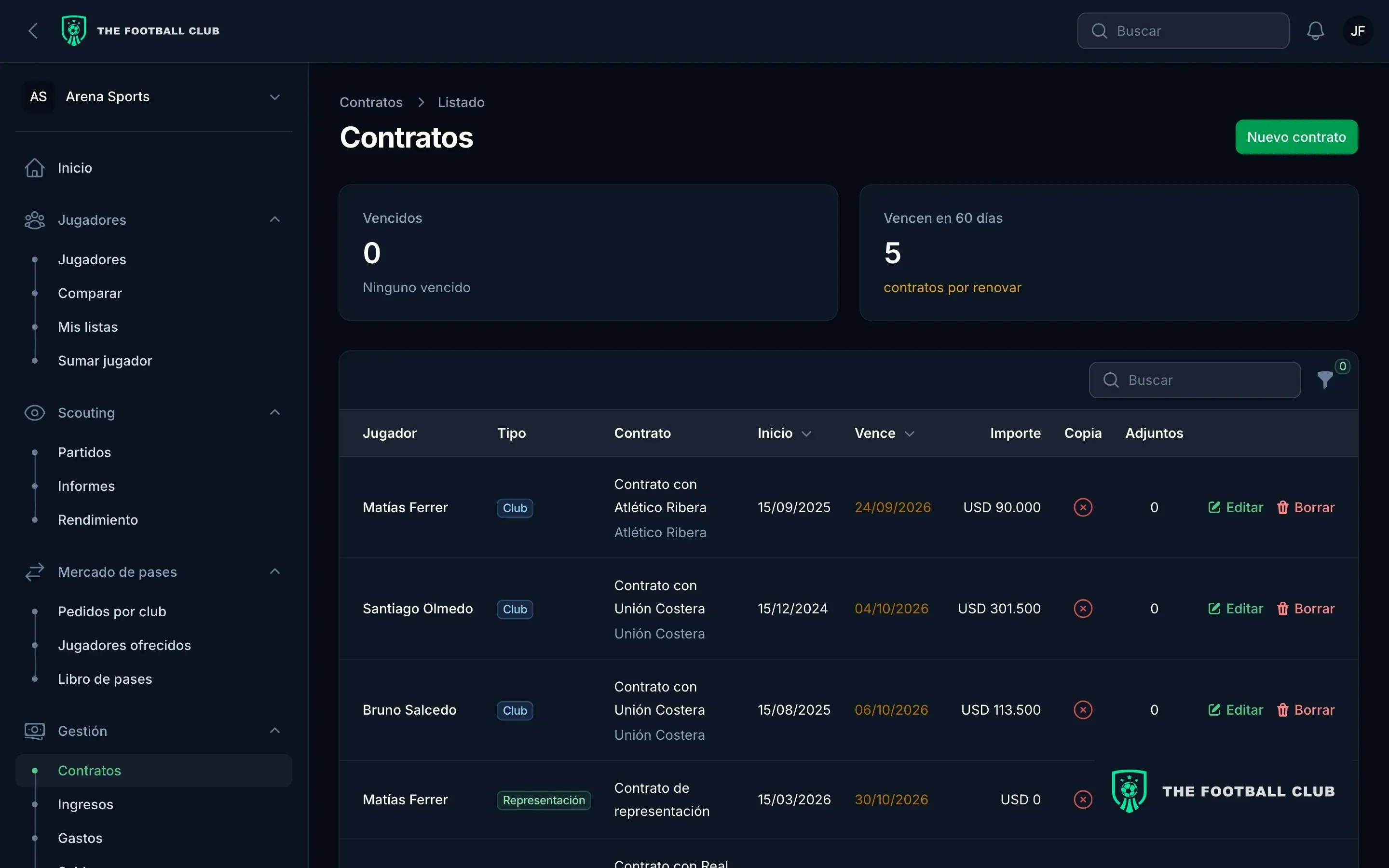
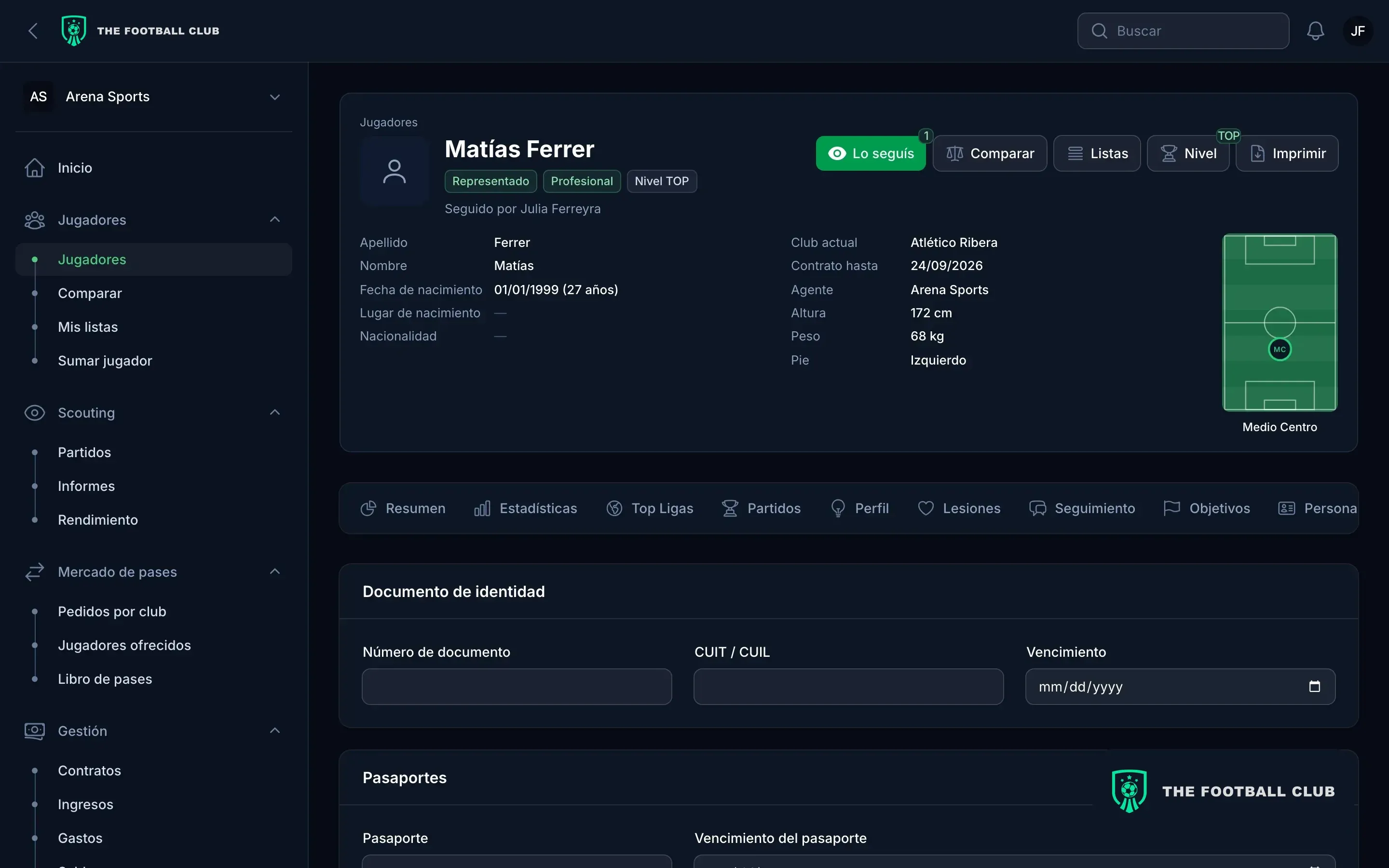
The Football Club does not detect third-party ownership and does not give legal advice. What it does is the step before: each player has a profile with the current contract, and the agency keeps every contract in contracts and commissions with its club, term and amount, with a copy and attachments, searchable. That order is what lets you, the day a club or FIFA asks for the full agreement and annexes, have it in one place and know who signed what and when. The page for football agents covers the rest of the dashboard.
In short
Third-party ownership means collecting part of a future transfer without being the player or one of his clubs. It has been banned by article 18ter of the RSTP since 1 May 2015, earlier agreements could run to expiry without extension, the Seraing case confirmed the rule before CAS and the Swiss Federal Supreme Court, and today TMS asks every club to declare whether it ever had one.
This article is informational and is not legal advice. It is based on FIFA’s RSTP, July 2025 edition, and the official TMS help pages, as of November 2026.
Sources
- FIFA: Regulations on the Status and Transfer of Players, July 2025 edition (PDF): articles 18bis and 18ter, definition 14.
- FIFA: TMS help on third-party ownership: the TMS declaration, examples of third parties, circular 1464.
- FIFA: Bureau of the Council approves the new regulatory framework for the transfer system (in force from 1 January 2027).
- Kluwer Arbitration Blog: the TPO ban before the Swiss Federal Supreme Court (October 2018): the Seraing and Doyen case.