Termination with just cause: what FIFA's rules say
By Mariano David Pérez Co-founder
Termination with just cause is the early ending of a contract between a professional footballer and his club, by either side, because that side can no longer reasonably be expected to continue the contract, and it carries no consequences: no compensation and no sporting sanctions. That is article 14 of FIFA’s Regulations on the Status and Transfer of Players (RSTP), which also names one specific case with its own rules: a club that fails to pay the player two monthly salaries.
This note explains what FIFA says, which steps it asks for in the unpaid-salary case, and what changes between the edition in force today and the one that applies from 1 January 2027.
What do FIFA’s regulations say about just cause?
The starting point is article 13: a contract between a professional and a club can only end when its term expires or by mutual agreement. Any other early exit without a justifying cause is a breach of contract, and article 17 sets out the consequences.
Article 14, paragraph 1, is the exception. Either party may terminate the contract without consequences of any kind (neither payment of compensation nor sporting sanctions) where there is just cause, and it defines it in general terms: just cause exists in any circumstance in which a party can no longer reasonably and in good faith be expected to continue the contractual relationship.
There is no closed list. The regulations do not enumerate everything that counts, so each case is assessed on its facts. What they do fix:
- Abusive conduct aimed at forcing the other party to terminate or change the terms of the contract entitles the counterparty, player or club, to terminate with just cause (article 14, paragraph 2).
- Unpaid salaries have their own provision, article 14bis, covered below.
- A player who barely plays has a different route, sporting just cause under article 15.
When can a player terminate over unpaid salaries?
Article 14bis answers it with precise conditions. A player is deemed to have just cause to terminate when the club unlawfully fails to pay at least two monthly salaries on their due dates, provided that he has:
- put the club in default in writing, and
- given it a deadline of at least 15 days to comply in full with its financial obligations.
Three more details in the same article:
- Salaries that are not monthly. The pro-rata value of two months is used. Delayed payment of an amount equal to at least two months also counts, as long as the player has complied with the prior notice.
- Contracts that pre-date the rule. Different provisions already in those contracts may be taken into account.
- Collective bargaining agreements. Agreements validly negotiated at national level may deviate from these rules, and their terms prevail.
Two practical cautions, which are a reading of the text and not a guarantee. First, the rule speaks of an unlawful failure to pay: a delayed payment with a justification is another discussion. Second, the written notice and the deadline are not formalities, they are part of the condition. A player who terminates without having met them risks having the termination treated as not made with just cause.
What is sporting just cause?
It is the one in article 15 for an established professional who, over the season, appeared in fewer than ten per cent of the official matches his club played. He may terminate early on that ground, but only in the 15 days following the club’s last official match of the season.
The difference from ordinary just cause is the consequence: no sporting sanctions, but compensation may be payable. It is assessed case by case, taking the player’s circumstances into account. The text is the same in both editions.
What changes between the 2025 edition and the January 2027 edition?
Two editions matter right now, because the regulations change text in a few weeks:
| January 2025 edition (in force until 31-12-2026) | January 2027 edition (applies from 1-1-2027) | |
|---|---|---|
| Article 14, paragraphs 1 and 2 | General definition and abusive conduct | Same |
| Article 14, paragraph 3 | Does not exist | Bars a club from abusing registration or deregistration as pressure, separating a player abusively from team training, withholding a passport, or unduly evicting him from his home |
| Article 14bis (unpaid salaries) | Two salaries, written notice, 15 days | Same text |
| Article 15 (sporting just cause) | Under 10% of matches, 15 days | Same text |
What the 2027 edition adds is paragraph 3 of article 14: a list of four club behaviours the earlier text did not name. That does not mean they were acceptable before: paragraph 2 already covered abusive conduct in general. What changes is that they are now named.
The new text was approved by the FIFA Bureau of the Council on 10 June 2026 and comes into force on 1 January 2027. Its article 26 sets the transition: the new regulations apply to cases where the facts arose after that date, and all other cases are assessed under the previous regulations. Which text governs a contract signed in 2026 and broken in 2027 is a question for a specialist lawyer.
What happens if a contract is terminated without just cause?
Article 17 says that when a contract is terminated without just cause, compensation is payable, and sporting sanctions may follow when the breach happens inside the protected period. The rest of that discussion (how the amount is calculated, which sanctions fall on each party) is long and beyond this note: for the definition, it is enough to know that just cause is precisely what avoids that chain of consequences.
One more limit, in article 16: a contract cannot be unilaterally terminated during a competition period, which the regulations define as running from the first official match of the national league championship or national cup (whichever comes first) to the last official match of those competitions. The text of articles 14 and 16 does not explain how they combine in a concrete case, so before moving to terminate in the middle of a season it is worth asking a specialist.
How can an agency or a club prepare for these cases?
Just cause is won or lost on paper. What weighs most in practice is being able to show what was requested, when and to whom:
- The payment dates of each salary, what was paid and what was owed.
- The written notice, with its date, and the deadline given.
- The contract and its annexes, including special provisions and any applicable collective agreement.
- Early warning: whoever represents the player needs to know that arrears are building up before they reach two months.
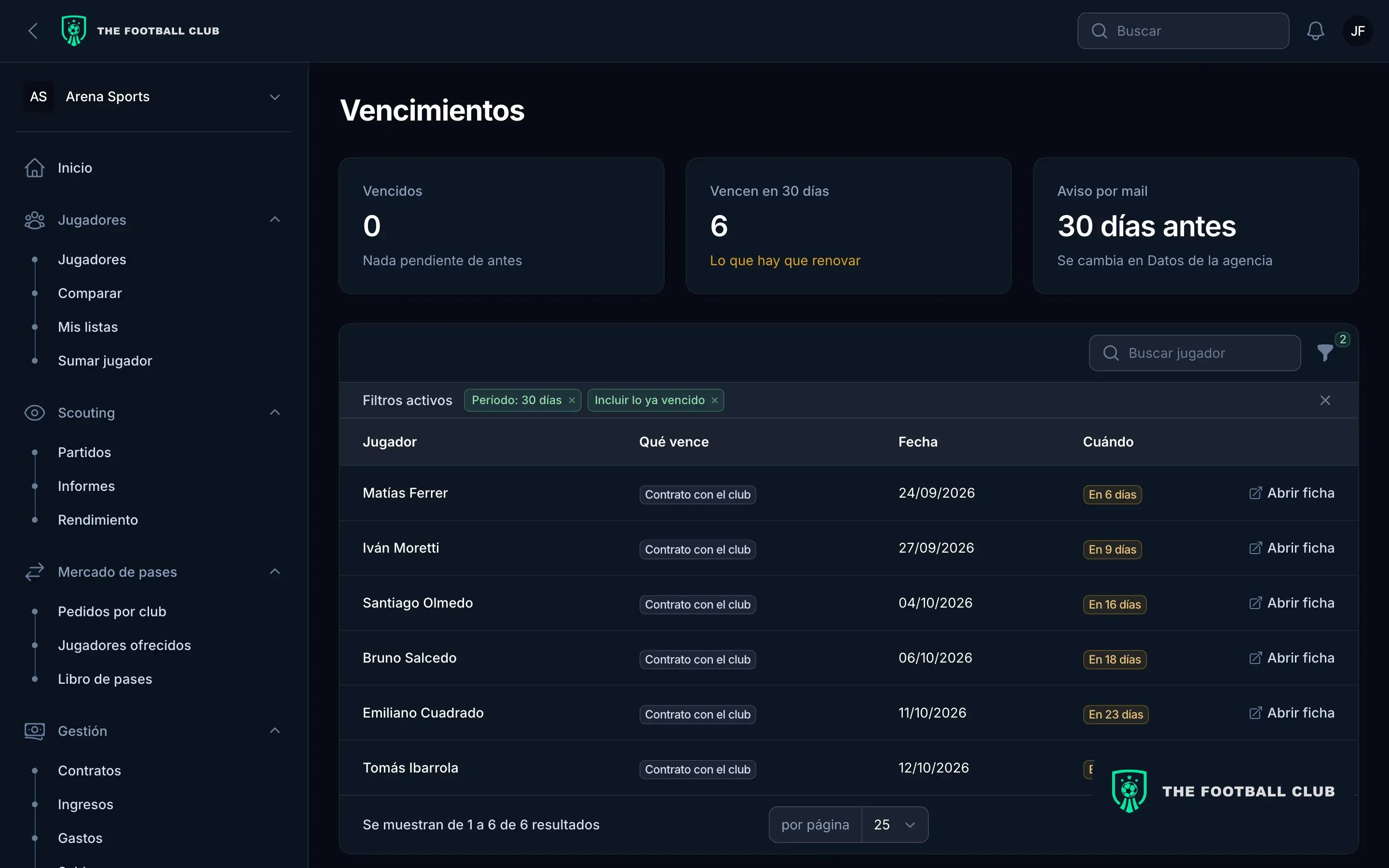
In The Football Club each contract is entered with its club, term and clauses, and the documents and follow-up notes stay on the player’s profile, dated. It does not decide on its own whether there is just cause, and it does not replace a lawyer, but it leaves in order what the lawyer will ask for. And expiry alerts email what falls due each morning, with a traffic light, so a date does not slip by unseen.
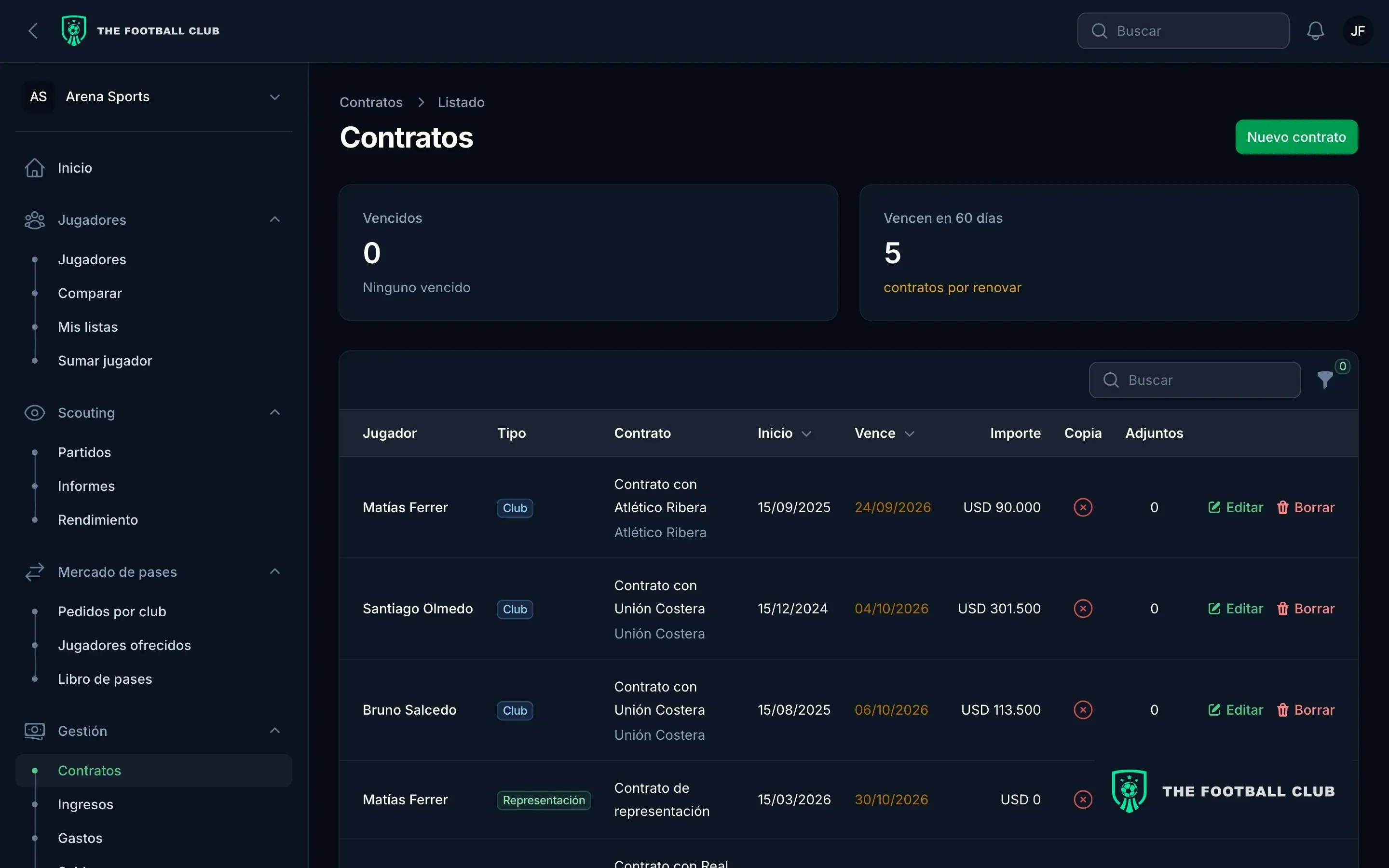
If you want to organise the contract calendar of your portfolio, the note on football contract expiry has the step-by-step. And if what interests you is leaving by paying, which is a different thing, see the release clause: you pay to leave, which is not the same as termination with just cause, where nothing is paid.
What to remember
- Just cause is an exception to the rule that contracts are respected: it has to be explainable on the facts.
- Unpaid salaries have their own rules: two monthly salaries, written notice and 15 days, unless a collective agreement says otherwise.
- Sporting just cause exists, but compensation may be payable.
- The regulations change edition on 1 January 2027: paragraph 3 of article 14 is added, and the unpaid-salary and sporting just cause rules stay as they are.
- Each case is decided on its facts and on each country’s law. This note is general information, not legal advice.
Sources
- FIFA, Regulations on the Status and Transfer of Players, January 2025 edition (PDF): articles 13, 14, 14bis, 15 and 16, and the definition of competition period.
- FIFA, Regulations on the Status and Transfer of Players, January 2027 edition (PDF): articles 13 to 16, 17 and 26.
- FIFA, Bureau of the Council approves the new regulatory framework for the transfer system (approval of 10 June 2026).
This note is for information and does not replace legal advice. Updated November 2026.