Performance bonuses in football contracts: drafting and tracking
By Mariano David Pérez Co-founder
Performance bonuses in football contracts are payments a club owes a player only if a condition written into the contract is met: a number of appearances, goals, a promotion, a qualification. To get them paid without a dispute, the condition has to be worded precisely (what is measured, from which source, until when), and someone has to track it match by match, because clubs do not announce when a bonus has been triggered.
What counts as a performance bonus?
There is no single name for it. The FIFA Football Agent Regulations include in remuneration “any amount payable if certain conditions are fulfilled”, with loyalty and performance bonuses as the examples. In Spanish professional football, the collective agreement (official gazette, 2015, in Spanish) lists the prima de partido, or match bonus, among the components of pay, and leaves its amount and conditions to what club and player agree, always in a signed document (Article 23).
In practice, conditions fall into four families:
| Type | Example condition | What must be defined |
|---|---|---|
| Appearances | Every 10 starts | Whether cup games count, whether coming off the bench counts |
| Individual output | Goals, assists, clean sheets | The official source of the data, and what happens with an own goal or a disallowed one |
| Team result | Promotion, survival, qualifying for a cup | The exact date on which it is deemed achieved |
| Loyalty | A sum if the player is still at the club on a given date | What happens with a loan or a termination before then |
How do you word a performance bonus so it is not disputed?
Most disputes start from a sentence that looked clear on signing day. A well-drafted bonus answers these questions in writing:
- What is measured? “Matches played” is not the same as “matches started” or “minutes”. Define it.
- From which source? The official match sheet, the league’s website, or a named data provider. With no named source, each side uses its own.
- Over what period? The season, the calendar year, or the whole contract. And what happens to a season split between two clubs.
- Is it tiered or a single sum? One amount at 20 appearances and another at 30 reads differently from “per appearance from the first”.
- When is it paid? On achievement, at the end of the season or in instalments. The deadline has to be written down.
- What if the player leaves? With a loan or a sale mid-season, say whether the bonus is pro-rated, lost or passes to the new club.
- Gross or net? An amount without that detail is a dispute waiting to happen.

In Spain, the law points the same way: Royal Decree 1006/1985 (Article 8, in Spanish) says pay is whatever the collective agreement or the individual contract sets, and that every payment a professional receives from the club as remuneration for their services counts as salary. A well-written bonus is therefore an enforceable pay claim; an ambiguous one is a long dispute. Other countries have their own rules: before closing a contract, check the regulations of the relevant league and federation.
How do bonuses affect the agent’s fee?
Contrary to what many assume, conditional payments are left out of the calculation of the service fee cap. Article 15 of the FIFA regulations states that the calculation of the cap based on an individual’s remuneration may not take into account any conditional payments. If the agent is to be paid on bonuses as well, it has to be agreed in the representation agreement and stay within whatever cap applies. How the cap works, and where its application stands, is in how much football agents earn.
How do you track a bonus through the season?
Drafting it well is half the job. The other half is knowing, on any date, how far the player is from triggering it. A simple routine is enough:
- One line per bonus, with its condition, threshold, source, deadline and amount, linked to the contract and the player.
- Progress kept up to date: appearances, goals or minutes accumulated against the threshold. If the bonus is “20 starts” and the player is on 17, the agency should know before the coach picks the team.
- A periodic review, for example at each month end, to spot what is close to triggering and what is no longer reachable.
- A notice to the club when it is met, with the evidence, so payment does not depend on someone at the club remembering.
- The payment recorded: when it was invoiced, when it arrived and what is still owed.

How can software help with bonuses?
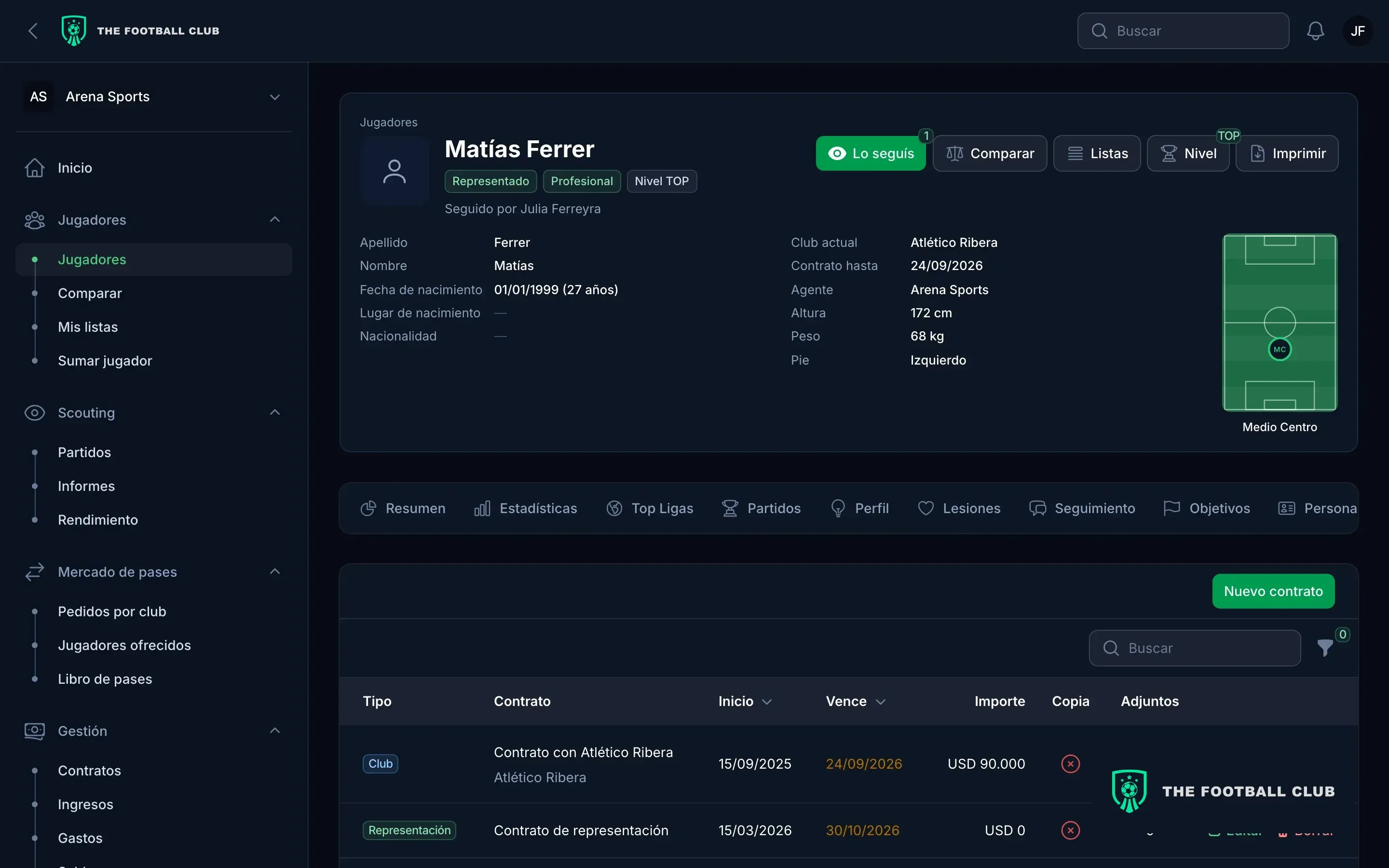
A spreadsheet works while there are few bonuses and one person maintains them. With a roster of players, each with several conditions, it gets fragile. In The Football Club each contract is stored with its club, term, remuneration and clauses, visible from the player profile, which also carries the season’s appearances, goals and minutes. Those are the numbers against which almost any appearance or output bonus is measured. Dates that close, such as the end of a contract, arrive by email through the expiry alerts.
To see how this fits the rest of the agency, there is the app for managing players and the guide to organising a football agency. For the payment made simply for signing, which depends on no result, see what a signing-on fee is.
Sources
- FIFA Football Agent Regulations (PDF): definition of “Remuneration” and Article 15 on the service fee cap.
- Collective agreement for professional football in Spain (official gazette, 2015, in Spanish): Articles 20 and 23, components of pay and match bonus. Check the text in force when signing.
- Royal Decree 1006/1985 on the special employment relationship of professional sportspeople (official gazette, in Spanish): Article 8, remuneration.