Footballer image rights: how they are agreed
By Mariano David Pérez Co-founder
Footballer image rights are a player’s power to decide who may use his or her face, name or voice commercially, and for what payment. They are agreed in writing, separately from the salary: a contract with the club, a sponsor or the player’s own company sets out what is licensed, for which uses, for how long and for how much.
This article explains what can be licensed and what cannot, what a good agreement should say and what role the agent plays. It is a general guide: every country treats the subject differently, and a specific agreement has to be reviewed by a local lawyer.
What exactly are image rights?
They are the commercial uses of a well-known person’s identity: photos in an ad campaign, a name on a shirt or in a video game, a voice in a commercial. In football three different things get mixed up, and it pays to separate them:
- The player’s image as a person: face, name, signature. This is what a player licenses, or not, when signing a sponsorship.
- The player’s image as a member of the club: photos in the kit, the squad in the club shop, the broadcast match. The club contract usually deals with it.
- The collective image: the whole team. It tends to be handled jointly, through the club or a collective agreement, rather than player by player.
Mixing them up is the most common source of disputes: the player thinks he licensed “club photos” and the club understands he licensed everything.
Can image rights be transferred? What does the law say?
It depends on the country, so there is no universal answer. Two examples, with their sources:
In Spain, Organic Law 1/1982 says in Article 1.3 that the right to one’s own image cannot be waived, transferred or lost through the passage of time. What can be given is authorisation: Article 2 requires express consent, and that consent can be revoked at any time, although the damage caused by revoking it, including justified expectations, has to be compensated. Article 7.6 treats using a person’s name, voice or image for advertising or commercial purposes without that consent as an unlawful intrusion. For professional footballers, Royal Decree 1006/1985 adds in Article 7.3 that sharing in the profits from the commercial exploitation of a player’s image is governed by whatever the collective agreement or an individual agreement provides, except when the player is hired through a commercial company. (Both texts are in Spanish.)
In England, HMRC’s Employment Income Manual, section EIM00734, quotes a case in which the Special Commissioners said that in England there is no property in a person’s image, so “image rights agreement” does not describe well what was signed: what exists are promotional, advertising and personal-endorsement contracts, with concrete obligations for the player (attending a photo shoot, not endorsing competitors).
The shared lesson is practical: what counts is what the contract says precisely, not the name it is given.
What should an image rights agreement say?
A good agreement sets out, at the very least:
- Who licenses and who receives. The player, a company of his, the club. If an intermediary company is involved, it must be named clearly.
- What is licensed. Name, nickname, signature, photograph, voice, shirt number, video game likeness. What is not listed was not licensed.
- For which uses. Advertising club products, the official shop, social media, broadcasting, third-party products. Whether the club may sub-license to a sponsor.
- Where and for how long. Territory, term, and what happens when the player moves club or the contract ends.
- How much is paid and how. A fixed sum, a share of what the exploitation earns, or both; in what currency, on what dates and against what document.
- Exclusivities and restricted categories. If the player has his own boot sponsor, he cannot license the same category to the club for the same use, and vice versa.
- Obligations on both sides. How many events or shoots, with how much notice, and what happens if they are not met.
- How it ends. Grounds for termination, return of materials and how long already-produced material may keep circulating.
What if the player is a minor?
A minor gives consent personally if maturity allows; otherwise the legal representative gives it in writing. In Spain, Article 3 of the same 1982 law adds that the legal representative must inform the Public Prosecutor beforehand, who may object. For a youth player, then, neither the boy’s signature nor that of a third party claiming to speak for the family is enough: it takes whoever holds legal representation, and that proof should be kept with the agreement. For what an agent may do with a minor, see our guide to representing a minor.
What role does the agent play in image rights?
The agent usually steps in at three moments: when negotiating the club contract (because the club may want to include image), when looking for the player’s own sponsorships and when sorting out who gets paid what. Two warnings:
- The representation agreement must say whether image is included. If the agent is going to take a fee on image income, it is agreed expressly and separately from the fee on the sporting contract. We explain it in the article on the representation agreement.
- Do not mix the caps. The fee cap in FIFA’s agent regulations is calculated on salary or transfer fee, and how much football agents earn depends on what is invoiced. Personal sponsorship income is a different matter: what may be charged on it is set by the representation agreement and the law that applies.
How do you keep track of image agreements?
The underlying problem is one of order, not theory: an image agreement has a term, a territory, exclusivities and periodic payments, and someone has to know when each one expires and whether it was paid. In an agency with several players, that information is usually spread across emails, PDFs and chats.
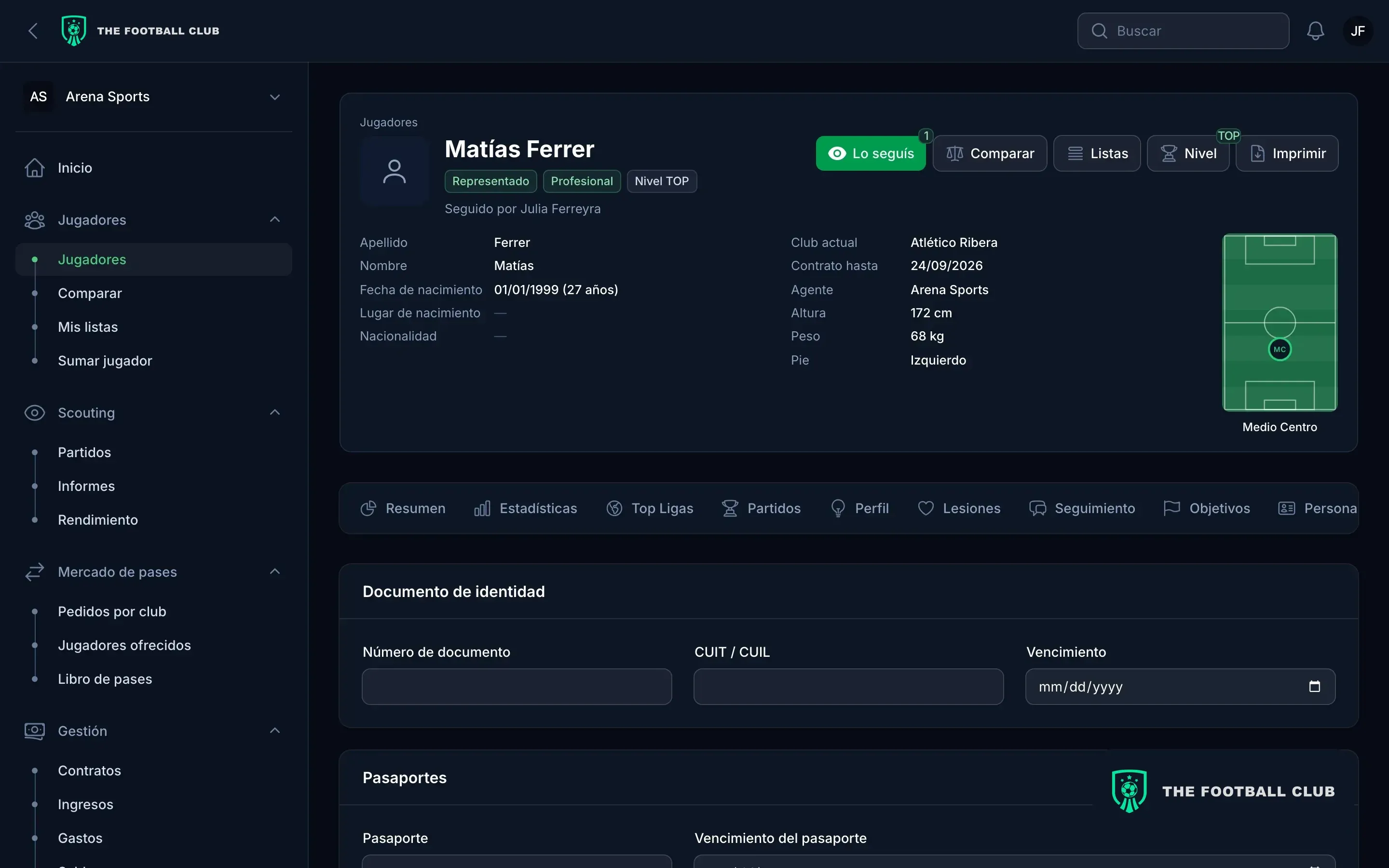
In The Football Club, the player profile has a documents tab where each player’s files are kept, including the signed image agreement. And expiry alerts flag what is about to expire, with the days left. There is no dedicated image rights module: what it offers is the document and the dates in the same place as the player’s contract. To see how that looks for an agency, there is the app for managing players.
What mistakes come up again and again?
- Licensing “everything” for a small sum, with no limit on uses or term.
- Not separating club image from personal image, then finding that the player’s own sponsor clashes with the club’s.
- Not fixing what happens on leaving the club: the material keeps circulating and nobody knows whether it can still be used.
- Signing with an intermediary company without understanding who gets paid. If the company is the player’s, it is one thing; if it belongs to a third party, it is another.
- Leaving it in an email or a message. An authorisation that is not signed and delimited is hard to prove.
- Forgetting tax. How image income is taxed varies by country and changes often: ask a local accountant before building the structure.
In short
Footballer image rights are agreed in writing, stating what is licensed, for which uses, where, for how long and for what payment. Each country treats them differently: in Spain the image cannot be fully transferred, only authorised and revoked with compensation, and in England what gets signed are promotional contracts, not property transfers. What holds everywhere: what is not written precisely gets argued about later.
This article is for information only and is not legal or tax advice. It rests on the Spanish legislation and the HMRC manual cited below, consulted on 16 November 2026; it does not cover every country.