Football scout salary: what a scout actually earns
By Mariano David Pérez Co-founder
There is no single football scout salary, and no official figure either: no public body publishes what football scouts earn, and pay ranges from nothing but expenses to a fixed salary in a big club’s recruitment department. What can be said with sources is what the income depends on, how scouts are usually paid and which public numbers exist, with their limits.
Is there an official figure for what a scout earns?
Not for football. The closest thing is United States labour data, which groups coaches and scouts across all sports into one category. According to the Bureau of Labor Statistics’ Occupational Outlook Handbook, the median annual wage for that category was USD 47,320 in May 2025, and the handbook itself notes that part-time work is common.
That number is of little use to a football scout: it mixes coaches with scouts, and it covers another country, other sports and another market. Do not read it as “a scout’s salary”; it is simply the only official figure we found, which is why we cite it.
We found no official statistic and no collective agreement that sets a football scout’s pay in Spain, Latin America or most other countries. If someone shows you a table of exact figures by country, ask where it comes from.
What do we know about the UK, where the job is better documented?
The Professional Football Scouts Association (PFSA), a private British organisation, publishes a career guide for football scouts with three useful points. All are attributed to the PFSA, not to an official statistic:
- Few clubs publish what they pay, so figures vary.
- Most scouts start on casual rates, not a salary.
- Full-time salaries are rarely advertised, and published estimates put them, according to the PFSA, at roughly £22,000 to £45,000 a year, without naming the source of that estimate.
The same guide gives examples of match rates: one English club’s academy scout rate follows the minimum wage (£12.71 an hour in 2026, per the PFSA) and another club pays £15 an hour or £30 a match. The minimum wage itself is official: the UK Government sets the National Living Wage for people aged 21 and over at £12.71 from April 2026. The clubs’ own rates are the ones the PFSA reports, and we could not check them with the clubs.
Take them for what they are: an example of how the entry level is paid in one country, not a worldwide average.
What does a scout’s pay depend on?
More than on any qualification, on four things:
| Factor | What changes |
|---|---|
| The type of arrangement | Volunteer with expenses, pay per match, pay per report, part-time contract or a fixed salary as an employee. |
| The level of the club or organisation | A lower-league club or a local academy is not the same as the recruitment department of a professional club with a structure. |
| The role | Regional scout, league scout, head of a group of scouts or head of recruitment: each step is a different kind of job. |
| Who pays for the work | A club, a player-representation agency, an independent scouting service or the scout selling reports directly. |
One more detail changes real income a lot: a scout rarely lives off scouting alone at the start. The PFSA says most scouts begin on casual rates, and the BLS handbook agrees that part-time work is common. In how to become a football scout we explain why the first job is often unpaid or paid per report.
Can a scout be paid a share of a transfer?
Sometimes, when working with agencies, the parties agree a share of what the agency earns if a player the scout brought ends up signing. That is a private arrangement and there is no standard rate: it depends on what the parties agree.
One limit is worth being clear about: negotiating a contract or a transfer on a player’s behalf is an agent service and requires a FIFA licence, while scouting is listed as an “other service”. We explain it in the FIFA football agent regulations. If you are offered a percentage, put it in writing and check it with a lawyer where it is signed, because regulation and tax change from country to country.
How do you set a rate as an independent scout?
With no official table, the rate is negotiated around three things you do control:
- Define the unit of pay: per match watched, per report delivered or per month. Each splits the risk differently.
- Ask for expenses to be spelled out: travel, tickets and transport. If they are separate, write it down.
- Agree what happens to what you bring: if your report leads an agency to sign a player, who gets paid what, and when.
And show your work. A clear report, with a consistent standard, delivered on time, counts for more in a rate conversation than any course. For that you need to be able to show what you did: how many matches you watched, which players you followed and what you said about each.
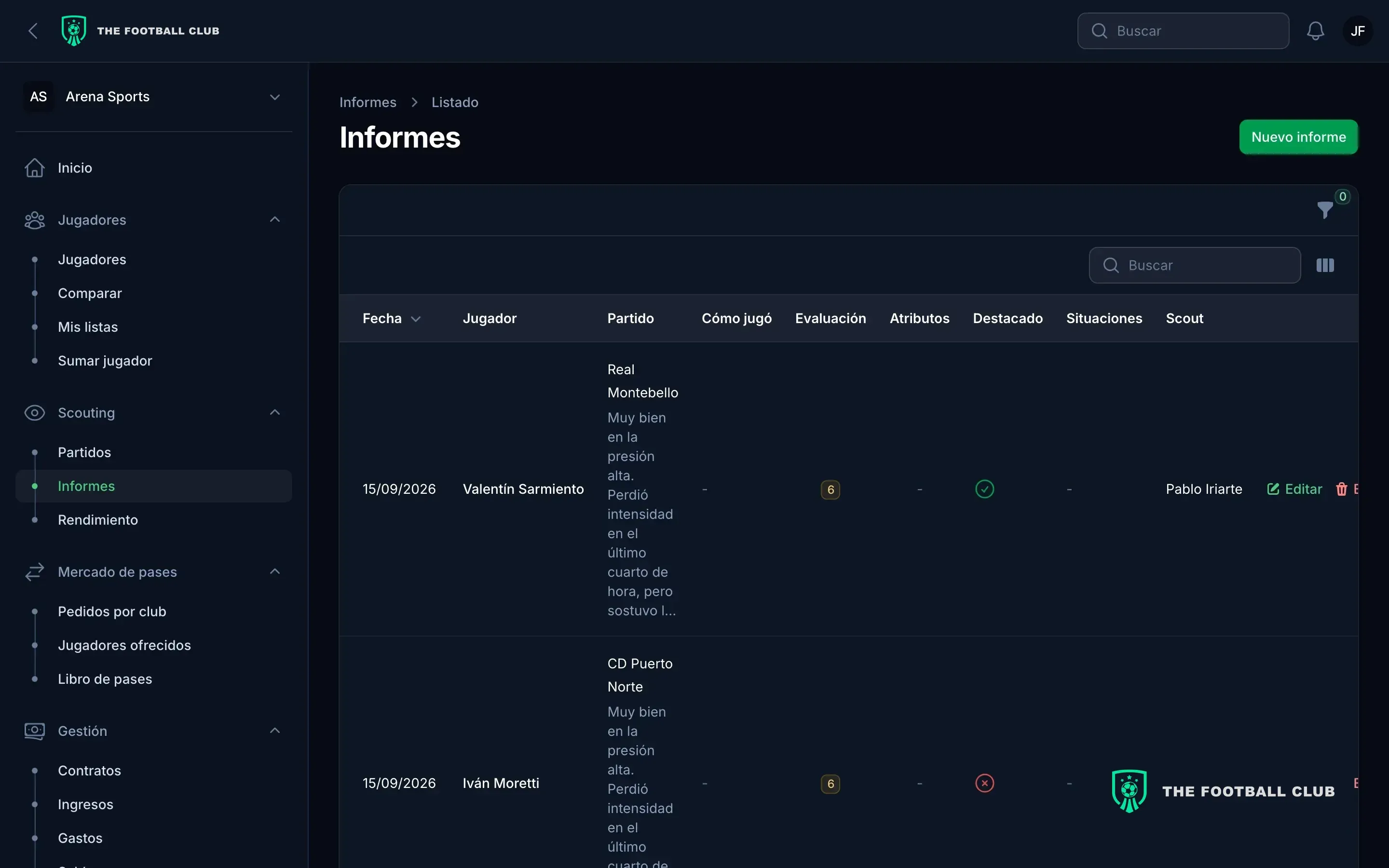
In The Football Club every match ends in a match report that adds to the player’s history, and the match reports shows how that work looks once it is organised. It will not tell you what to charge; it lets you show, on the day you negotiate, how much work sits behind the number.
In short
There is no official salary for a football scout: the only official figure we found is a US median that mixes scouts with coaches in every sport. Income depends on the type of arrangement, the level of whoever pays and the role, and the entry level is usually per match, per report or unpaid. Be wary of any figure without a source.
Informational article, updated November 2026. The figures cited are those each source published at that date and they change.
Sources
Consulted in November 2026:
- US Bureau of Labor Statistics (BLS): Occupational Outlook Handbook, Coaches and Scouts.
- PFSA: Football Scout: role, skills and UK salary.
- UK Government: National Minimum Wage and National Living Wage rates.