Football players agents: how they work behind the scenes
By Mariano David Pérez Co-founder
Football players agents work through a cycle that repeats with every client: they recruit the player, sign a representation agreement, follow him for months, negotiate when a deal comes up, collect their fee and, before two years are up, renew the relationship or lose it. Each of those six stages has a rule in the FIFA Football Agent Regulations saying who may do it and what has to be in writing.
Updated on 15 November 2026. The regulatory points come from the FIFA Football Agent Regulations (edition in force since 1 January 2025) and from circular 1873, which suspended several articles. The split into stages is our way of laying out the work, not wording from the regulations. For the player’s side of the story, see what a football player agent does.
How are football players agents organised internally?
Around a licence that belongs to a person, not a company. The regulations define a football agent as “a natural person licensed by FIFA” and an agency as an organisation or company “retaining, comprising, employing or otherwise acting as a vehicle for the business affairs of one or more Football Agents”. The licence is “strictly personal and non-transferable” (article 8): the agency does not hold one of its own.
That explains the shape of almost every agency: one or more licensed agents at the centre, surrounded by people who watch matches, run the administration and prepare paperwork. Article 11, paragraph 3 sets the limit for that team: staff who are not agents may not perform football agent services or approach a potential client to sign them, and the agent “remains fully responsible” for anything the agency and its employees do in breach of the regulations. How the work is split under that rule is covered in roles in a football agency.
FIFA itself gives the size of the profession: according to its Football Agents Report 2025, 10,525 individuals held a football agent licence as of 4 December 2025.
What are the stages of an agent’s work with each player?
Six, always in the same order. What changes from one player to the next is how long each one lasts.
| Stage | What the agency does | What the regulations say |
|---|---|---|
| 1. Recruitment | Spots the player, follows him and makes the approach | Only a licensed agent may make the approach (art. 12, para. 2) |
| 2. Representation agreement | Agrees terms and signs | In writing, with minimum content, two years at most with a player (art. 12, paras. 3 and 7) |
| 3. Follow-up | Supports him, watches him play, talks to clubs | Always act in the client’s best interests (art. 16, para. 2 a) |
| 4. Negotiation | Negotiates the employment contract or the transfer | The agent’s name, licence number and signature go in the contract (art. 12, para. 11) |
| 5. Getting paid | Invoices and collects the fee | What the representation agreement says, on an invoice basis (art. 14, paras. 1 and 4) |
| 6. Renewal or exit | Signs a new agreement or ends the relationship | No automatic renewal; termination with just cause (art. 12, paras. 3 and 14) |
In a roster of twenty players there is, at any given moment, someone at every stage. That is why an agency’s internal work is less about negotiating than about knowing which stage each player is in and which date is coming up.
How do agents sign players, and what are the limits?
Recruitment starts long before the first conversation: someone at the agency watches matches, builds a list and follows the player for weeks. Anyone on the team can do that part. The approach is different: article 12, paragraph 2 reserves for licensed agents both approaching a potential client and signing the representation agreement. And an “approach”, as the regulations define it, includes contact made through a relative, a friend or a third party acting on the agent’s behalf.
There are two further limits:
- A player who already has an agent. Article 16, paragraph 1, bans approaching or signing a client who has an exclusive representation agreement in force with another agent, except in the final two months before it expires. The rule is contested: in its judgment of 16 July 2026 in case C-209/23, the Court of Justice of the European Union said it appears to be incompatible with the EU prohibition on cartels.
- A minor. Article 13 only allows an approach from six months before the age at which the player can sign a first professional contract, with the written consent of the legal guardian, and requires the agent to have completed the course on representing minors. The detail is in representing a minor.

What has to be signed before an agent can act for a player?
The representation agreement, and before any work is done: article 12, paragraph 1, says an agent may only perform football agent services for a client after entering into a written one. To be valid it must state the names of the parties, the duration, the fee and the nature of the services, and carry everyone’s signature (paragraph 7).
With a player or a coach, the agreement may not exceed two years, and any automatic renewal clause is null and void (paragraph 3). Before signing, the agent has to tell the player in writing to consider taking independent legal advice, and keep the player’s written confirmation that he either took it or chose not to (paragraph 4). Both documents are filed with the agreement itself. Which clauses to include is covered in football representation agreements.
What does an agency do between signing and negotiating?
Most of its work. Months can pass between a player signing with the agency and a deal coming up, and during that time the regulations ask for one thing above all: to “always act in the best interests” of the client (article 16, paragraph 2 a). In practice that means watching how he plays, talking to him when he is left out and keeping the clubs that might need him informed.
One concrete duty comes out of this stage. Among the conduct prohibited by article 16, paragraph 3, is concealing material facts from a client, and the regulations name two examples: failing to disclose a conflict of interest, and failing to report a written offer made to the client, by any means of communication. For an agency, that means every offer that arrives — by email or by message — should be logged with its date, along with the day it was passed on to the player.
No article covers the rest, yet it decides whether the agency keeps the player: every conversation written down somewhere the whole team can read. How that fits into the week is in football agent daily tasks.
How is a negotiation handled inside the agency?
When a club wants the player, the work narrows down to the licensed agent. The preparation — what the player earns today, when his contract expires, which bonuses he has, what the club asked for — can be done by the team; negotiating with the club cannot.
The regulations add two things worth keeping in view:
- Who the agent acts for in that deal. Article 12, paragraphs 8 to 10, only allows acting for the player and the club engaging him at the same time, with the prior written consent of both, and bans the other combinations. Those paragraphs are among the ones FIFA suspended through circular 1873.
- What the signed contract must say. Any transfer agreement or employment contract resulting from the agent’s work has to state the agent’s name, FIFA licence number and signature, and the name of the client (paragraph 11).
How and when does the agency get paid?
The agent is entitled to receive from the client the fee agreed in the representation agreement (article 14, paragraph 1), and it is paid on an invoice basis (paragraph 4). A fee is only due for services set out in advance in a representation agreement that was in force when they were performed (paragraph 5).
The same article requires payment in quarterly instalments over the whole term of the employment contract, and article 15 sets caps; both rules are suspended, so today the schedule and the percentage are whatever the parties agree. The figures are in how much football agents earn.
For the agency, the point is that a closed deal is not a paid deal. A commission agreed in instalments over three years means several due dates per player, and someone has to know which one has been invoiced, which has been collected and which is late. On top of that, the client has the right to request a detailed schedule of all payments made by or in relation to them (article 18, paragraph 1 e).
Which rules in the regulations are suspended?
On 30 December 2023 FIFA suspended worldwide, through circular 1873, the provisions affected by a German court injunction, until the Court of Justice of the European Union ruled: among them the service fee cap, payment in instalments, the client-pays rule, the limits on acting for more than one party and the reporting duties on the platform. The licence, the written agreement of up to two years and the prohibited conduct in article 16, paragraph 3, were left outside the suspension.
The European court ruled on 16 July 2026 and left it to the German court to decide whether several of those rules are justified. Before treating any of them as applicable in a deal, check the current circulars from FIFA and from the relevant association: article 3 requires every member association to have national regulations for deals that are not international.
What that path looks like in a system
The six stages leave different records, and in a growing agency they tend to end up in different places. In The Football Club, using a demonstration agency’s data, the path looks like this:
- Recruitment and follow-up: player lists by criterion and the player profile, where each follow-up note keeps its date.
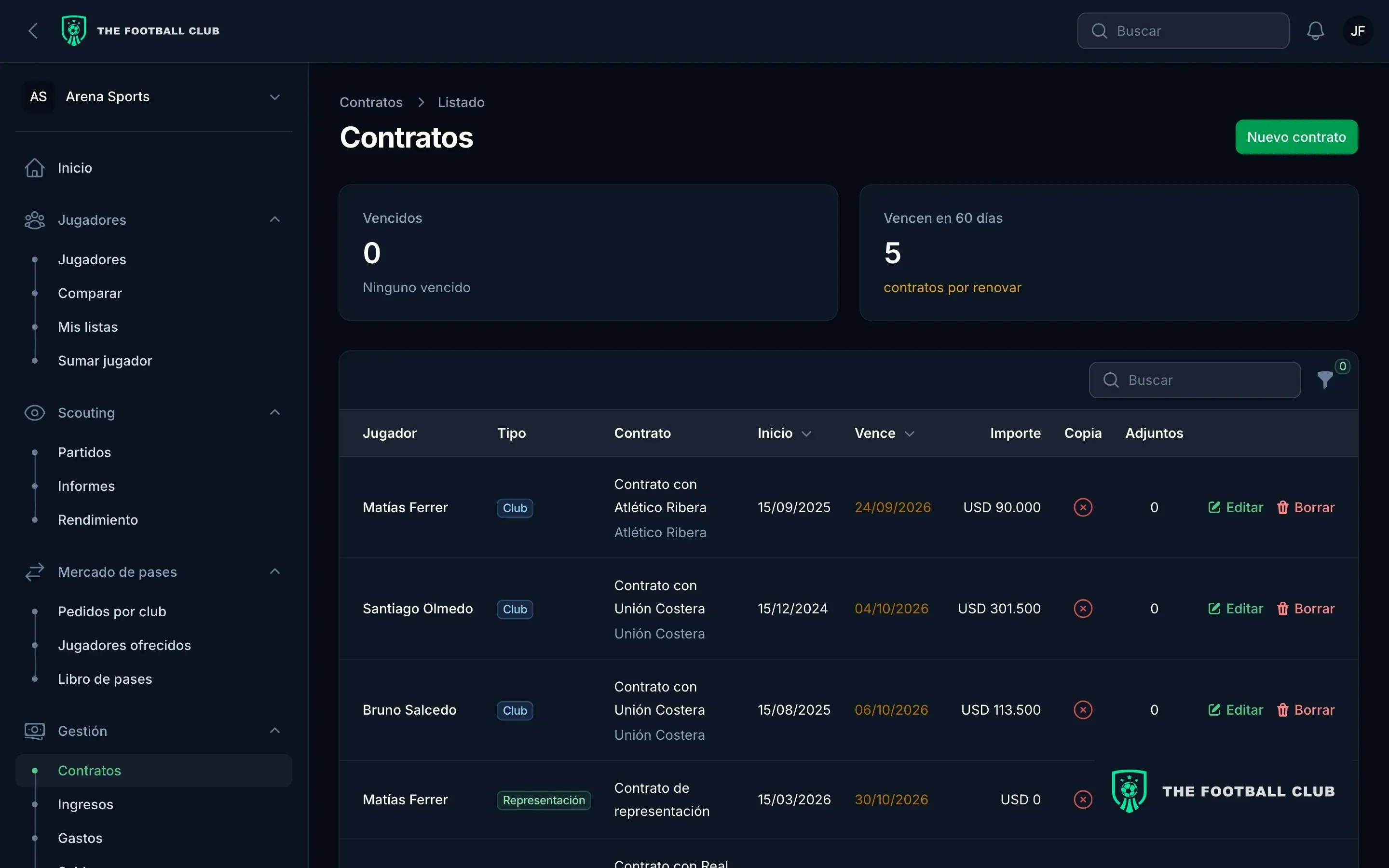
- Agreement and renewal: contracts with their term, and contract expiry alerts, with a daily email.
- Negotiation: the transfer market, with what each club is asking for and which player was offered to whom.
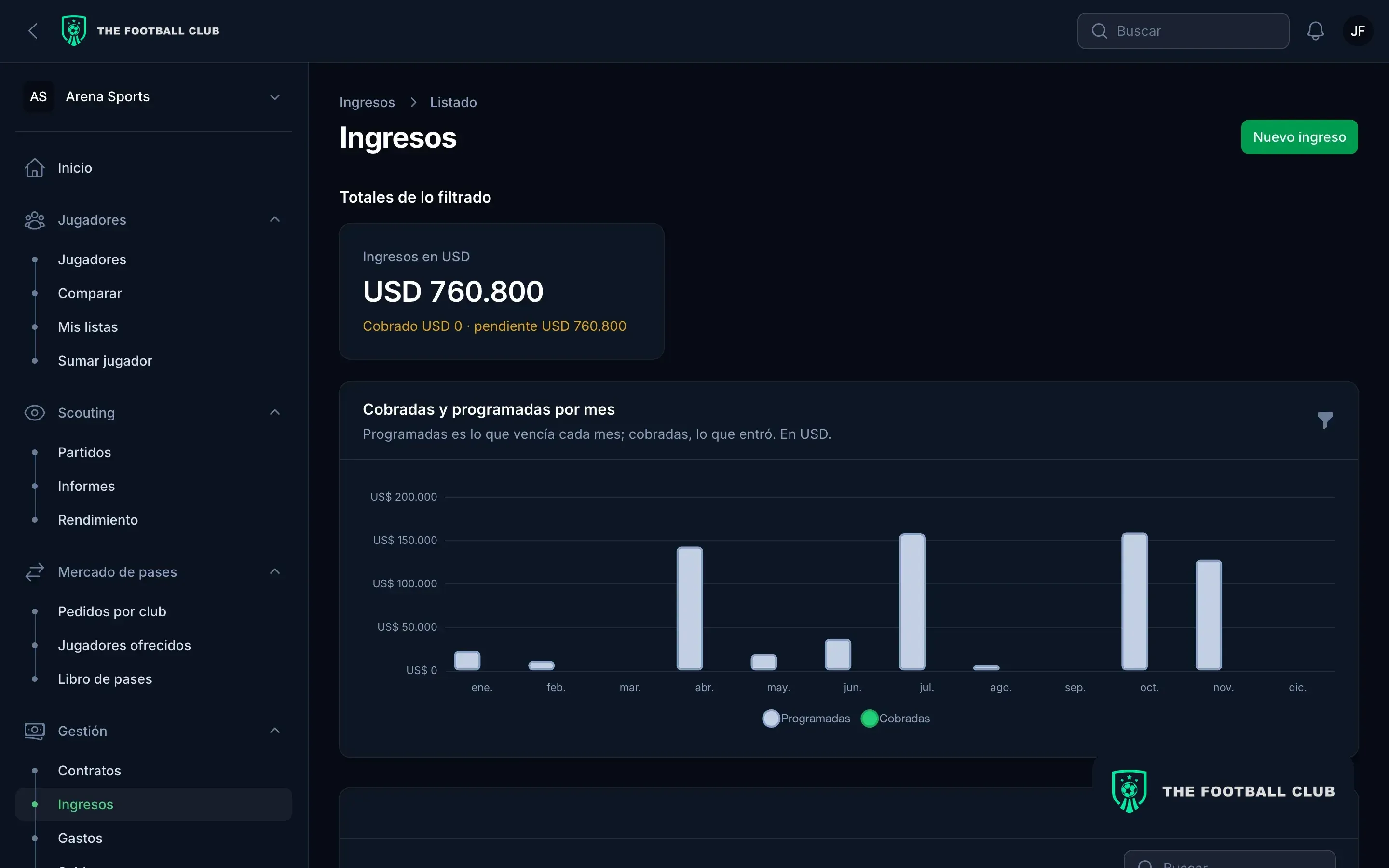
- Getting paid: contracts and commissions, with what has been collected and what is outstanding.
Each person sees what their role allows: whoever files reports does not see what the agency earns. The rest is on the app for managing players.
This article is for information only and is not legal advice. The regulatory points were checked against the editions cited, as of November 2026; the rules suspended by circular 1873 may be reinstated or changed depending on what the courts and FIFA decide.
Sources
- FIFA Football Agent Regulations, in force since 1 January 2025 (PDF) — definitions and articles 3, 8, 11, 12, 13, 14, 15, 16 and 18
- FIFA circular 1873: update on the implementation of the regulations (PDF, 30 December 2023) — suspended provisions
- Court of Justice of the European Union, press release 110/26 on case C-209/23, RRC Sports (PDF, 16 July 2026)
- FIFA Football Agents Report 2025 (PDF, December 2025) — number of licensed agents