How to prepare a football contract renewal
By Mariano David Pérez Co-founder
A football contract renewal has to be prepared months ahead, not weeks: the time to negotiate is before the player has six months left, because from that point FIFA’s rules let him agree terms with another club. Preparing a renewal means arriving at the table with the dates, the numbers and the agency’s own paperwork already checked, and with a clear idea of what you are asking for and what you can give.
This article is written from the agency’s side, but it works just as well for a club. It is current as of November 2026 and cites FIFA’s Regulations on the Status and Transfer of Players (RSTP), July 2025 edition, and the FIFA Football Agent Regulations. In June 2026 FIFA approved a new regulatory framework that enters into force on 1 January 2027: if talks run past that date, check which text applies.
When should you start preparing a renewal?
At least a year ahead, and always before the final six-month window. Article 18(3) of the RSTP says a professional is only free to sign with another club if his contract has expired or is due to expire within six months. From that day the talks change: the player has alternatives and the club receives no fee if he leaves.
A working timeline, counted back from the expiry date:
| Time left | What happens |
|---|---|
| 12 to 18 months | Decide what you want: renew, sell or let it run. Build the renewal file (below) and talk to the player. |
| 9 to 12 months | First formal conversation with the club. A transfer fee is still possible, which gives both sides weight. |
| 7 to 9 months | A written proposal on the table. This is the last comfortable stretch. |
| 6 months | The window opens in which the player may agree terms with another club. The renewal offer must already have been made. |
These are guidelines and depend on the market: what matters is when the last useful window closes for selling or securing a destination, not the calendar. How to set up alerts with a named owner for each is covered in our article on contract expiry, and what happens if the player signs elsewhere in those six months in the one on pre-contract agreements.
What should you check before sitting down to negotiate?
Before proposing a figure, the agency needs to know exactly where the player stands. A minimum renewal file holds:
- The current contract, read end to end. End date, salary and bonuses, extension options and their notice deadline, clauses whose amount or date changes, and the image-rights arrangement. Any date buried in a clause becomes part of the negotiation.
- The representation agreement. If the agency’s own agreement with the player expires first, the conversation starts there. Article 12(3) of the Football Agent Regulations says an agreement between an agent and an individual may not exceed two years and can only be extended by signing a new one: automatic renewal clauses are void. The details are in our guide to representation agreements.
- The season’s performance: appearances, minutes and follow-up reports. An argument backed by data weighs more than “he deserves a raise”.
- Market interest. Who is watching, what is known and what can be shown. A real offer from another club changes the table; an invented one breaks it.
- Up-to-date documents, so paperwork does not hold up a signature. See which player documents to keep current.
- The player’s own situation. What does he want: minutes, a project, being near family, money? A renewal that is good on the spreadsheet and bad for the player falls apart within six months.
What can be negotiated in a renewal?
More than salary. The points that usually reach the table:
| Point | What to look at |
|---|---|
| Length | RSTP Article 18(2) sets a maximum of five years and, for players under 18, three. Any other length is only valid if national law allows it. |
| Salary and bonuses | The base, what depends on appearances or results, and when it is paid. |
| Signing-on fee | A single sum on renewing, and when it is paid. |
| Release clause | If there is one, its amount and whether it changes by season. See release clauses. |
| Options and extensions | Who exercises them, until when and with what notice. |
| Image rights | What the player assigns and what he keeps. |
One more point from the same Article 18: paragraph 4 prevents a contract’s validity from being made subject to a medical examination or a work permit. If a draft says so, that is not something to negotiate but a text to correct.
What does FIFA say about the agent’s fee on a renewal?
A renewal falls within what the Agent Regulations call a transaction, which includes creating, terminating or varying an individual’s terms of employment. So the agent may be paid for it, under the same rules as for a new signing. In the Football Agent Regulations:
- Representation agreement in force. Article 14(5) says the agent is only entitled to a fee if it matches services set out in advance in a representation agreement that is in force when the services are performed. If the agreement has lapsed, sign a new one before negotiating the renewal, not after.
- Cap. Article 15 sets a maximum of 5% of the player’s annual remuneration up to USD 200,000 (or equivalent) and 3% of the annual excess above that. Conditional payments are not counted.
- Payment. Article 14 provides for payment on an invoice basis, in instalments every three months over the life of the negotiated employment contract. More in how much football agents earn.
- Legal advice. Before amending a representation agreement with a player, Article 12(4) requires the agent to tell him in writing that he should consider independent legal advice and to obtain his written confirmation.
- The agent named in the contract. RSTP Article 18(1) requires an employment contract concluded after agent services to state the agent’s name, their client, their FIFA licence number and their signature.
How do you keep track of a renewal?
A renewal runs for months and passes through several hands, so what gets lost is not the negotiation but the thread: what was offered, when it was answered, what is missing. An agency with dozens of players needs dates and agreements in one place, not in somebody’s chat. What follows is one way to do it, not the only one.
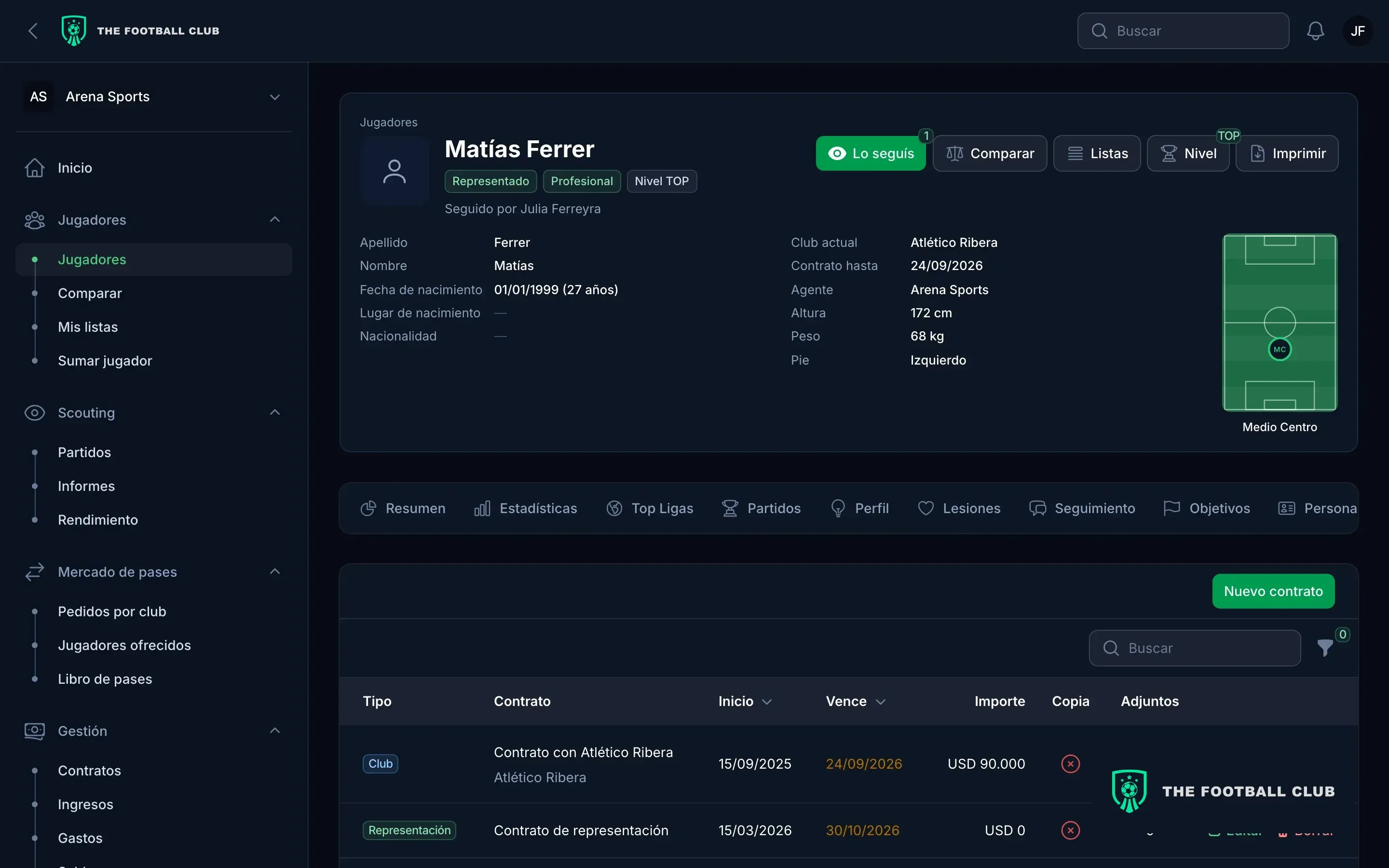
In The Football Club, the player profile holds the current contract and contract expiry alerts send an email when a contract comes into range, with a traffic-light view in the panel. Each client’s contracts and commissions sit next to the outstanding instalments. For an agency looking to organise all this, the app for managing players explains how it is set up, and the general guide is how to organise a football agency.
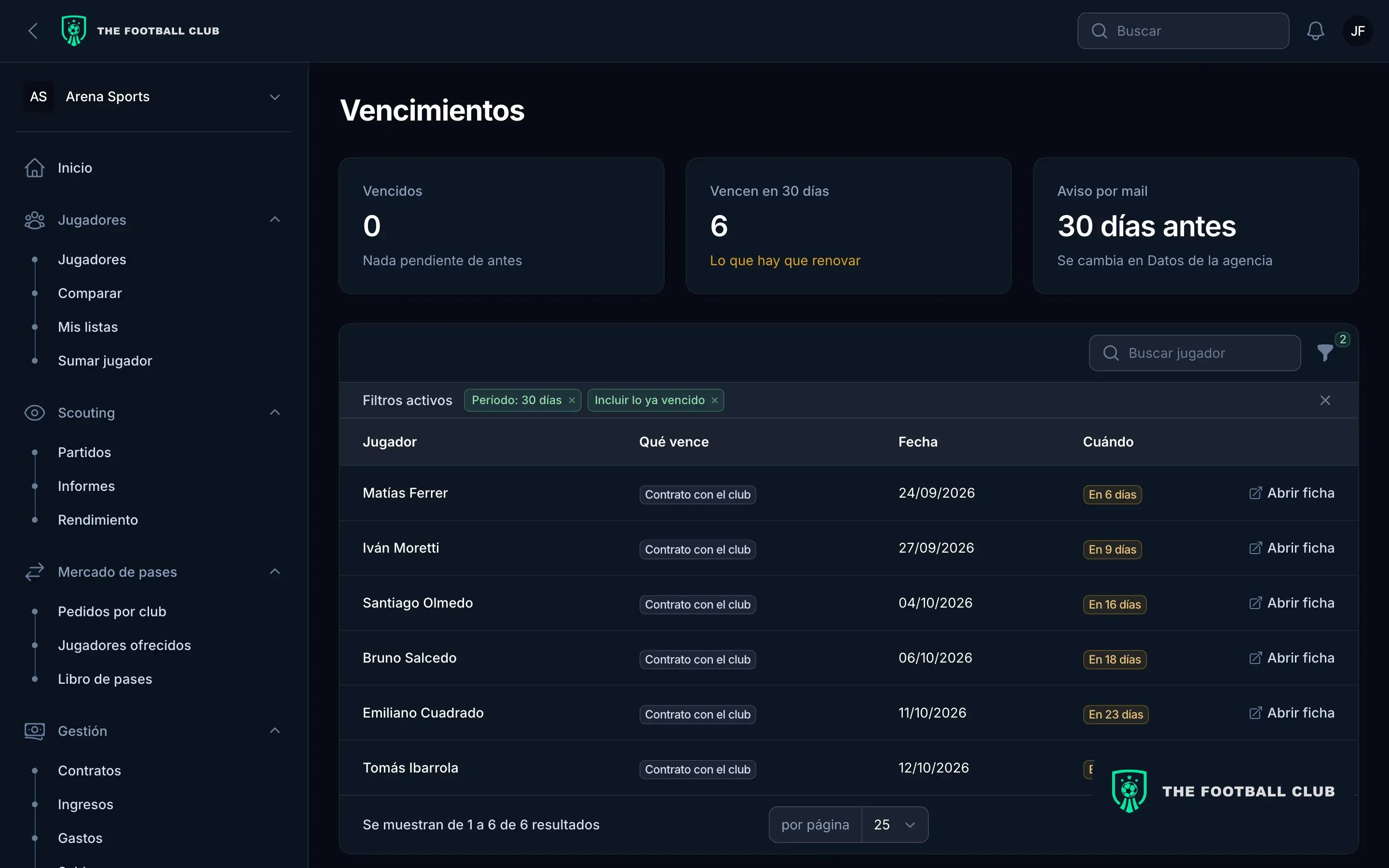
The data in the screenshot belongs to a demonstration organisation.
In short
A renewal is won before the last six months: start a year ahead, arrive with the file built (contract, representation, performance, market, documents) and check the representation agreement is in force. FIFA limits the length, caps the agent’s fee and requires the agent to be named in the contract.
Sources
- FIFA Regulations on the Status and Transfer of Players, July 2025 edition, Article 18.
- FIFA Football Agent Regulations, Articles 12, 14 and 15 and the definition of “transaction”.
- FIFA announcement of 10 June 2026 on the new regulatory framework, in force from 1 January 2027.
This article is informational and does not replace legal advice.