Financial fair play explained
By Mariano David Pérez Co-founder

Financial fair play explained in one line: it is the set of rules UEFA uses to stop clubs in its competitions from spending more than they earn or leaving debts unpaid. It began in 2010 and is now formally the financial sustainability regulations: UEFA calls them “an evolution of financial fair play”, built on three pillars of solvency, stability and cost control. The one that shapes the transfer market most is the last: since 2025/26 a club may not put more than 70% of its revenue into its squad.
This article is current as of November 2026 and follows the 2026 edition of the UEFA Club Licensing and Financial Sustainability Regulations, in force since 1 June 2026.
How does UEFA’s financial fair play work today?
It is a monitoring system for clubs that play in the Champions League, Europa League or Conference League, with three requirements checked separately:
| Pillar | What it requires | Who is exempt |
|---|---|---|
| Solvency | No overdue payables to other clubs, employees, tax authorities or UEFA (arts. 81 to 84) | Nobody: it applies to every club |
| Stability | Aggregate “football earnings” deficit within the acceptable deviation (arts. 85 to 92) | Clubs with total employee costs below €5 million |
| Cost control | Squad costs no higher than 70% of revenue (arts. 93 to 95) | Clubs with total employee costs below €30 million |
The thresholds and article numbers come from the club monitoring chapter of the 2026 edition. Enforcement sits with UEFA’s Club Financial Control Body (CFCB), which has a first chamber and an appeals chamber; its final decisions can only be appealed to the Court of Arbitration for Sport, according to UEFA’s own page.
What is the 70% rule?
It is the cost control rule: the ratio between what a club spends on its squad and what it earns cannot exceed 70%. UEFA phased it in at 90% for 2023/24 and 80% for 2024/25, and it has been a permanent 70% since 2025/26. Breaches carry “predefined financial penalties as well as sporting measures”.
Article 93 defines the calculation. On the cost side it adds employee benefit expenses, amortisation of registration costs, loan income and expenses, and what is paid to agents and intermediaries. On the revenue side it takes adjusted operating revenue plus the result of player sales, among other items. Transfer items are averaged over 36 months.
Two practical consequences:
- Every euro of commission counts. What a club pays an agent sits in the numerator, like a salary. How that fee is built is covered in how much football agents earn.
- Selling helps buying. Player sales improve the denominator, so a club near the cap treats each outgoing transfer as room for the next signing.
What about losses?
The stability rule leaves some room: a club complies if its aggregate football earnings deficit over the monitored period fits within the acceptable deviation. That deviation is €5 million, but it can rise to €60 million if the increase is fully covered by owner contributions or club equity, and by up to €10 million more per period if financial health conditions are met (article 88, 2026 edition). In plain terms: losses are possible, but someone has to fund them.
Why does this matter to an agent or a club?
A club close to the 70% line negotiates differently: it may prefer a loan to a purchase, spread a bonus over instalments, or wait for a sale before offering a renewal. An agent who understands that knows when to push and when to offer a way out. It also pays to watch contract expiry dates across a squad, because a player who leaves on a free transfer frees wage room but brings in no income.
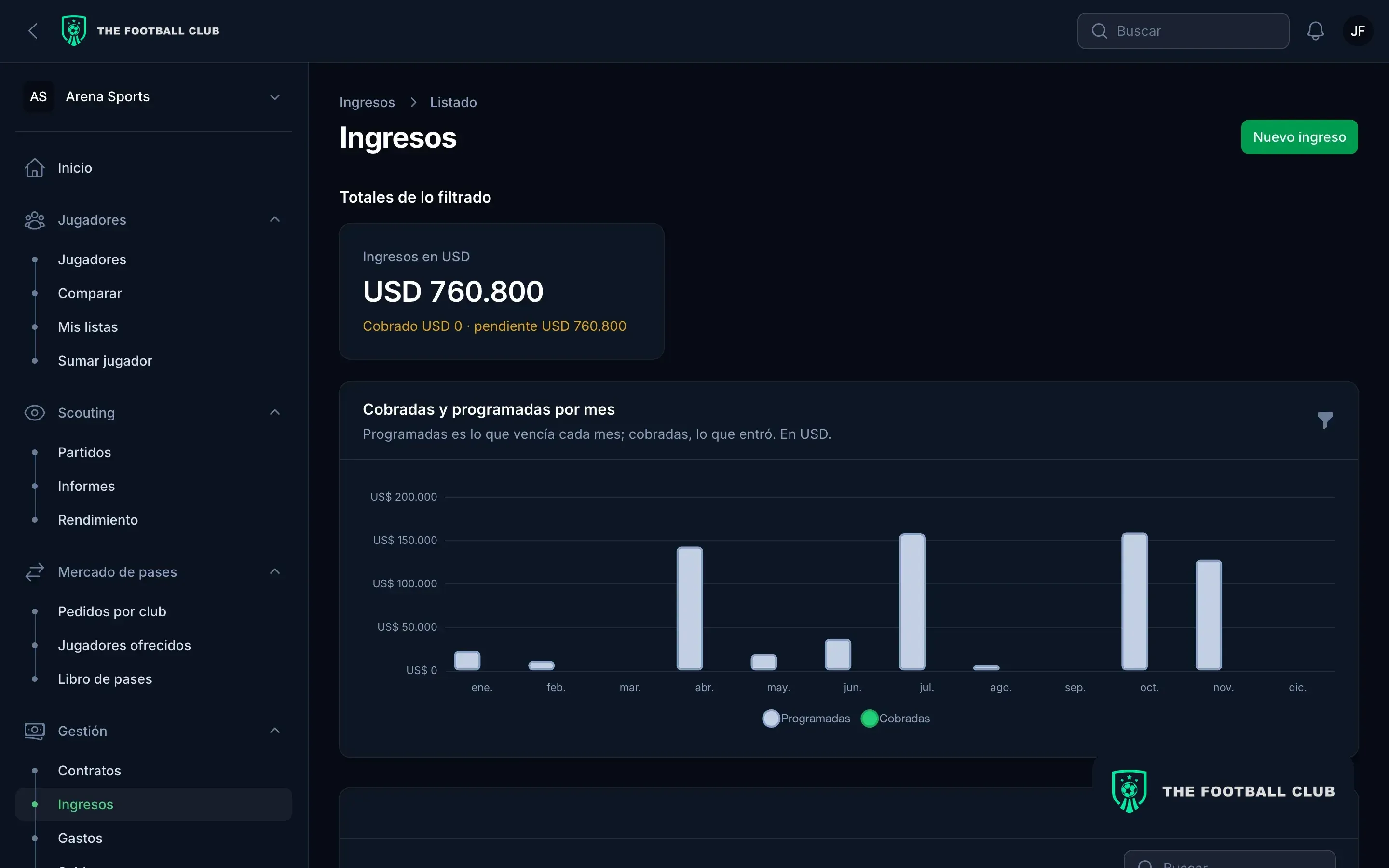
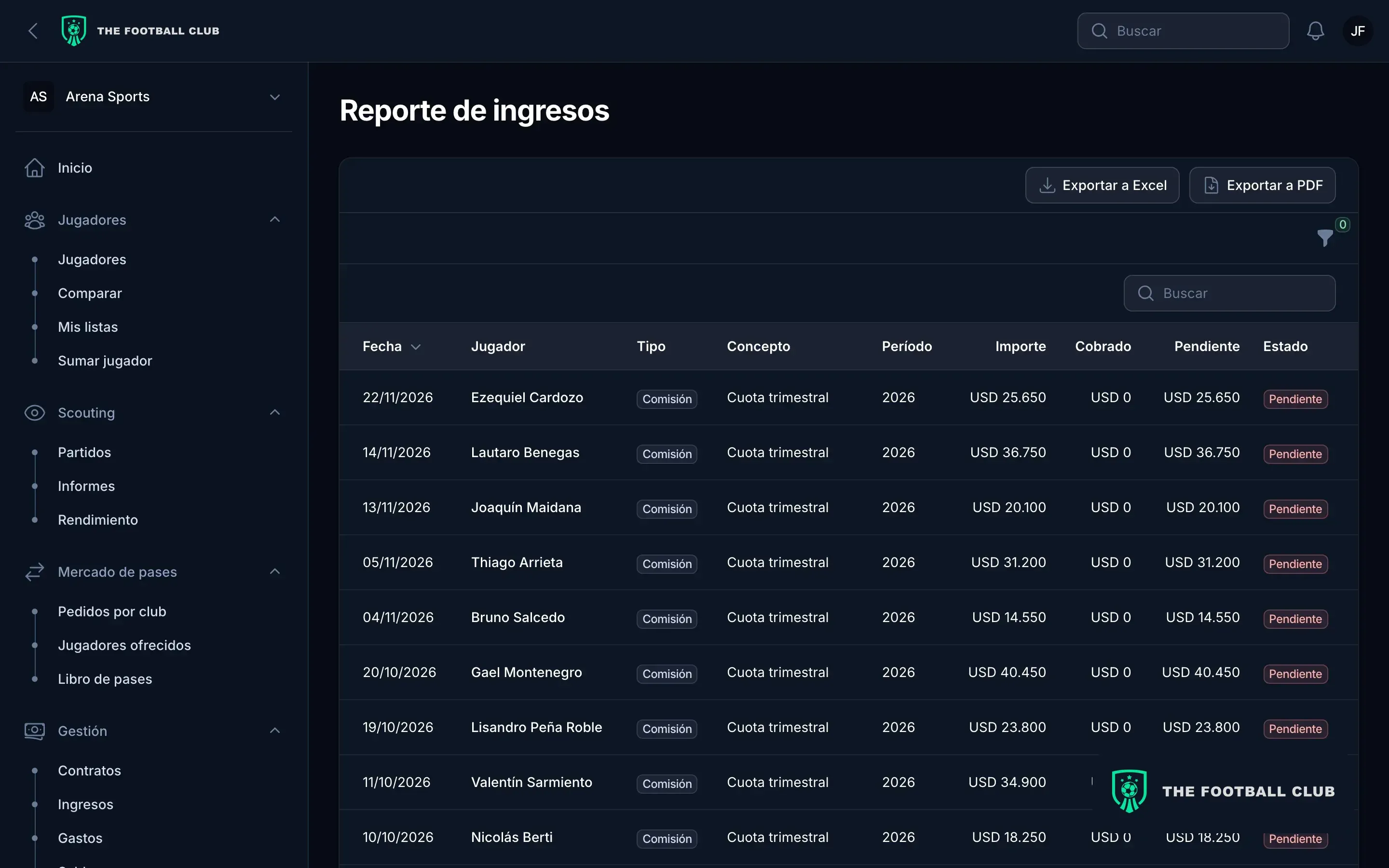
In The Football Club, an agency tracks contracts and commissions for each player, with what has been collected and what is pending, and clubs have their own version on the page for football clubs. The tool does not calculate UEFA’s ratio: that is done by the club’s finance department from its audited accounts. What it does organise is the starting data, which contract and which fee belong to whom.
Does the old “financial fair play” still exist?
The name survives in everyday use, but UEFA now talks about financial sustainability, and the benchmark is a 70% spending ratio rather than the break-even test of 2010. National leagues may run their own controls, which this article does not cover: always check the rulebook of the competition in question.
Sources
- UEFA, Financial sustainability: pillars, the 90%, 80% and 70% steps, the CFCB and sanctions.
- UEFA Club Licensing and Financial Sustainability Regulations, 2026 edition: arts. 80 to 95 and 103 (in force from 1 June 2026).