What FIFA TMS is and what it is for
By Mariano David Pérez Co-founder

FIFA TMS (the Transfer Matching System) is the online platform where clubs and national associations record every international transfer of a footballer. Its job is to make the move documented and checkable: both clubs enter the details of the deal separately, the system checks that they match, and only then can the new association request the International Transfer Certificate (ITC). Without that step the player cannot be registered to play for the new club.
What exactly is the Transfer Matching System?
The FIFA Regulations on the Status and Transfer of Players (RSTP, July 2025 edition) define it as a web-based data information system whose primary objective is to simplify international player transfers and improve transparency and the flow of information. The rules on how it works are in Annexe 3 of those regulations.
Using it is mandatory for international transfers of professional and amateur players in eleven-a-side football, and it is free: Annexe 3 states that no one is charged for anything done in the system (article 2). FIFA made it mandatory on 1 October 2010 for male professionals, according to its 2018 release marking 100,000 transfers, and later extended it to the women’s game, amateurs and minors.
A move between two clubs in the same country does not go through TMS: the national association records it in its own system.
Who uses FIFA TMS?
Clubs and associations do, through users who are trained and authorised by FIFA, each with a personal login. Under article 5 of Annexe 3, a TMS user has to be a direct employee of the club or association.
Agents and players do not operate the system. The agent is still in it, though: the club has to enter the agent’s name and fee, upload a copy of the representation agreement, and then declare every payment made to the agent (articles 10 and 12).

How does a transfer work in TMS?
Annexe 3 sets the process out in four steps:
- Each club creates its transfer instruction. It states whether the club is engaging or releasing the player, whether the move is permanent or a loan, the contract dates, the fixed fee and its instalments, any conditional fees and any sell-on percentage.
- The documents are uploaded. Among others: proof of the player’s identity (passport or ID card), the employment contract with the new club and the transfer agreement.
- The details have to match. Both clubs enter and confirm independently; if something differs, the transfer sits in a “matching exception” until they resolve it.
- The new association requests the ITC from the former one, inside the same system, and registers the player once it arrives.
What deadlines apply in TMS?
| Step | Deadline (Annexe 3, July 2025 edition) |
|---|---|
| Requesting the ITC | At the latest, the last day of the new association’s registration period (art. 11) |
| Delivering the ITC | 72 hours from the request; if the former association does not respond, the new one can register the player anyway (art. 11) |
| Proof of each club-to-club payment | 30 days (art. 12) |
| Representation agreement and payments to the agent | 14 days (arts. 10 and 12) |
This is why deadline day is, in practice, a TMS deadline: an ITC requested too late goes into a “validation exception”. The dates for each country are in our guide to transfer window dates. Breaches of Annexe 3 are sanctioned by the FIFA general secretariat and the FIFA Disciplinary Committee (articles 16 and 17).
What is entered in TMS is also relied on by the FIFA Clearing House, which centralises training reward payments between clubs, according to the transfer guide FIFA published in 2024.
What an agency can have ready before the club enters the deal
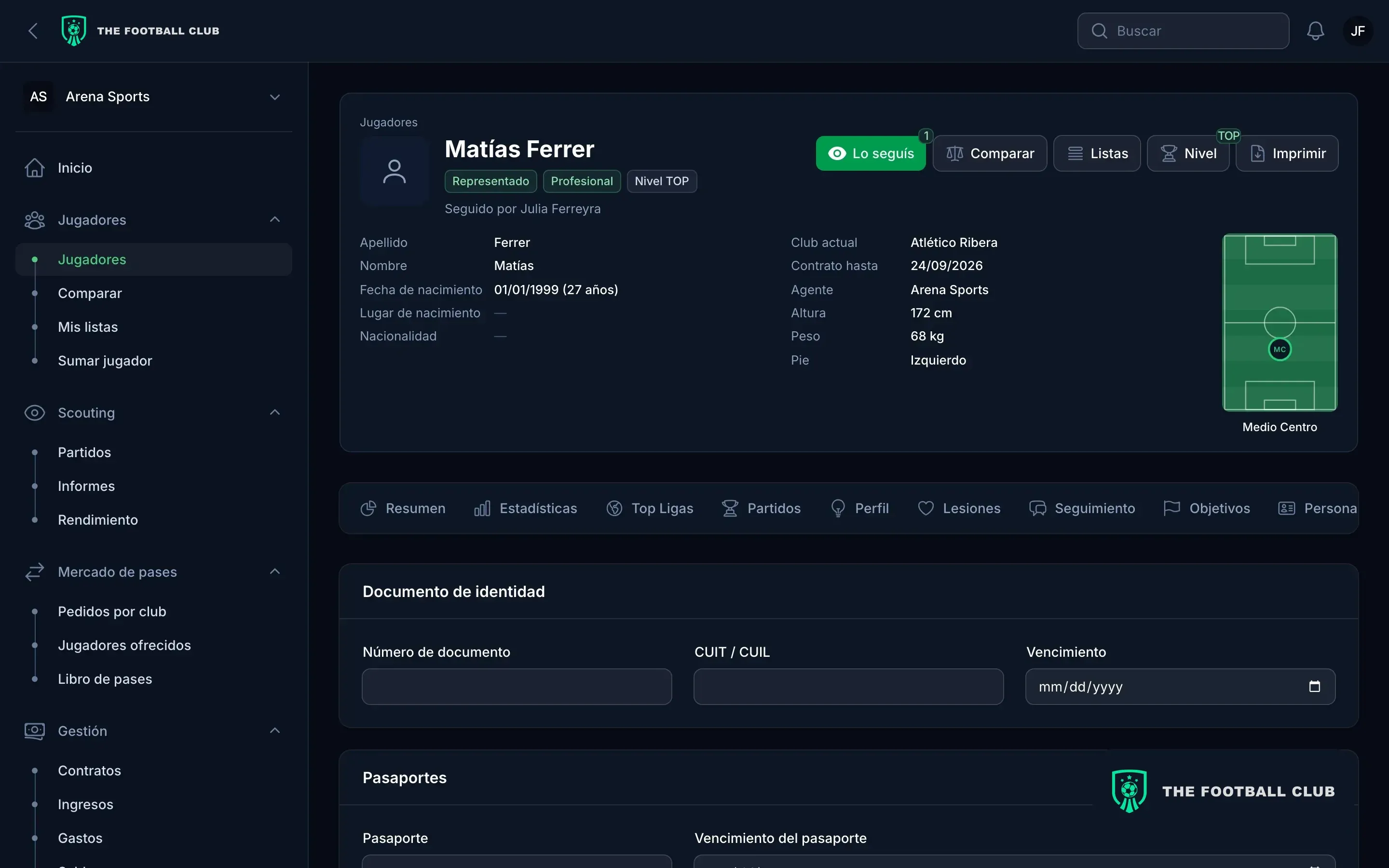
An agency has no access to TMS, but much of what the club needs comes from the agency’s files: a valid passport, the previous contract and how it ended, the signed representation agreement. In The Football Club that sits on the player profile, with an expiry date for each document, and the transfer book shows which windows are open. We go through the paperwork worth keeping current in football player documents.
Sources
- FIFA Regulations on the Status and Transfer of Players, July 2025 edition: definition 13 and Annexe 3 (articles 1, 2, 5, 10 to 12, 14, 16 and 17).
- “100,000 international transfers completed in ITMS”, FIFA media release, 20 March 2018: mandatory since 1 October 2010.
- FIFA International Player Transfer Guide announcement, July 2024: TMS is compulsory for male, female, professional, amateur and minor players.
- FIFA announcement on the new RSTP: the version approved on 10 June 2026 comes into force on 1 January 2027, so the article numbers cited here may change.
This article is for information only and is not legal advice. Updated to November 2026.