What the FIFA protected period of a contract is
By Mariano David Pérez Co-founder

The FIFA protected period is the opening stretch of a professional footballer’s contract during which breaking it without just cause brings sporting sanctions on top of compensation. Once the period is over, a party who terminates without just cause may still owe compensation, but no sporting sanction is imposed. Until 31 December 2026 it lasts three seasons or three years (two if the contract was signed at 28 or older); from 1 January 2027 it depends on the player’s age at signing and runs from four years down to one.
What do the FIFA regulations say about the protected period?
The term is defined in the definitions section of FIFA’s Regulations on the Status and Transfer of Players (RSTP), and the consequences of breaking a contract inside it sit in article 17. The underlying rule is article 13: a contract between a professional and a club can only end when it expires or by mutual agreement. Ending it early without just cause is a breach.
Two texts matter right now, because the regulations change edition in a few weeks:
- Until 31 December 2026: the January 2025 edition applies, which includes the interim framework adopted after the Diarra case.
- From 1 January 2027: the January 2027 edition applies, which the FIFA Bureau of the Council approved on 10 June 2026.
How long does the protected period last?
It depends on the edition. In the 2025 edition the period is three entire seasons or three years, whichever comes first, if the contract was signed before the player’s 28th birthday, and two entire seasons or two years if it was signed after. In the 2027 edition the length is stepped by the player’s age at the moment of signing:
| Age when the contract is signed | Until 2026 (2025 edition) | From 2027 |
|---|---|---|
| Before 23 | 3 seasons or 3 years | 4 seasons or 4 years |
| 23 up to before 28 | 3 seasons or 3 years | 3 seasons or 3 years |
| 28 up to before 32 | 2 seasons or 2 years | 2 seasons or 2 years |
| 32 or older | 2 seasons or 2 years | 1 season or 1 year |
“Whichever comes first” means the shorter measure applies: on a two-year contract there is no three-year protection. A season, for the regulations, is a consecutive 12-month period fixed by each association for its official competitions.
In practice, the age that counts is the age at signing, not today’s. Under the 2027 rule, a contract signed at 21 is protected for up to four seasons or years even if the player is 24 when a dispute arises, provided the contract runs that long.
And when a contract is renewed and extended, the protected period starts again. Both editions say so where the renewal lengthens the previous contract. That is one reason a renewal is never a formality; how to prepare one is covered in football contract expiry: how not to lose a renewal.

What sanctions follow a breach inside the protected period?
Sporting sanctions apply only if the contract is broken inside the protected period, and they fall on each side:
- On the player. A four-month restriction on playing official matches, rising to six months in aggravating circumstances. It is in article 17.3 of the 2025 edition and 17.12 of the 2027 edition. The sanction is suspended between a season’s last official match and the next season’s first.
- On the club that breaches. In the 2025 edition, a ban on registering players for two consecutive registration periods (art. 17.4). In the 2027 edition sanctions are graduated: a first breach brings a warning and a fine; a second, a limit of five new registrations in one registration period plus a fine; a third, one registration period with no new players; a fourth, two periods. Breaches count within a two-year recidivism period (art. 17.10).
- On the club that signs the player. If it is established that the new club induced the player to breach during the protected period, the 2027 edition imposes a ban on registering players for two consecutive registration periods. It also presumes inducement when the player signs with the new club within 45 days of the breach; the club can rebut that presumption (art. 17.11).
Financial compensation is separate: the 2027 edition calculates it under new criteria (article 17, paragraphs 2 to 6) and it does not depend on the protected period.
When is there no sporting sanction?
When the contract is terminated with cause rather than breached. Termination with just cause carries neither compensation nor sporting sanctions, and it has its own note on terminating a contract with just cause. All that matters here is that it exists and runs on a separate track (arts. 14 and 14bis). The regulations also provide for sporting just cause: an established professional who played in fewer than ten per cent of his club’s official matches in the season may terminate within the 15 days after the club’s last official match of that season, with no sporting sanctions, though compensation may be payable (art. 15).
Terminating after the protected period is also outside the sanctions: the 2025 edition says expressly that a unilateral breach without just cause after the protected period does not result in sporting sanctions, although disciplinary measures can follow if the player failed to give notice within 15 days of the season’s last official match. We did not find that same sentence in the 2027 edition; what it does say is that the article 17 sanctions apply to breaches “during the protected period”.
What should an agent or a club check?
The protected period is a calendar date like any other, worked out from data already in the contract: the player’s date of birth, the signing date and the duration. It pays to record it at signing and to watch three moments:
- Before signing or renewing: work out how long the protection runs under the edition in force, because a renewal that extends the contract restarts it.
- Before moving a player who says he wants to leave: check whether the contract is inside its protected period and what sanctions that would bring. An agent representing a player under contract with no agreed exit needs to know this before talking to another club.
- When building a portfolio: contracts leaving the protected period are a negotiating window.
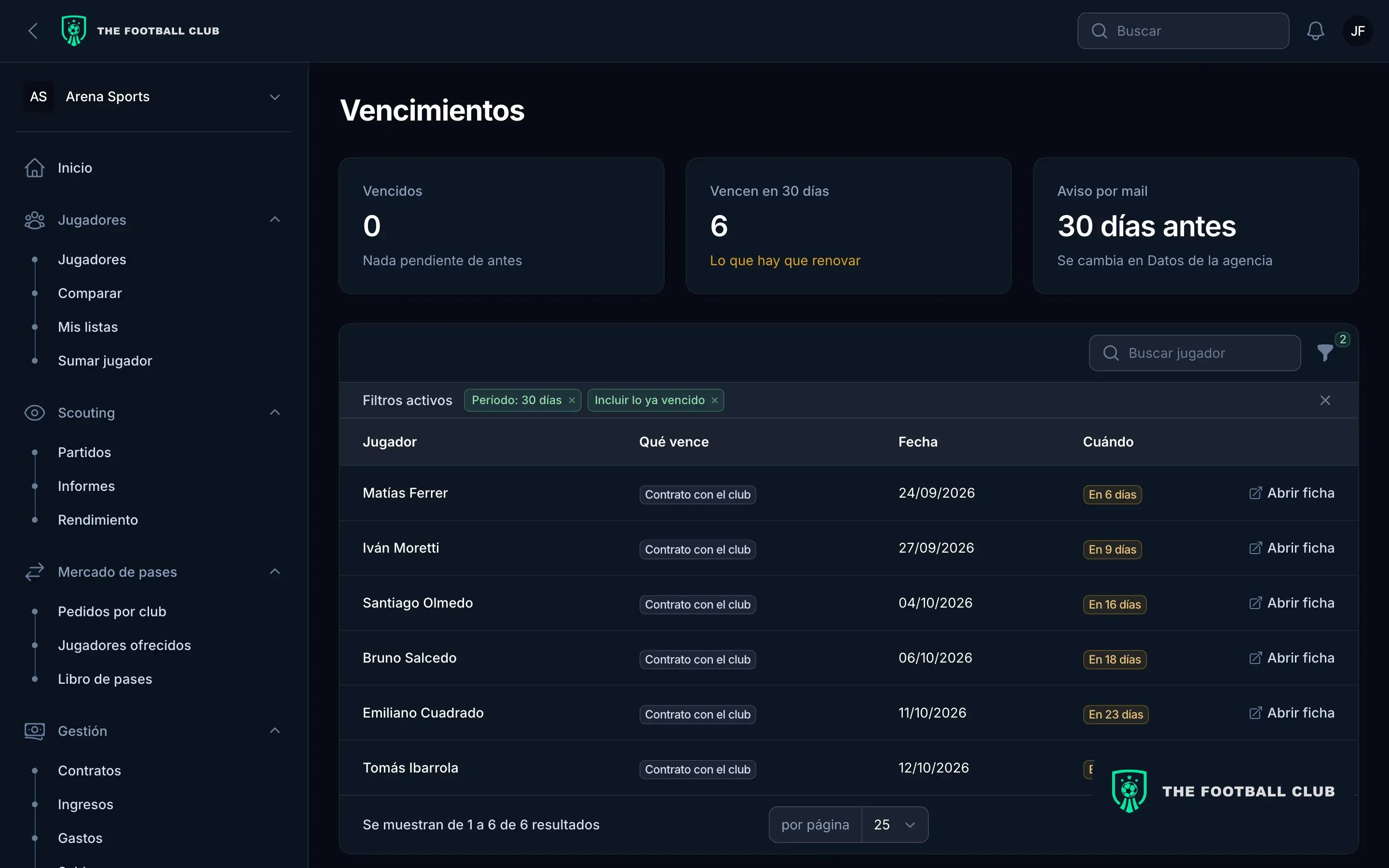
In The Football Club every contract is entered with its club, term and clauses, and expiry alerts flag what falls due in 30, 90 and 180 days with a traffic light. The protected period is not a field of its own: it is worked out from the date of birth and signing date already on the profile, and noted on the contract or in the notes.
What has changed and what may still change
The 2027 regulations carry their own transition rule (article 26): they apply to cases whose facts arose after they enter into force, and everything else is assessed under the previous regulations. What we do not settle here is how the two editions combine for a contract signed in 2026 and broken in 2027: that is a question for a specialist lawyer, as is any concrete dispute. Collective bargaining agreements and national federation rules can add nuances.
Sources
- FIFA, Regulations on the Status and Transfer of Players, January 2027 edition (PDF): definition of “protected period”, articles 13, 15, 17 and 26.
- FIFA, Regulations on the Status and Transfer of Players, January 2025 edition (PDF): definition of “protected period” and article 17.
- FIFA, Bureau of the Council news release on the new regulatory framework for the transfer system (approval of 10 June 2026, in force from 1 January 2027).
This note is for information and does not replace legal advice. Updated November 2026.