FIFA player passport: what it is and what it is for
By Mariano David Pérez Co-founder
The FIFA player passport is the document that records which clubs a footballer has been registered with since the calendar year of their 12th birthday. It is issued by the association that registers the player, not by the player or the club, and it has one job: showing which clubs trained the player and for how long, which is the basis for sharing out training compensation and the solidarity contribution. It has nothing to do with a travel passport.
The rule is article 7 of FIFA’s Regulations on the Status and Transfer of Players (RSTP), July 2025 edition. This article is current as of November 2026; FIFA has approved a new RSTP that applies from 1 January 2027.
What does a player passport contain?
Two versions exist side by side, and article 7 separates them by whether or not the case runs through the FIFA Clearing House:
| Player passport | Electronic Player Passport (EPP) | |
|---|---|---|
| When it applies | Cases outside the Clearing House | Cases that run through the Clearing House |
| Who produces it | The registering association, which hands it to the club | TMS, FIFA’s transfer system, from what the associations have submitted |
| What it shows | The player’s “relevant details” and the clubs they have been registered with | Association, status (amateur or professional), type of registration (permanent or loan) and clubs, with their training category |
| Starting from | The calendar year of the 12th birthday | The calendar year of the 12th birthday |
To build the EPP, associations must make “reliable, accurate and complete” registration information available to FIFA through the FIFA Connect Interface (art. 7.4).

What is the player passport used for?
Paying the clubs that did the training. When a player signs a first professional contract or moves between clubs of different associations, the receiving club may owe money to the earlier ones, and the split follows the career history set out in the passport (Annexes 4 and 5 of the RSTP). What is owed and how much is covered in our articles on training compensation and the FIFA solidarity mechanism.
The practical consequence follows directly: a year missing from the passport is a year the training club does not get paid for.
How is the Electronic Player Passport reviewed?
An EPP does not start out final. The FIFA Clearing House Regulations, January 2026 edition, set out this sequence:
- Provisional EPP. TMS generates it when a training rewards trigger is identified (art. 8.1).
- Inspection, 10 days. Every association and club can look at it; a club that is not listed and thinks it should be has to ask its association to be included (arts. 8.2 and 8.3).
- Review, 15 days. Associations request amendments, backed by proof of registration, the ITC and the employment contract (arts. 9.2 and 9.4).
- Final EPP. The registration information in a player’s first final EPP is binding on every later one (art. 10.6).
FIFA summarises the steps on its EPP page.
What should a club or agent keep on file?
Associations build the passport, but the evidence has to come from the club: each youth player’s registration and deregistration dates, the registration form and the contracts. An agent gains just as much from knowing a client’s path year by year, because training rewards go into the sums of any club thinking of signing him. The full list of paperwork is in football player documents: what to keep up to date.
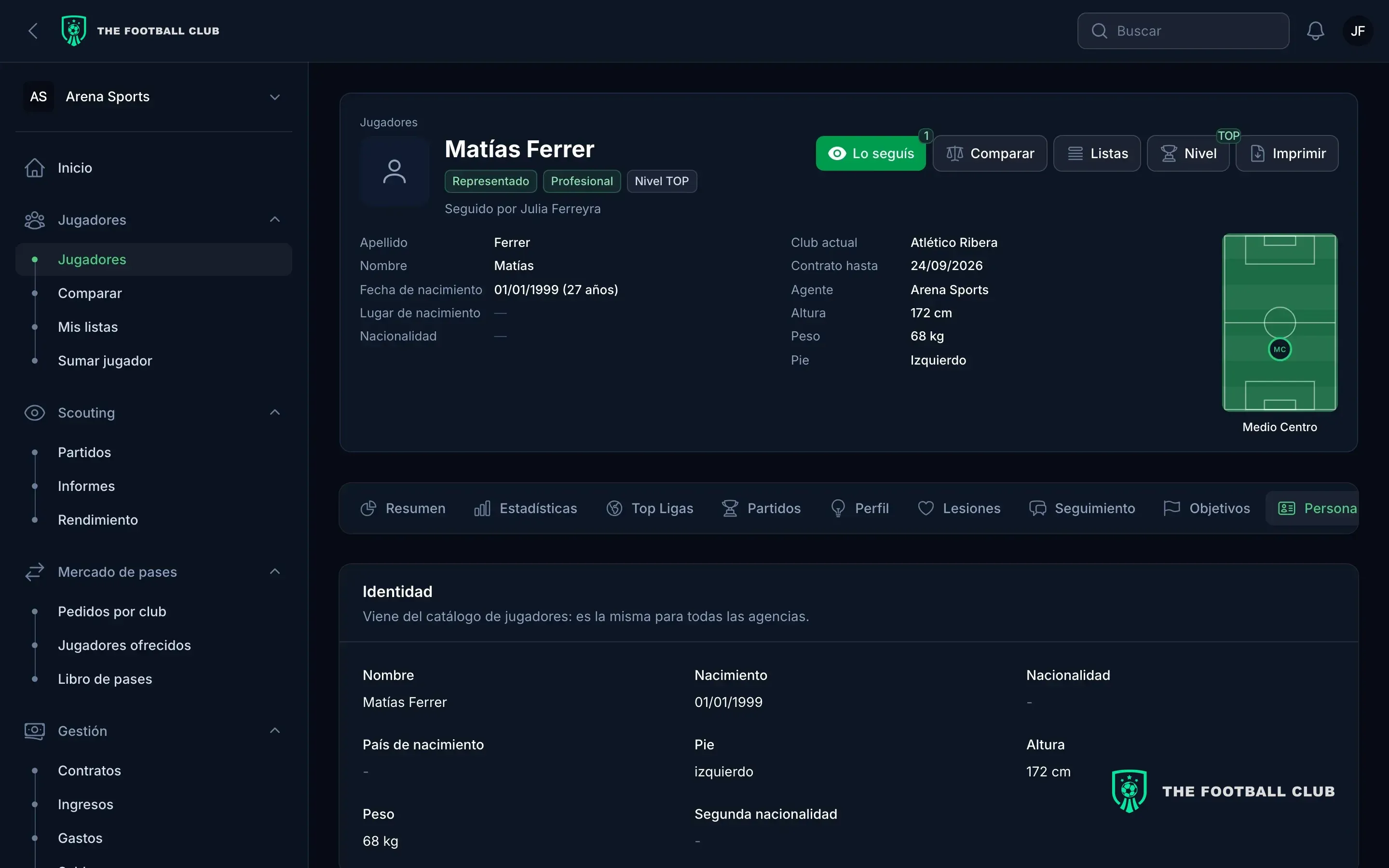
In The Football Club, the player profile holds each youth player’s age group, documents and files, and the panel for clubs keeps the academy alongside the first-team squad. It does not issue or replace the player passport — that belongs to the associations and FIFA — but it keeps to hand what you will need to submit when one comes up for review.
This article is for information only and is not legal advice.
Sources
- FIFA: Regulations on the Status and Transfer of Players, July 2025 edition (PDF): definition 34, article 7, Annexes 4 and 5.
- FIFA: Clearing House Regulations, January 2026 edition (PDF): articles 8, 9 and 10.
- FIFA: the Clearing House and the Electronic Player Passport.
- FIFA: Bureau of the Council approves a new regulatory framework for the transfer system (in force from 1 January 2027).