Federative and economic rights: the difference
By Mariano David Pérez Co-founder

Federative and economic rights are two different things that are often named together. The federative right is the player’s tie to a club before the association: the registration that lets him play official matches. The economic right is the money that tie generates when it is transferred: the transfer fee, a release clause or a percentage of a future sale. The terms are common in Latin America; FIFA’s regulations do not use them, but they do regulate what sits behind each one.
This note is current as of November 2026 and relies on FIFA’s Regulations on the Status and Transfer of Players (RSTP), July 2025 edition, and on the Brazilian law that defines them in writing. Article numbers follow the Spanish edition of the RSTP linked in the sources; check them against the English text.
What is a player’s federative right?
It is the player’s registration relationship with a club. The RSTP requires every player to be registered with an association, as a professional or an amateur, and only registered players with a FIFA ID are eligible for organised football (art. 5.1, Spanish edition). A player can also be registered with only one club at a time (art. 5.3).
That is why people say a club “holds the federative rights”: it is the club the player is registered with and plays for. Two practical consequences:
- It cannot be split. A player cannot be registered with two clubs at once, so the federative right belongs to the registering club, not to a group of investors.
- It follows the contract. Without a live contract there is no tie to transfer: a player who leaves on a free registers wherever he signs.
What is the economic right?
It is the economic value of the transfer: what the holder of the tie collects when the player changes club. Brazil’s General Sports Law defines it as any result or economic benefit arising from the temporary or permanent transfer of a professional athlete’s sporting tie between employing organisations, from payment of the sporting release clause, or from compensation for termination set by a competent body (art. 94 of Law 14,597/2023, Legisweb transcription, in Portuguese).
In practice it can include:
- a transfer fee, fixed or in instalments;
- add-ons tied to targets;
- the release clause paid by the buying club (see what a release clause is);
- a sell-on fee, the percentage the selling club keeps from a future sale; the RSTP treats it as one more payment that clubs declare in the TMS (annex 3).

What is the difference between federative and economic rights?
| Federative right | Economic right | |
|---|---|---|
| What it is | The player’s registration with a club before the association | The money value of a future transfer |
| What it is for | Playing official matches | Collecting when the player is sold |
| Can it be split? | No: one club at a time | Between clubs, yes (sell-on fee) |
| Can a third party hold it? | No | No, under the RSTP (art. 18ter) |
| In the RSTP | Yes, art. 5 onwards (registration and transfers) | Only to ban its sale to third parties |
The confusion comes from both being “the club that owns the player”. One is an administrative position and the other is money to collect. The first cannot be fragmented; the second can, between clubs.
Can a third party own a player’s economic rights?
Not if that third party is not a club. Article 18ter of the RSTP bars any club or player from signing a contract with a third party that entitles it to share, in whole or in part, in the value of a future transfer, or that gives it rights tied to future signings. The ban has applied since 1 May 2015, and earlier contracts could only run to their expiry, with no extension.
This is the core of the third-party ownership debate, and FIFA treats it alongside article 18bis, which forbids contracts giving third parties influence over a club’s employment and transfer matters. FIFA published a manual on third-party influence and ownership explaining how it interprets both articles, with FIFA and CAS case law. For international transfers, clubs must even declare in the TMS whether there is third-party influence or ownership over the economic rights (annex 3 of the RSTP).
What happens in each country with arrangements that fall short of a share in the transfer depends on national law and the association: in Brazil, for instance, the law itself sends the trading of economic rights to the rules of each sports organisation and to international regulations (art. 94, sole paragraph). For a specific case, ask a sports lawyer.
How do they relate to other payments in a transfer?
Do not mix them up with other amounts that are also paid around a transfer:
- Training compensation: paid to the clubs that trained the player, even with no transfer fee. See training compensation.
- Solidarity mechanism: 5% of a transfer with a live contract, shared among training clubs. See the solidarity mechanism.
Neither is the selling club’s “economic right”: they come out of the same move but have their own formula and their own recipients.
What should an agent know?
- Check who signs what. A contract promising a third party a percentage of a player’s next sale is a problem for FIFA; do not draft or recommend one without legal review.
- Keep every contract’s economic terms in order. Sell-on fees, add-ons, clauses: each has a date and a condition, and they are easy to forget.
- Do not confuse commission with an economic right. What an agent earns for the work is a separate matter, covered in how much football agents earn.
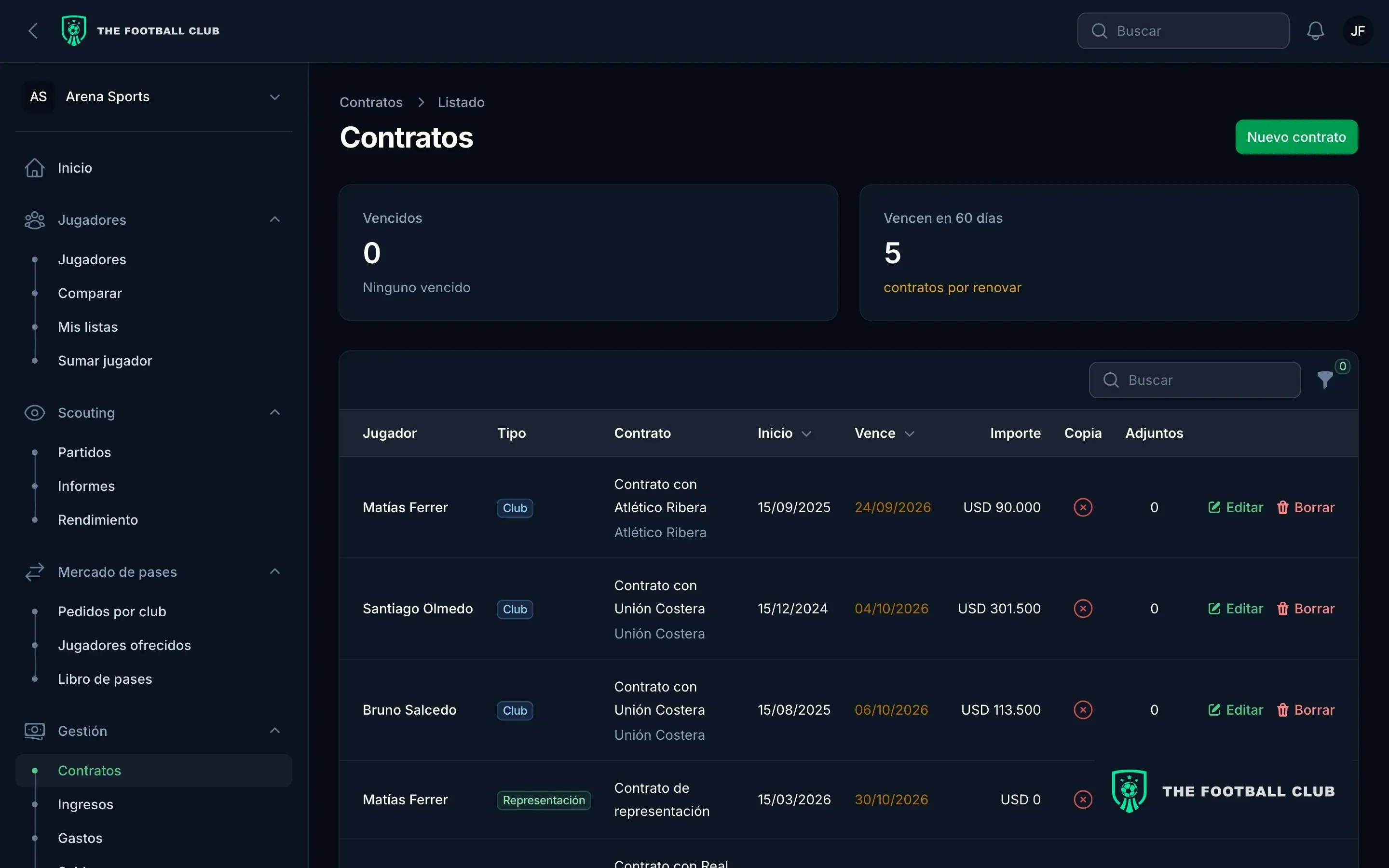
In The Football Club, each player has a profile and contracts and commissions are logged with their term, amount and attachments, and the panel for agencies alerts you to expiries. It does not record federative or economic rights as such, since the association and the contracts define those, but it keeps at hand when each contract ends and what was signed.
In short
The federative right is the player’s registration with a club; the economic right is the money his transfer generates. The first belongs to one club at a time; the second can carry clauses between clubs, but the RSTP has banned sharing it with third parties since 2015.
This note is informational and is not legal advice.
Sources
- FIFA: Regulations on the Status and Transfer of Players, July 2025 edition (PDF, Spanish): arts. 5, 18bis and 18ter, annex 3.
- FIFA: first manual on third-party influence and ownership, media release of 9 September 2020.
- Law 14,597/2023 (General Sports Law, Brazil), art. 94: Legisweb transcription (in Portuguese).