Dual representation: when a football agent can be paid by two sides
By Mariano David Pérez Co-founder

Dual representation football agents is the narrow exception under which one agent acts for both the player and the club engaging him in the same transaction. The FIFA Football Agent Regulations allow it only with the prior, explicit, written consent of both clients, and with a fee cap of its own. Any other mix of parties in one transaction is prohibited.
One caveat before going further: in December 2023 FIFA suspended these rules worldwide, and the matter is still in the courts. The section on whether the rule applies today sets out what could be verified.
What is dual representation and when is it permitted?
It means representing both the individual (the player or coach) and the engaging entity (the club taking them on) in the same transaction. Under Article 12 of the regulations, the general rule is that in a single transaction an agent may act for only one party. The exception: the agent may provide services to the individual and the engaging entity if both clients give prior, explicit consent, recorded in writing.
Two words in that text carry more weight than they seem to:
- Prior: the consent is signed before the services start, not after the deal has gone well.
- Both clients: it is not enough for the player to sign, nor for the club to be aware. Each has to say yes in writing.
Which combinations are prohibited?
The same Article 12 closes off everything else. In one transaction, an agent may not act for:
| Combination | Allowed? |
|---|---|
| Only the player, or only a club | Yes, the normal case |
| Player and engaging club | Only with prior written consent from both |
| Selling club (originating entity) and player | No |
| Selling club and buying club | No |
| All parties to the deal | No |
Splitting the work does not get around it: the regulations say an agent and a connected football agent may not provide services to different clients in the same transaction, except in the permitted dual representation case. Two partners in one agency cannot each take a side.

How much can an agent charge when representing both sides?
Article 15 sets a specific cap: 10% of the individual’s annual remuneration up to USD 200,000, and 6% on the part above it, against 5% and 3% when acting for one party. Variable payments, such as performance bonuses, are not counted. On who pays, Article 14 adds that the club may pay no more than 50% of the fees due.
With the table in hand, the sums are simple arithmetic (illustrative figures, not a real case):
- A player on USD 150,000 a year: a 10% cap, so USD 15,000 a year, of which the club may pay up to USD 7,500.
- A player on USD 1,000,000 a year: 10% of the first 200,000 (USD 20,000) plus 6% of the remaining 800,000 (USD 48,000): at most USD 68,000 a year, with up to USD 34,000 payable by the club.
The cap is a ceiling for the total, not an entitlement: what is actually charged is set in the representation agreement, and fees are paid in instalments against an invoice, as explained in how much football agents earn.
What must the agent do to stay compliant?
The exception is tight and the regulations ask for more than a signature:
- Get both consents before providing any service, in writing and from each client.
- Disclose the conflict of interest. Article 16 prohibits concealing material facts from a client and names failing to declare a conflict of interest, even if the conflict is permitted under the regulations. Dual representation is by definition a permitted conflict: it has to be declared.
- Act in each client’s best interests. The same article requires acting in the best interests of the client or clients and avoiding conflicts of interest. With two clients negotiating against each other, that is the hardest duty to honour.
- Do not dress up other services. Under Article 15, if in the 24 months before or after a transaction an agent provides other services to a client involved, those are presumed to be representation services for that transaction unless proven otherwise.
- Document everything. Article 16 also requires uploading contracts with clients, including those for other services, to the FIFA platform within fourteen days of signing (this duty was among those suspended, see below).
To build your own record, the checklist in what to keep on file under the FIFA agent regulations is a good start.
Does the rule apply today?
There is no single answer, which is why it pays to check before acting. What the official sources say:
- On 30 December 2023 FIFA suspended worldwide, until the Court of Justice of the European Union ruled definitively, several provisions of the regulations, among them the prohibition on dual representation (Article 12, paragraphs 8 to 10), according to its Circular 1873. It also recommended that member associations suspend the equivalent provisions of their national agent regulations, unless these conflict with mandatory local law.
- On 16 July 2026 the Court of Justice of the EU ruled in case C-209/23 (RRC Sports). According to its press release, rules restricting multiple representation are an obstacle to the freedom to provide services, but that obstacle may be justified, for example to avoid conflicts of interest. Whether it is justified is for the German court that referred the case.
What could not be verified is whether FIFA lifted the suspension after that ruling, or what each national association says today. Before accepting or proposing a dual representation, check FIFA’s current circulars and your association’s own regulations.
How do you keep control inside an agency?
The practical risk of dual representation is not the theory but the paperwork: two consents, a representation agreement, a fee split between two payers and an expiry date nobody watches. The minimum is that, for each player, it is easy to see what was signed, with whom and what was collected from each side.
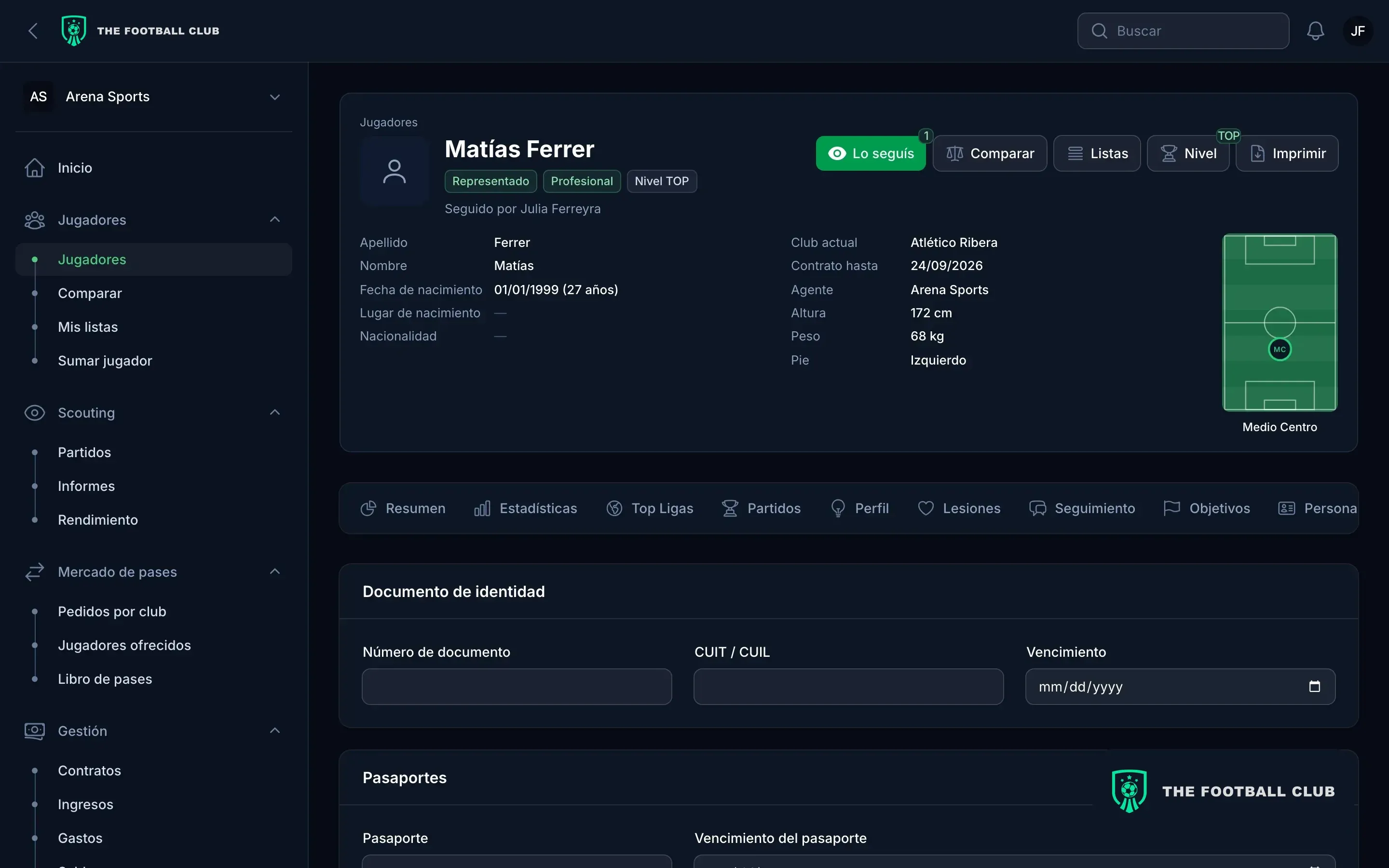
In The Football Club, the player profile has a documents and files tab, where you can keep the signed consent next to the rest of the player’s paperwork. And in contracts and commissions each contract carries its collected and pending commissions. To see how it fits the rest of an agency’s work, there is the page for football agents and the parent guide on how to organise a football agency.
In short
In FIFA’s text, dual representation is lawful only between the player and the engaging club, with prior written consent from both, a 10% and 6% fee cap and no more than 50% paid by the club. Its application has been suspended since 2023 and the 2026 European ruling did not settle the matter, so the prudent course is to check the rules in force and put everything in writing.
This article is for information and is not legal advice. It is based on the FIFA Football Agent Regulations, edition in force since 1 January 2025, and the official sources listed below, consulted on 17 November 2026.