What is a buy-back clause in football?
By Mariano David Pérez Co-founder
A buy-back clause is a term in a transfer agreement that lets the selling club buy the player back later, at a price or by a formula fixed on the day of the sale. The right belongs to the selling club, not the player, and it can only be used within the window or at the moments the agreement sets. If the club does not use it, the clause lapses and the player moves on.
How does a buy-back clause work?
It is written into the agreement between the two clubs and usually settles three things: how much must be paid (a figure or a formula), when it can be exercised (a transfer window, a season) and how notice is given.
When it is exercised, it is a new transfer, with its own contract for the player. It is not a loan: in a loan the player returns to his club when the spell ends; here he left permanently, and coming back needs the club to pay and the player to sign.
What do FIFA’s rules say about buy-back clauses?
FIFA’s Regulations on the Status and Transfer of Players (July 2025 edition) do not mention buy-back clauses: they neither define nor ban them. What they set are the limits within which clubs can agree one:
- Article 18bis bars contracts that let the counter club, or any third party, influence another club’s employment and transfer matters, its independence, its policies or the performance of its teams. A buy-back that fixes a price and a deadline is one thing; one that gives the seller a say in the buyer’s decisions can collide with this article.
- Article 18ter bars third parties from sharing in the value of a future transfer. The regulations define a “third party” as anyone other than the player, the two clubs in the transfer or any previous club he was registered with: a selling club falls inside that exception, a fund or an intermediary does not.
- Annexe 3, article 10, which lists the types of payment a club declares in the TMS system, names a fixed fee, a release (buy-out) fee, conditional fees and a sell-on fee, and does not include a buy-back. The regulations do not treat it as a separate payment, so the agreement itself has to state the amount and the conditions clearly.
That is as far as the regulations go. Which deadlines and forms are valid in each country depends on the federation and league of the two clubs, and is a matter for a lawyer.
How is it different from a release clause and a sell-on clause?
All four involve money and a future move by the player, but who holds the right, and what happens when it is used, differ.
| Who holds the right | What it does | Where it is written | |
|---|---|---|---|
| Buy-back clause | The club that sold | Buys the player back at an agreed price | Transfer agreement between clubs |
| Release clause | The player, by paying the amount | Breaks his contract and leaves | The player’s contract |
| Sell-on clause | The club that sold | Takes a share if the player is sold again; does not get him back | Transfer agreement between clubs |
| Option to buy | The club receiving a loan | Turns the loan into a permanent transfer | Loan agreement between clubs |
A buy-back and an option to buy are siblings pointing in opposite directions: with an option the player is on loan and the borrowing club can buy him; with a buy-back he has already been sold and the seller can recover him.
For an agent there is a commission detail. FIFA’s Football Agent Regulations leave compensation for breach of contract and sell-on fees out of the base for the selling club’s service fee; they do not mention a buy-back, so if your fee depends on a future transfer, put in writing what happens if it is exercised. Those caps are also suspended for now, as we explain in how much football agents earn.
How to record a buy-back clause in The Football Club
A buy-back right with a deadline is the kind of clause that is forgotten until the other club calls. In The Football Club each contract is entered with its club, term, amount and a summary of its clauses, visible from the player’s profile; that is where to note, for example, “selling club buy-back at EUR 2,000,000 until June 2028”.
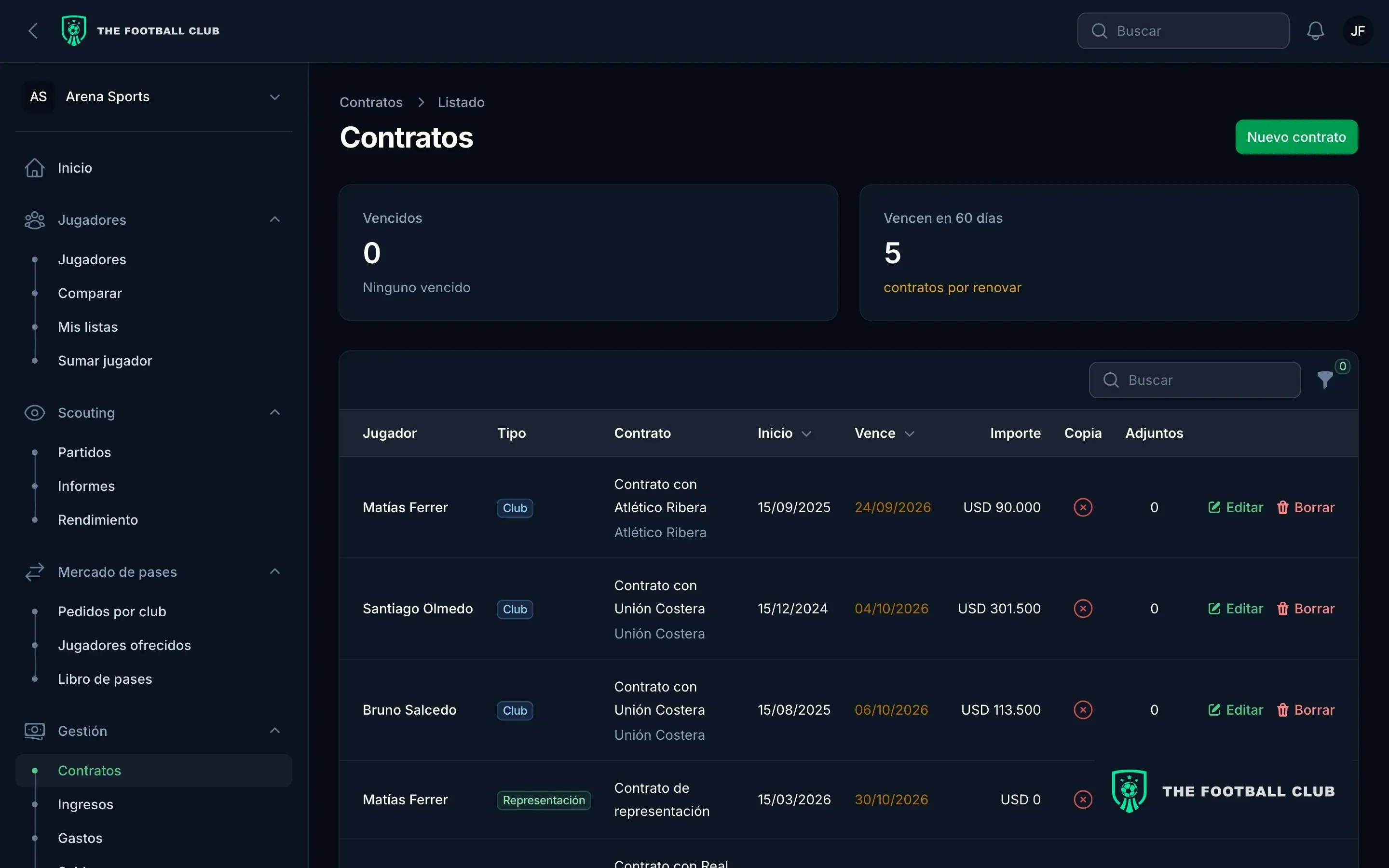
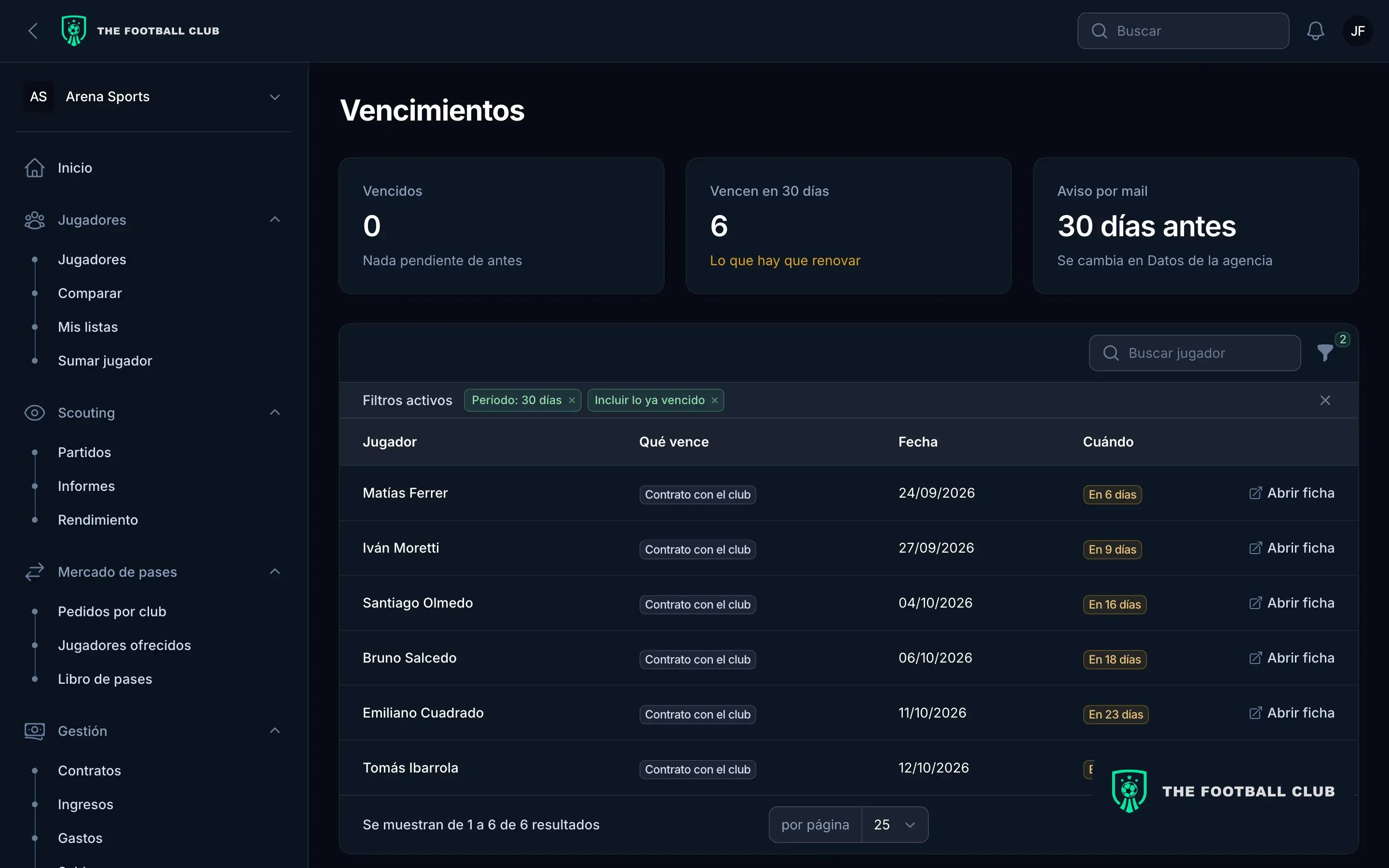
The contract expiry alerts follow contract dates; the buy-back deadline goes in the clause summary, and is worth reading next to the date the player’s contract ends.
Sources
- FIFA: Regulations on the Status and Transfer of Players, July 2025 edition (PDF): articles 18bis and 18ter, the definition of “third party” and Annexe 3, article 10.
- FIFA: Football Agent Regulations (PDF): article 15, the base for the service fee.
- FIFA: circular 1873 on the implementation of the agent regulations (PDF).
This note is informational and does not replace legal advice. FIFA’s regulations have no official definition of a buy-back; the description of how one is agreed reflects common practice between clubs. Updated November 2026.