What is xA in soccer: expected assists, no formulas
By Mariano David Pérez Co-founder

If you are asking what is xA in soccer, the short answer is this: expected assists measures how much goal there was in a player’s passes. Every pass gets a value between 0 and 1, and the total says how many assists that player “deserved” for what they created, whether the team-mate scored or put it wide.
How is xA worked out?
It depends on who measures it, because there are two ways of doing it and they do not give the same number.
| Provider | What it values | Which passes count |
|---|---|---|
| Opta | The likelihood that a completed pass becomes an assist | Every completed pass, shot or no shot |
| Wyscout | The xG of the shot that the pass led to | Only the last pass before a shot |
Opta defines its model as the likelihood that a completed pass will become a goal assist, based on the type of pass, where it ends and how long it is. Its explainer adds that the model rewards players who pass into dangerous areas, whether or not the receiver shoots.
Wyscout ties it to the shot: the xA of a pass is the xG of the shot that pass led to. Crosses, corners, throw-ins and passed free kicks count too; fouls won that end in a penalty or a direct free kick do not. If the team-mate never shoots, the pass adds nothing. How each shot gets its value is covered in what is xG in soccer.

How is xA different from an assist?
An assist depends on somebody else finishing; xA does not. A midfielder can put his striker through on goal three times and end the game with no assists, or pick one up for a five-yard pass that a team-mate smashed in from outside the box.
Opta illustrates it with two Liverpool full-backs in the 2019/20 Premier League: Trent Alexander-Arnold finished with 13 assists and Andy Robertson with 12, but in open play Alexander-Arnold’s passes were worth 7.1 xA and produced 6 assists, while Robertson’s were worth 4.9 and produced 10. The first created more than the scoresheet gave him credit for; the second, less.
What does xA tell a scout?
It tells you whether a player creates good chances, whoever is on the end of them. To read it properly:
- Per 90 minutes, over a season or more: across a handful of matches it is noise.
- Within a single source. Opta’s xA and Wyscout’s measure different things.
- Open play apart from set pieces, when the provider splits them: whoever takes every corner inflates his number.
- With the video alongside. xA does not see the pass before the last one, nor the ball a team-mate failed to control (in the shot-based model).
Which positions it matters most for is in soccer metrics by position.
Where xA sits in The Football Club
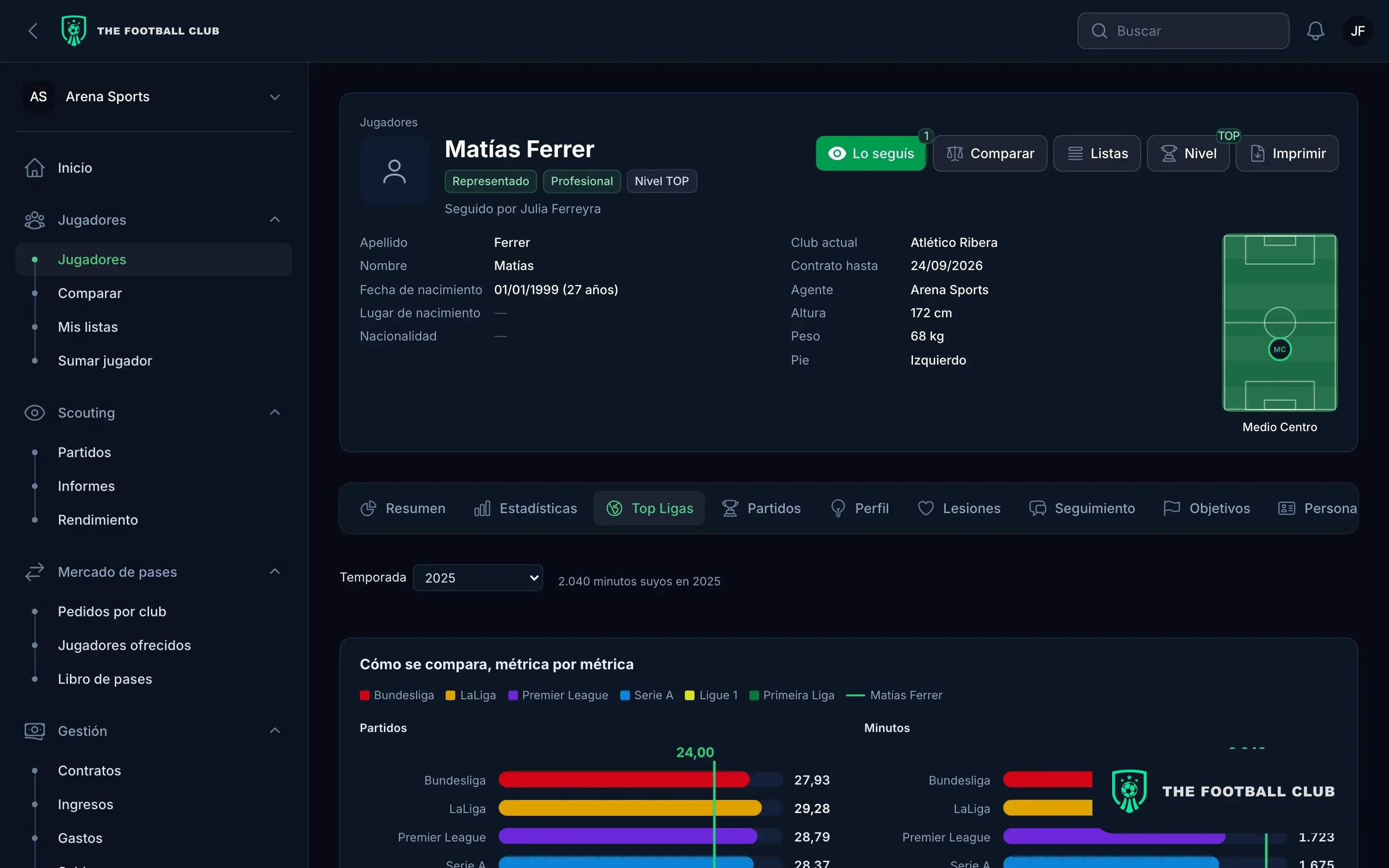
In the player profile the numbers live next to the games and your scouts’ reports, and every metric is compared with the average for the position in the world’s six best leagues. If you work with Wyscout, you upload your export and it lands in the same place, with each block saying which source it came from, so figures from two models never get mixed.
Updated November 2026.
Sources
Consulted in November 2026:
- Opta, The Analyst: What are expected assists (xA)?.
- Opta, The Analyst: Opta soccer stats definitions.
- Wyscout, data glossary: xA.