What does a soccer player agent do?
By Mariano David Pérez Co-founder

A soccer player agent is the person who negotiates with clubs on the player’s behalf — their contract, their transfer, their renewal — and advises them on everything around that negotiation: which club suits them, when to move, what to sign and what not to. FIFA calls them a soccer agent, and since 2023 only someone holding a FIFA license may do that work. The rest of what an agent does — advice, sponsorships, image rights — anyone can offer; sitting down to negotiate a contract for the player, only a licensed agent can.
Updated 5 November 2026. The regulatory content comes from the FIFA Football Agent Regulations (edition in force since 1 January 2025) and from circular 1873, which suspended some articles. This article is written for players and their families; if what you want is the license, the route is in how to become a soccer agent.
What exactly does a soccer player agent do?
The FIFA regulations split the job in two. Soccer agent services are any “soccer-related services performed for or on behalf of a Client, including any negotiation, communication relating or preparatory to the same” with the purpose of concluding a transaction: a contract with a club, a transfer, a loan. Other services are what the player may hire the agent for on top: the regulations name legal advice, financial planning, scouting, consultancy, management of image rights and negotiating commercial contracts.
In practice, working with a player looks like this:
| Area | What the agent does | When |
|---|---|---|
| Career | Helps decide which club to join, when to renew and when to move; tracks how the player is playing and how many minutes they get | All year |
| Contracts | Negotiates salary, length, bonuses and release clause with the club; reviews every document before the player signs | Renewals and transfer windows |
| Clubs | Keeps the relationship with sporting directors and recruitment staff, offers the player, receives and passes on offers | All year, daily during the window |
| Support | Is there when the player is not playing, gets injured or changes country; coordinates with the family | All year |
| Image and commercial | Negotiates sponsorships and image-rights deals, if the player asks | Case by case |
The first two rows are soccer agent services, which require the license. The last one is an “other service”. And the two in the middle are the part nobody sees from outside: negotiation takes up a few weeks a year, and the rest is follow-up. How that week is organized is in soccer agent daily tasks.
Who can be a player’s agent?
Only a soccer agent licensed by FIFA. Article 11, paragraph 1, of the regulations says it in one line: “Only a Soccer Agent may perform Soccer Agent Services.” Article 12, paragraph 2, adds that only they may approach a player to sign a representation agreement.
That changed in 2023. Before, registering as an intermediary with a national association was enough; today there are eligibility requirements, an exam and an annual fee. According to FIFA’s Football Agents Report 2025 (December 2025), as of 4 December 2025 there were 10,525 licensed soccer agents worldwide, and 69% of them were authorised to represent minors.
An agent may work through an agency, but the regulations are clear about the team around them: agency employees who are not agents may not negotiate or approach a player to sign them, and the agent is responsible for whatever they do (article 11, paragraph 3). The scout who watched you play or the administrator who sends your paperwork is not your agent, even if they work with them. Who does what inside an agency is in roles in a soccer agency.

How do you check that an agent is licensed?
By looking them up in FIFA’s public directory. FIFA’s agents page links to the directory of licensed agents, which lists everyone with a current license. It is a two-minute check, and the regulations in fact ask the player to make it: article 18, paragraph 1 c), requires clients to “satisfy themselves that a Soccer Agent is appropriately licensed by FIFA prior to signing the relevant Representation Agreement”.
Two more signs, beyond the license:
- They ask for a written contract. Without a signed representation agreement, they cannot represent you (article 12, paragraph 1). Someone negotiating for you “on a handshake” is not working within the regulations.
- They recommend a lawyer before you sign. Article 12, paragraph 4, obliges them to advise you in writing to seek independent legal advice on the agreement, and to keep your written reply. An agent who skips that step is skipping the regulations.
What is a player agent not allowed to do?
The regulations set concrete limits, and knowing them is the best way to tell whether yours is doing the job properly:
- They cannot sign you for more than two years. A representation agreement with a player lasts at most two years and does not renew itself: a new agreement has to be signed (article 12, paragraph 3). What that agreement must say is in the guide to the representation agreement.
- They cannot stop you negotiating on your own. Article 12, paragraphs 12 and 13, voids any clause that restricts or penalizes you for negotiating a contract without them. You have the right to do so; if you do, it must be stated in the contract with the club.
- They cannot approach a player who already has an agent. If you have an exclusive agreement with another agent, no agent may contact you, except in its final two months (article 16, paragraph 1 b).
- They cannot act for both sides without your knowledge. In a single transaction they may act for only one party; the sole exception is representing you and the club signing you, with the prior written consent of both (article 12, paragraph 8). That limit on dual representation is among the articles FIFA provisionally suspended through circular 1873, so it is worth asking anyway.
- They cannot charge for a minor until that player signs their first professional contract, and before approaching a minor they need the parents’ written consent and a specific course (articles 13 and 14, paragraph 9). The detail is in soccer agents for minors.
And one duty they owe every client: to always act in the best interests of their client (article 16, paragraph 2 a). It is the sentence that sums up the rest.
How much does a soccer player agent charge?
A percentage of what the player earns, agreed in the representation agreement. The regulations set caps in article 15 — 3% or 5% of the player’s pay depending on the amount, when the agent represents the player — but those caps have been provisionally suspended worldwide since 30 December 2023 under circular 1873, pending a final ruling by the European courts. Today, then, the percentage is whatever is negotiated, and it should be written down clearly: what it is calculated on, when it is paid and what happens if the player moves club early. The full picture, with the caps and who pays, is in how much soccer agents earn.
What does remain in force: the player has the right to ask the agent for a schedule detailing all payments made by them or regarding them, fees and expenses included (article 18, paragraph 1 e). An agent who keeps tidy books hands it over without fuss.
Does a player have to have an agent?
No. The FIFA regulations say so plainly: “A Client may negotiate and conclude a Transaction without engaging a Soccer Agent” (article 12, paragraph 12). Any footballer can negotiate their own contract, and many do in the lower divisions.
Where an agent adds value is in what the player cannot do while training and playing: knowing what each club is looking for, knowing what the going rate is in their division, reading a contract with clauses that are not obvious at first glance, and holding a negotiation without it spilling into the dressing room. What to ask before you sign deserves an article of its own, coming in the next few days.
How a soccer agency works on the inside
On the agent’s side, everything described above rests on records: each player’s profile with their contract and its dates, a log of every conversation with a club, the fees agreed and collected, the expenses of every trip. A small agency keeps it in a spreadsheet; past ten clients, dates start slipping through. How to put that in order is in how to organize a soccer agency.
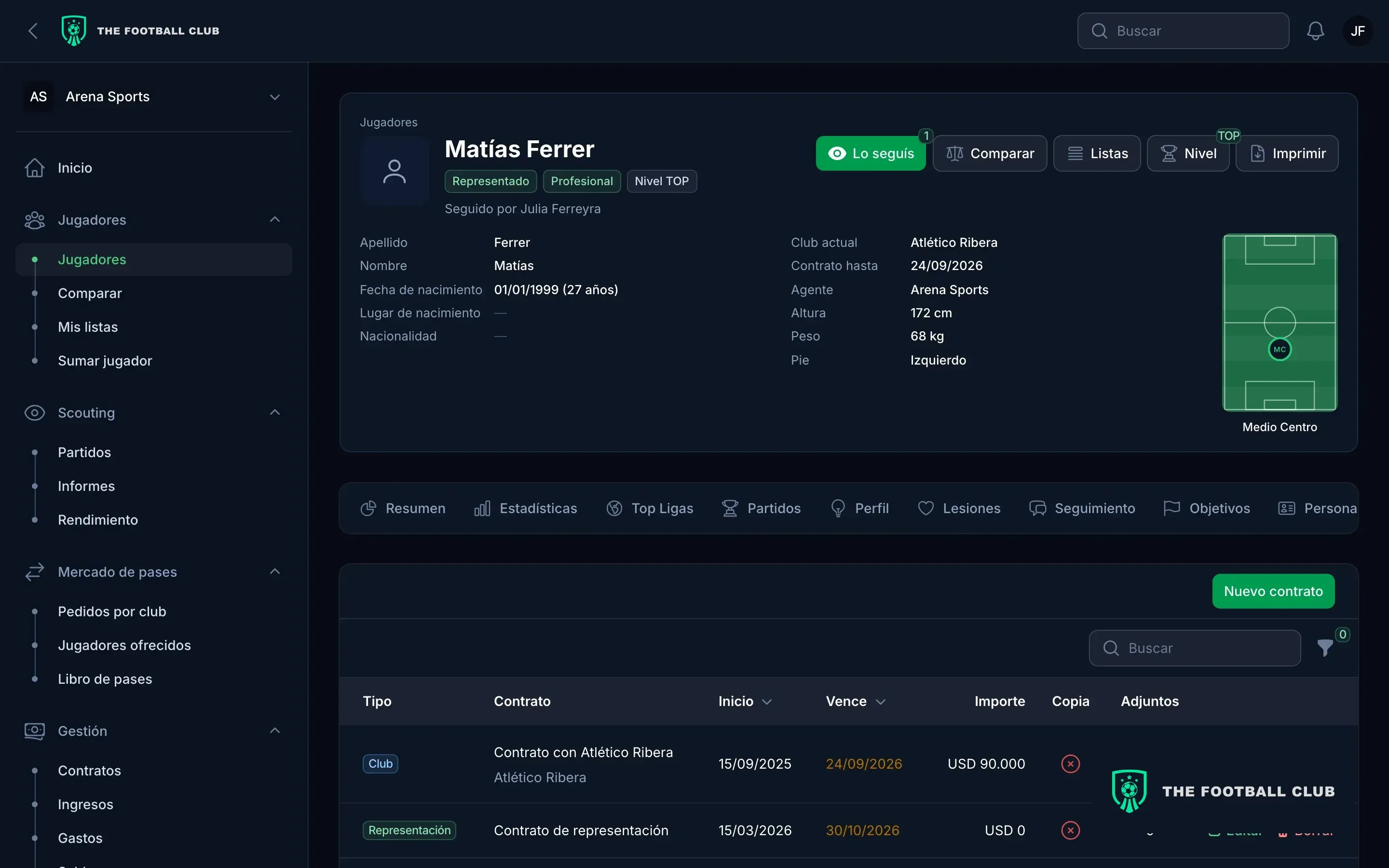
In The Football Club, with the data of a demo agency, that work lives in the player profile — contract, representation, documents, follow-up — and in contract expiry alerts, which email every morning about any contract entering its final six months. And the payment schedule the player is entitled to request comes out of contracts and commissions without rebuilding it by hand. How an agency works with the platform is on the app for managing players.
In short
A soccer player agent negotiates with clubs on the footballer’s behalf and supports them through their career; to FIFA they are a soccer agent and may only do so with a license, which you can check in the public directory. The representation agreement lasts at most two years, cannot stop you negotiating on your own, and the agent must always act in your interest. They charge a percentage of your pay, currently with no cap in force, and owe you a breakdown of every payment when you ask. And having an agent is not compulsory: it is the player’s decision.
This article is for information only and does not replace legal advice. The regulatory content was checked against the FIFA editions cited at the top, as at November 2026; the articles suspended by circular 1873 may come back into force once the pending proceedings are resolved.
Sources
- FIFA Football Agent Regulations, in force since 1 January 2025 (PDF) — definitions and articles 11, 12, 13, 14, 15, 16 and 18
- FIFA circular 1873: update on the implementation of the regulations (PDF, 30 December 2023)
- FIFA Football Agents Report 2025 (PDF, December 2025) — number of licensed agents
- FIFA agents page and directory of licensed agents