Scouting report template: the fields it needs and why
By Mariano David Pérez Co-founder
A scouting report template has five blocks: the player’s details, the game context, the qualities being assessed, the ratings and a recommendation. Each field is there so that two reports, written by two people at two different grounds, can be compared. Below is the template field by field, with the reason for each one, and a short version you can copy.
There is no official format. The closest thing to a public reference is the talent identification guide on the FIFA Training Centre (module 3, November 2024), which publishes two example observation tools, a long one and a short one, and stresses that every organization should build its own around its philosophy and profiles. This article starts from that base. How to write the report once the template exists is covered in how to write a soccer scouting report clubs will read.
Which fields does a scouting report template need?
FIFA’s guidance on creating player observation tools says the form should capture three things — biographical information, event context and the key qualities the organization prioritises — and add a rating scale and a recommendation section. Laid out as a template, that gives:
| Block | Fields | Why they are there |
|---|---|---|
| Report details | Who wrote it, date submitted, watched live or on video | A report with no author or date cannot be weighed or placed in the player’s history |
| Player details | Name, date of birth, nationality, club, leading foot, primary and secondary position, shirt number | So he is not mistaken for someone else, and so you know which position he is judged against |
| Match context | Date, competition and level, home and away teams, score, each side’s formation, quality of the game, minutes played | What you saw is worth more or less depending on the opponent, the level and how long he played |
| Key qualities | Tactical, technical, physical and psychological, each with a rating and a comment | The body of the report: what was observed, split by area |
| Moments of the game | Attacking, defending and both transitions | Forces the scout to watch the player when he does not have the ball |
| Ratings | Overall rating and potential rating | Separates what the player is today from what he could become |
| Recommendation | Next step and general comment | Without it, the reader has to decide with less information than the person who watched |
Nearly all of those fields appear, under similar names, in FIFA’s long player observation tool. For youth players that form adds two more: birth quarter and observable maturation. The reflection checklist in the same module asks whether reports consider each player’s relative age and maturation status: a boy born in January and one born in December play in the same age group almost a year apart.
Why are the qualities split into four areas?
Because a single mark hides too much. A “6” can be a technically tidy player who is late to every challenge, or one who runs all match and chooses badly. FIFA’s form separates tactical understanding, technical skills, physical attributes and psychological factors, and asks for a comment on each: game understanding and decision-making, technical execution, physical potential, and growth mindset and learning ability.
The English FA frames player development in a similar way in its 4 Corner Model — technical/tactical, physical, psychological and social — and notes that no one corner works in isolation. For a template that means two things: all four areas have to be on the page, even when there is little to say about one, and the general comment is where they get tied together.
Within each area, the specific attributes change with the position. One template for goalkeepers and wingers ends up with half its boxes empty; a common base plus a list of attributes per position works better. What to look at in each one is in soccer metrics by position.
Do you need both a long and a short template?
Yes, if your team does both jobs. FIFA’s guidance separates observing a single player, which calls for a detailed report with examples of specific actions in the game, from observing several players or a talent identification event, which calls for a broader but systematic evaluation with shorter reports.
The example short tool keeps the player details, the game information, the overall rating, the potential rating and the recommendation, and swaps the long write-up for a grid of a few attributes, each with a rating and a line of notes. A working rule: the short one decides who is worth a second look; the long one decides what to do about a player you have already watched several times.
Which rating scale goes on the template?
The one your team has defined in writing. FIFA accepts several forms — colour codes, a numerical 1–4 or 1–10 — and its own examples use four named levels: “below level”, “potential, can be developed”, “core player” and “exceptional player”. What is not optional is that every value has a definition everyone reads the same way, and that today’s level and potential sit in separate boxes: the module’s checklist asks exactly that, whether a grading system with clear definitions is in use and whether grades consider both performance and potential.
A scouting report template you can copy
This is the minimum version. Position-specific attributes go under each area.
- Report: author · date · live or video · how many times you have now seen him
- Player: name · date of birth · club · leading foot · primary position · secondary position
- Match: date · competition · opponent · score · team formation · position played · minutes
- Conditions: anything that distorted the game (red card, field, change of role)
- Tactical: rating · one observation with its minute
- Technical: rating · one observation with its minute
- Physical: rating · one observation
- Psychological: rating · something he did, not an adjective
- Overall rating · potential rating
- Recommendation: sign, keep watching, watch again in a different context, or drop
- General comment: two or three lines
The “how many times you have seen him” field is not on FIFA’s forms, but it answers another question on its checklist: whether players are observed multiple times before a recommendation is given.
How the template looks in The Football Club
The same FIFA checklist asks whether there is a database or software to collect reports and track players. A template on paper or in a document settles the format, not the archive.
In The Football Club the template is the game report form. The player and the schedule are picked from the catalog, so biographical details and context are not typed again. You record how he featured (started, came on, unused substitute, not in the roster), minutes, goals and cards; you grade the attributes for his position from 1 to 10; and the report closes with an overall rating, the comments and a “highlight” flag.
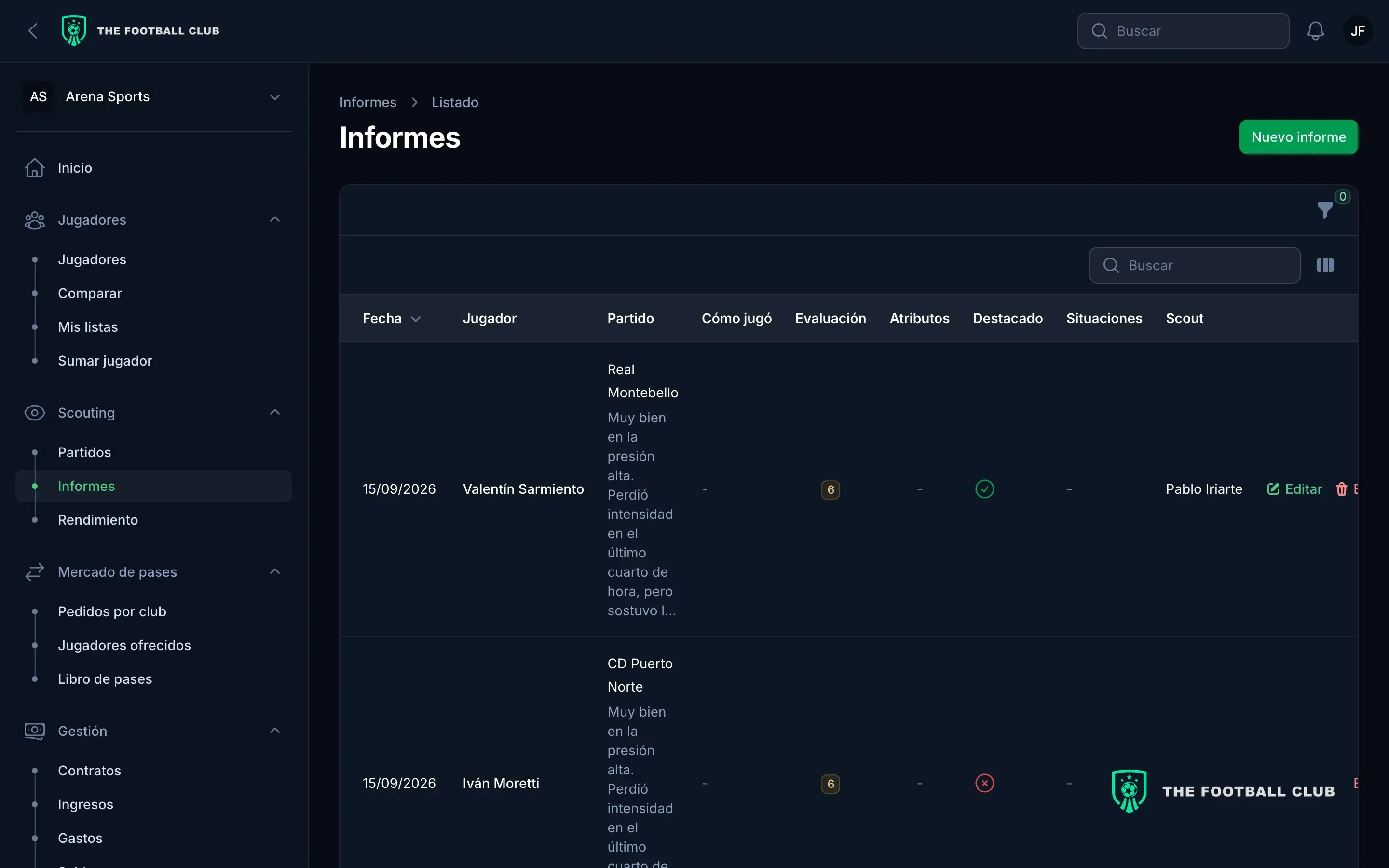
Every report is signed and attached to the player profile, next to the earlier ones, which is what lets you see whether the third viewing confirms the first. How that work is shared between a coordinator and the scouts is on the page for soccer scouts.
Updated November 2026. There is no official scouting report template: the FIFA tools cited here are examples for each organization to adapt.
Sources
- FIFA Training Centre: Talent Identification Guide, Module 3 (7 November 2024).
- FIFA Training Centre: Creating Player Observation Tools, Long Player Observation Tool, Short Player Observation Tool and Reflection Checklist.
- The FA, England Soccer Learning: The FA 4 Corner Model.