Option to buy vs obligation to buy clause: the difference
By Mariano David Pérez Co-founder

An obligation to buy clause is a term in a loan agreement under which the club taking the player commits to signing him permanently, for a fee agreed at the outset. An option to buy uses the same mechanism with one difference: it gives that club the right to buy, not the duty. With an option, the club decides at the end of the loan; with an obligation, the decision was made the day the deal was signed.
How do an option and an obligation to buy differ?
| Option to buy | Obligation to buy | Conditional obligation | |
|---|---|---|---|
| What the club taking the player agrees to | A right: it may buy him | A duty: it must buy him | A duty that only arises if something happens |
| Who decides | That club, within the agreed deadline | Nobody: it was settled at signing | The event written in as the condition |
| If no purchase happens | The player goes back to his club | It should not happen: that would be a breach | The player goes back, if the condition was not met |
| How a club records it under UEFA rules | As a loan, until it is exercised | As a permanent transfer from the start | It depends on how certain the condition is |
The last row comes from Annex G.4 of UEFA’s Club Licensing and Financial Sustainability Regulations, 2026 edition, which applies to clubs applying for a license to play in its competitions. With an unconditional obligation, the lending club has to take the player off its assets and recognise the sale from the start of the loan, even though the permanent move comes later. With an option, the deal stays a loan until the day the option is exercised.
What is a conditional obligation to buy?
It is an obligation that only kicks in if an event written into the agreement happens: the player reaching a set number of appearances, say, or the club avoiding relegation. Until then, it works like an ordinary loan.
The same UEFA annex deals with it separately. If the condition is considered virtually certain, both clubs record a permanent transfer from the start. If it cannot be assessed with enough certainty, the deal is recorded first as a loan and then as a permanent transfer once the condition is met.

What do FIFA’s rules say about these clauses?
They do not name them. Article 10 of the Regulations on the Status and Transfer of Players, July 2025 edition, requires a written loan agreement that sets out the duration and the financial conditions, and that is where clubs write in the option or the obligation. The player may be a party to that agreement, but the contract he signs with the new club covers the loan period only: the permanent move needs a contract of its own.
What the regulations do provide for is the paperwork. Under article 10 of Annexe 3, when a transfer instruction in the Transfer Matching System (TMS) relates to an earlier loan, the club must state why, and one of the listed reasons is “a loan being converted into a permanent transfer”. Payments that depend on a condition are declared too, with the amount and the conditions.
How to record the clause in The Football Club
For an agency, the difference changes what you track. An option means a deadline to watch; a conditional obligation means a counter: how many matches the player has played. In The Football Club a contract is stored with its club, its term, its amount and a summary of its clauses, and that is where it goes, for instance “obligation to buy for EUR 1,500,000 after 20 appearances”.
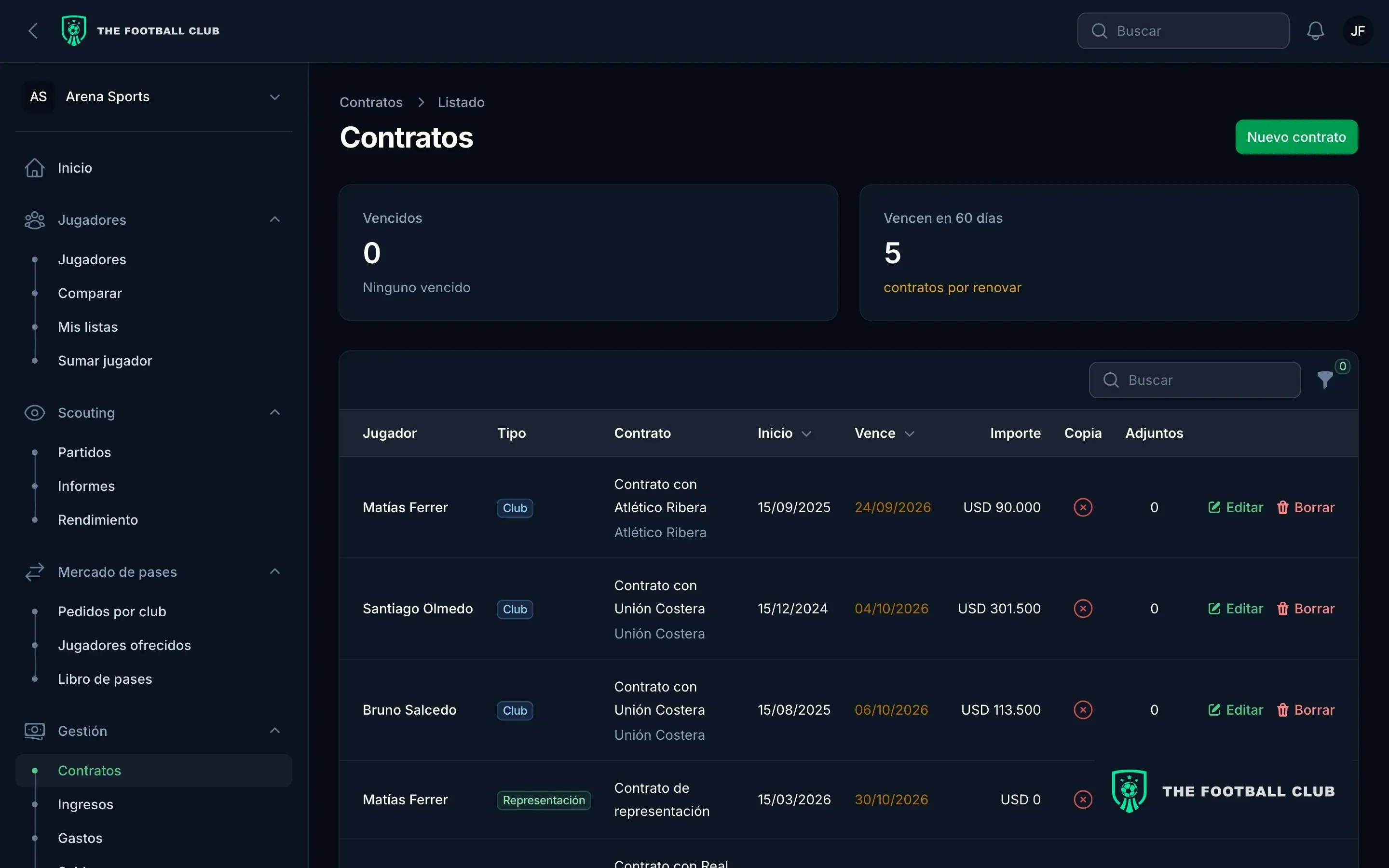
The end of the loan shows up in contract expiry alerts, and because it has to fall inside a registration period, it is worth reading alongside the transfer window dates. Neither clause is a release clause: that one sits in the player’s contract, not in the agreement between clubs.
Sources
- FIFA: Regulations on the Status and Transfer of Players, July 2025 edition (PDF): article 10 and Annexe 3, article 10.
- UEFA: Club Licensing and Financial Sustainability Regulations, 2026 edition, Annex G.4: paragraphs G.4.4 to G.4.6.
This article is for information only and is not legal or accounting advice. Updated November 2026.