Month-end checklist for a soccer agency before you invoice
By Mariano David Pérez Co-founder

A month-end checklist for a soccer agency is a one-hour review, on the same day every month, that answers four questions before a single invoice goes out: which fees are due to be invoiced, which earlier invoices have not been paid, which expenses are still missing and where each client’s balance stands. It comes before invoicing because an invoice is only right if the agreement behind it is in force, the amount is the agreed one and the payer is the correct one, and the close is where those three things get checked.
Updated on 16 November 2026. The regulatory points come from the FIFA Football Agent Regulations, in force since 1 January 2025, and from circular no. 1873, which suspended some of their articles. How a fee is invoiced and taxed depends on your country and on how the agency is set up: that is your accountant’s call, not this article’s.
What is the month-end close, and why does it come before invoicing?
It is the fixed moment when the agency stops entering things and looks at what has been entered. It is not bookkeeping — the accountant works afterwards, with what the close hands over — but the check that prevents three expensive mistakes:
- Invoicing something that is not due. An installment on a contract the player no longer has, a percentage that differs from the signed one, the wrong payer.
- Not invoicing something that is due. The installment that fell this month and that nobody remembered because the transfer was a year ago.
- Treating invoiced as paid. They are two different dates, and the agency lives on the second.
In how to organize a soccer agency the close appears as the monthly half of the minimum routine. Here it is taken apart, item by item.
What do the FIFA regulations say about collecting a fee?
The FIFA Football Agent Regulations do not tell you how to run your back office, but several of their rules work, in practice, as month-end checks. These remain in place:
| Rule | What it says | Article |
|---|---|---|
| Fees are paid against an invoice | The service fee due to a soccer agent is paid on an invoice basis | Art. 14 par. 4 |
| Only what was agreed, with an agreement in force | An agent is entitled to a fee only if it corresponds to services stipulated in advance in a representation agreement that was in force when the services were performed | Art. 14 par. 5 |
| Being paid after the representation ends | Where the employment contract outlasts the representation agreement, the agent may keep receiving the fee after the latter expires, if that was expressly agreed with the client and while the employment contract is still in effect | Art. 14 par. 5 a) |
| Two years at most | A representation agreement with a player or coach may not exceed two years, and any automatic renewal clause is null and void | Art. 12 par. 3 |
| The client can ask for the detail | A client may request from the agent a schedule detailing all payments made by or regarding that client, including fees and expenses | Art. 18 par. 1 e) |
And these are suspended worldwide since 30 December 2023 under circular no. 1873, which put them on hold following an injunction from a German court:
- The payment calendar: fees paid after the registration period closes and in installments every three months for the duration of the employment contract (art. 14 par. 6), or in a single installment at expiry when the contract runs for less than six months (par. 8).
- The pro-rata rule: that only remuneration the player has actually received generates a fee (par. 7), and that the agent loses any fee not yet due if the player moves to another club early (par. 12).
- Payment through the Clearing House (par. 13). Today the FIFA Clearing House describes its job as processing payments between clubs for training rewards — training compensation and solidarity contribution — and the article itself provides that, until the Clearing House regulations cover agent fees, they are paid directly to the agent.
- The service fee cap (art. 15) and the reporting duties on the FIFA platform (art. 16 par. 2 j), including uploading the details of each fee payment within 14 days.
What this means for the close: while the suspension lasts, the due date of each installment is set by the agreement you signed, not by a FIFA calendar. That is why the close is done with the contracts open. And since suspended rules can be reinstated, check FIFA’s current circulars and your association’s agent regulations before treating anything as settled. The full picture is in our guide to the FIFA Football Agent Regulations.
What goes on the checklist, and in what order?
Eight items. The order matters: first what backs an invoice, then the money, then what gets reported.
| # | What you look at | The question |
|---|---|---|
| 1 | Representation agreements | Is the one behind each of this month’s fees in force? Does any expire in the next two months? |
| 2 | Installments due this month | Are they all on the list to invoice, with the amount and currency in the contract? |
| 3 | Changes to employment contracts | Did any player move, terminate or renew? What does your agreement say about the remaining installments? |
| 4 | Invoiced and unpaid | Which invoices from earlier months are still open, since when, and who is chasing them? |
| 5 | The month’s expenses | Are they all entered, against a player or as overheads, with a receipt? |
| 6 | Money advanced by staff | Has whoever paid out of pocket been reimbursed? |
| 7 | Balance per client | How much has each one brought in and cost this year? |
| 8 | One figure for the partners | Collected, outstanding and spent this month, by currency, always in the same format |
The three items that get skipped most:
- Item 1 is not red tape. If the service was performed after the representation agreement had lapsed, article 14 paragraph 5 leaves the agent with no entitlement to a fee. And if the representation has ended but the employment contract runs on, what lets you keep collecting is having that in writing. How to track those dates is in soccer contract expiry.
- Item 3 is settled by reading the agreement, not from memory. With paragraph 12 suspended, what happens to outstanding installments when a player leaves early is whatever you agreed.
- Item 5 has its own article: what each expense entry needs and how to separate player costs from overheads is in soccer agency expenses.
What should you confirm before issuing each invoice?
Five things, all taken from the contract rather than from the email thread where it was negotiated:
- Who pays. The player, the club that signed him or the club that sold him, depending on whom the agency represents in that deal. The rule that only the client may pay (art. 14 par. 2) is also among the suspended ones, so the signed agreement governs.
- What the fee is calculated on. Fixed salary, salary plus variables, the transfer amount. If the agreement says “remuneration actually received”, you need to know what the player was paid in the period before you invoice.
- How much, and in which currency. The percentage or amount in the contract, in the contract’s currency. If it is paid in another, the exchange rate of which day.
- Which period it covers. So the March installment is not invoiced twice and the June one not at all.
- That the invoice is tied to its contract. Player, club and installment number in the description, so that a year from now someone who was not there can work out where it came from.
An example with invented data: “Matías Ferrer · contract with Unión Costera · installment 3 of 8 · 5% of the quarter’s fixed salary · USD 4,500 · due 30/11 · representation in force until 06/2027.” If any piece cannot be filled in, the invoice does not go out yet.

What do you do with invoices that have not been paid?
Look at them separately, because this is where an agency loses money without noticing. Sort what is outstanding by age — under 30 days, 30 to 90, over 90 — and make sure every open invoice leaves the close with two things: an owner and a date for the next reminder.
Under the regulations, a client’s obligations include paying the agreed service fee in a timely manner (art. 18 par. 1 b). But chasing depends on being able to show the agreement, the invoice and the record of what has already been paid, which is what the close keeps in order. The same record produces the payment schedule a player may request under article 18 paragraph 1 e).
Who runs the close, and how long does it take?
An hour, with two people: whoever handles administration prepares the lists and a partner goes through them, because decisions come out of the close — chase, renegotiate, stop investing in a player. It takes an hour only if everything was entered during the month on the day it happened; if the close is the day four weeks of expenses get typed in, it takes an afternoon and comes out wrong. How to spread that work across the week is in soccer agent daily tasks.
How the month-end close works in The Football Club
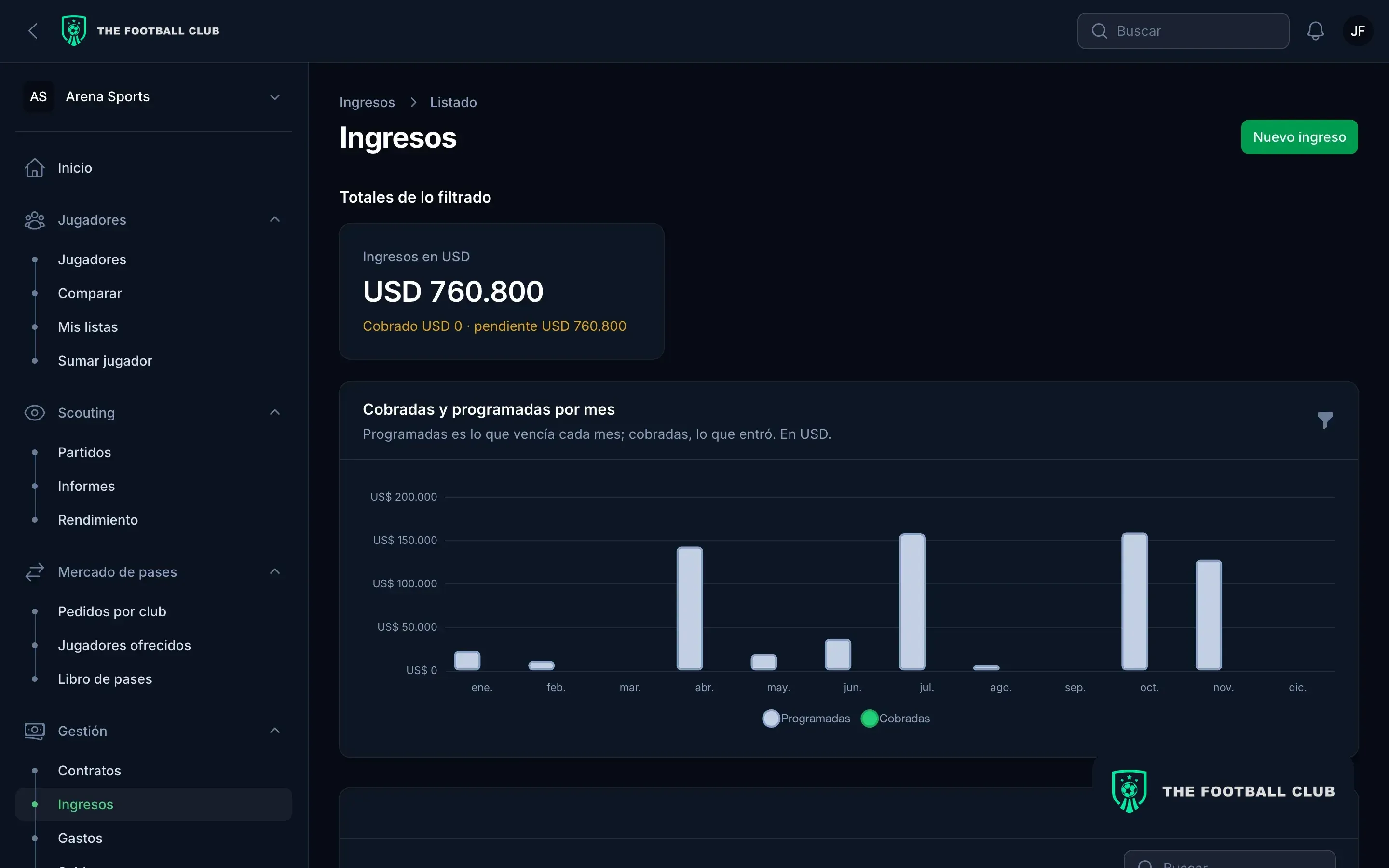
A spreadsheet copes with the close while there is one currency, one person entering data and few contracts paid in installments. After that, closing the month means rebuilding it. This is how it looks in The Football Club (the screens are from a demo agency, with invented data):
- Every fee with its percentage and its due date. What was agreed is recorded when the contract is entered; when the money arrives it is marked as collected, and what is still owed stays in view. See contracts and commissions.
- Club contracts and representation agreements on the player profile, with their term, and expiry alerts on a traffic-light view by deadline, with a daily email of what is coming into range.
- Expenses by player and by category, and how much has been invested in each one.
- Several currencies with the day’s exchange rate, and the agency’s consolidated balance.
- The financial report by period, broken down by player and by item, exported to Excel for the accountant and to PDF for the partners.
- The month’s figure by chat. The WhatsApp assistant tells you how the month is going — collected, spent and balance by currency — for the agency or for one player.
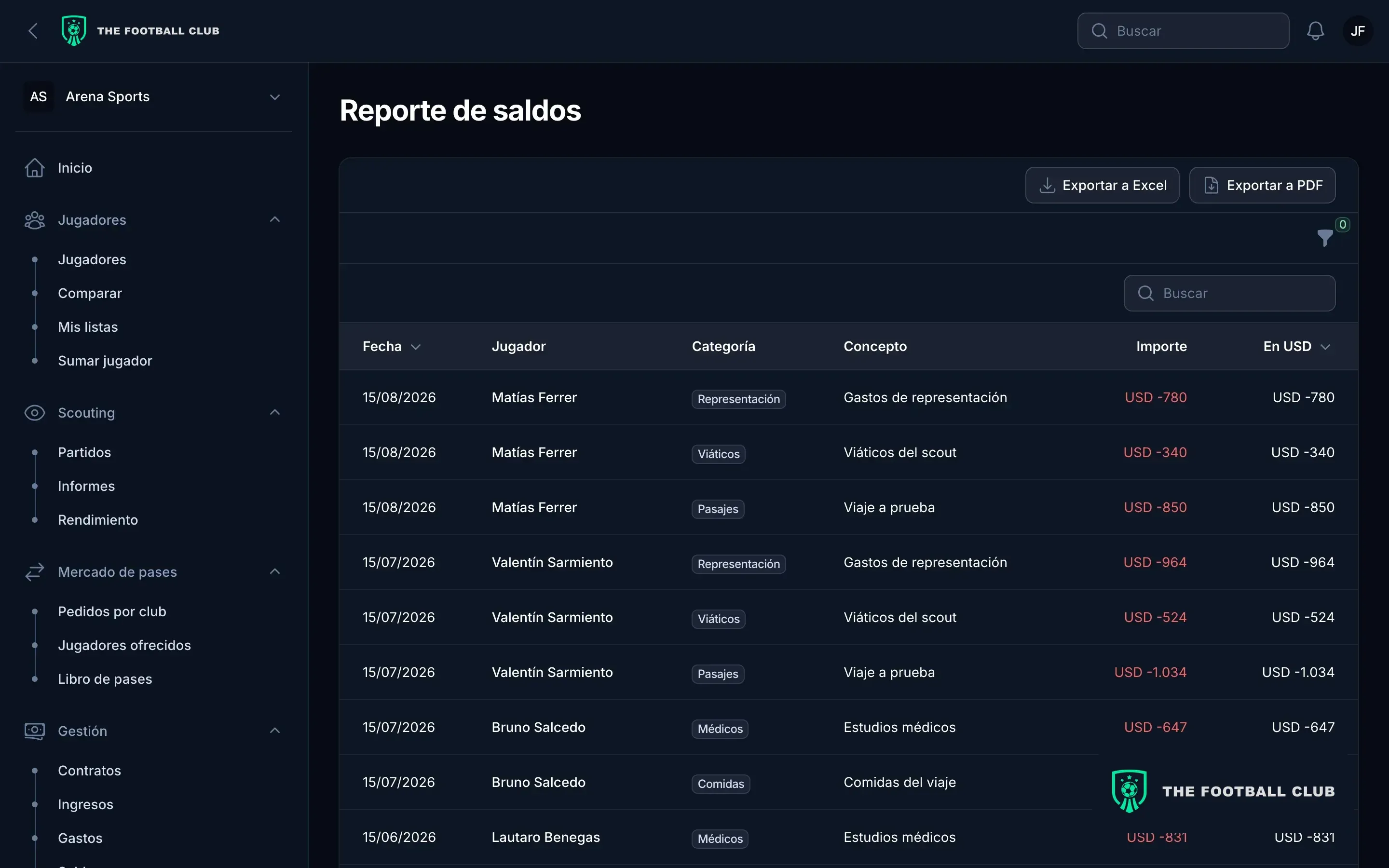
The invoice is still issued wherever you issue it today; what changes is that the lists for the close are already there when you sit down. How it fits with the rest of the work is on the app for managing players, and the plans are under pricing.
This article is for information only and does not replace legal or accounting advice. The regulatory points were checked against the FIFA documents cited, as of November 2026; the articles suspended by circular no. 1873 may be reinstated, and each association may have its own rules on agents.
Sources
- FIFA Football Agent Regulations, in force since 1 January 2025 (PDF) — articles 12 paragraph 3; 14; 15; 16 paragraph 2 j); and 18 paragraph 1 b) and e)
- FIFA circular no. 1873: update on implementation of the regulations (PDF, 30 December 2023) — list of suspended articles
- FIFA Clearing House: objectives