How to sign players as a soccer agent
By Mariano David Pérez Co-founder

How to sign players as a soccer agent: you must first hold a FIFA license, then find players worth watching, approach them within the rules and sign a written representation agreement of two years at most. The hard part is the order. FIFA’s agent regulations set out who may approach a player, when, and what may never be offered.
This article walks through that path. It is not a recipe for winning clients at any cost, but the sequence that builds a roster that is still yours two years later.
Can you sign players without a license?
Not to approach them or to represent them. The FIFA Football Agent Regulations (edition in force since 1 January 2025) say in article 11 that only a Soccer Agent may perform agent services, and in article 12 that only a Soccer Agent may approach a potential client or enter into a representation agreement. Agency staff who are not licensed agents may not do either, and the agent remains fully responsible for what the agency does.
The license is obtained through FIFA’s platform: you apply there, meet the eligibility requirements and sit the exam, 20 multiple-choice questions. The whole route is in how to become a soccer agent. While you wait, you can do what is not an “approach”: watch games, build lists and learn the market.
Where do you find players worth representing?
There is no secret place. What works is what any scout does, and it all rests on watching players:
- Youth and lower-league matches, where no agent is entrenched yet. Going often to the same grounds and the same clubs pays more than going everywhere.
- Youth tournaments and national-team age-group events in your region.
- Performance data, to decide who to go and see before you travel. It filters; it does not decide, because a number does not say how someone plays.
- Recommendations from coaches, fitness staff and other players: the most reliable source and the slowest.
- Players whose contract is running out, though anyone with an exclusive agent follows a separate rule (see below).
What ties it together is keeping a record. A player you saw once and did not write down does not exist; with three reports over six months you have something to say to him and his family. How to write one is in how to write a soccer scouting report.
When and how may you contact a player?
The word that matters is “approach”. In FIFA’s definition, an approach is any physical contact or contact by electronic means with a client, any direct or indirect contact with someone linked to them such as a family member or friend, and also using another person to make that contact on your behalf. A social-media message to a parent, or asking a friend to “pass the word” to a player, is an approach.
Three rules in the regulations change how you go about it:
- A player with another agent on an exclusive deal. You may not approach him or sign him, except in the final two months of that agreement (article 16, paragraph 1).
- A player under contract with a club. Article 16, paragraph 3, bans approaching, negotiating or facilitating talks with the aim of inducing him to terminate his contract without just cause or breach its obligations.
- No inducements. The same article prohibits offering or paying any undue advantage, directly or indirectly, to a player or to his family member, legal guardian or friend in relation to the representation agreement.
Minors have a rule of their own, and it is the one with the heaviest sanction.
What applies to minors?
An approach to a minor or their guardian may only be made no more than six months before the age at which the player can sign a first professional contract under the law of the country where they will be employed, and only after written consent from the legal guardian (article 13). The agent must also have completed FIFA’s course on minors first. A breach is sanctioned, at a minimum, with a fine and a license suspension of up to two years.
In practice: you cannot recruit children in infant or early academy ranks. You can follow their progress and wait for the window. The detail is in soccer agent for minors.
What must be signed before you represent someone?
No written agreement, no service: under article 12 an agent may only provide services to a client after entering into a written representation agreement. With a player:
- It lasts two years at most, can only be extended by signing a new one, and automatic renewal is void.
- One agreement at a time with the same player.
- Before signing, you must tell him in writing to consider independent legal advice and obtain his written confirmation that he took it or decided not to.
Which clauses to include and which to avoid is in the soccer representation agreement. What you may charge is in how much soccer agents earn.

How do you persuade a player to sign with you?
With what you can show, not what you promise. Players and families usually ask for:
- Clarity on what you will do: which clubs you reach, what the service covers, who will be their contact.
- Real contact: quick answers and someone who remembers what was said last time.
- A transparent fee: how much, who pays and when, in writing.
- A plan with dates: when his contract ends, which windows are coming, what will be done before then.
Avoid promising a transfer. No offer depends on you alone, and a broken promise costs more than an honest “no”.
How do you keep track of players who have not signed yet?
This is where work gets lost. Between the first time you watch a player and the signature there can be months: matches seen, a chat with the father, a call pending, the date a window opens. In a spreadsheet that disappears by the third tab.
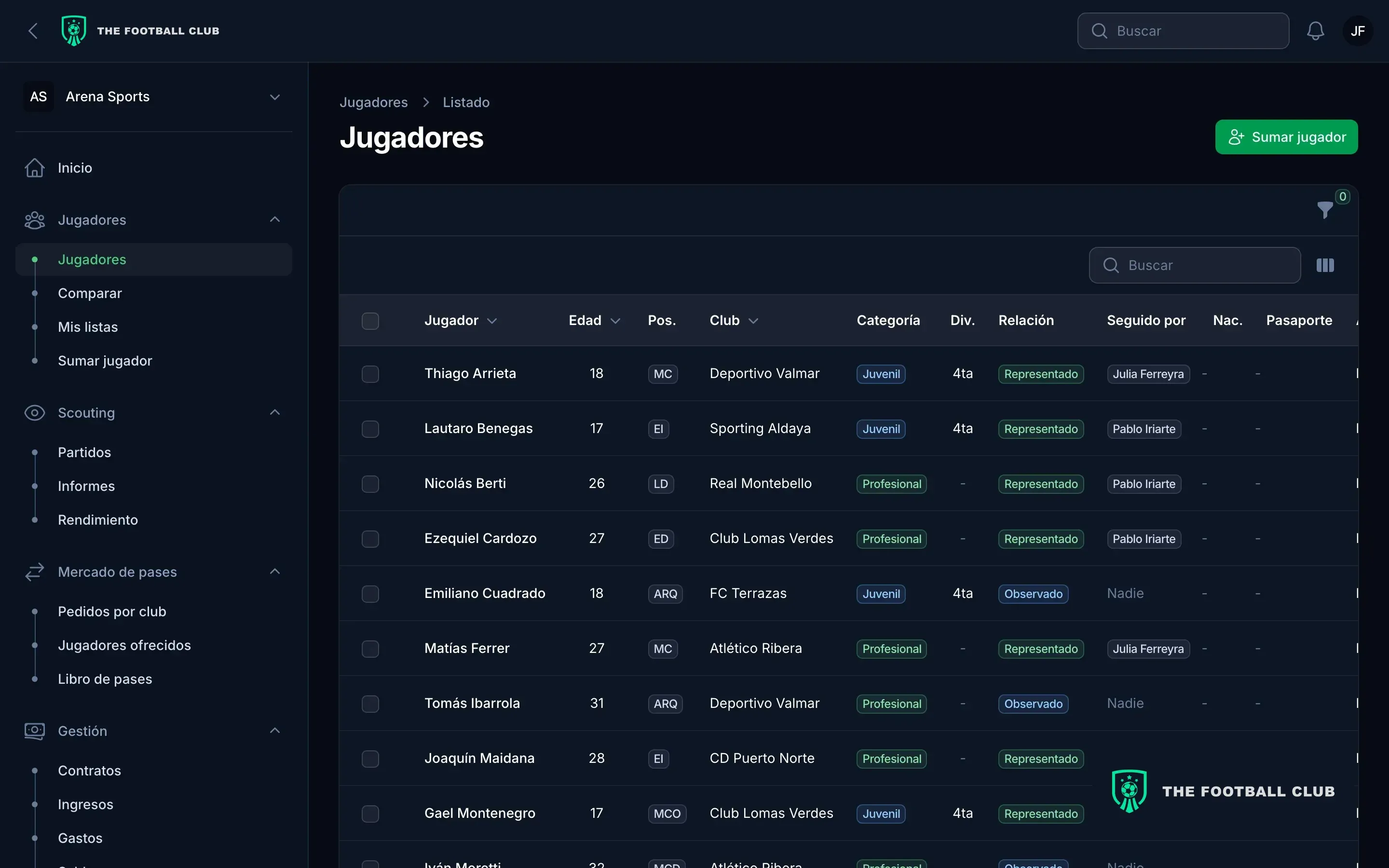
The Football Club keeps every player, represented or not, in one profile with reports, follow-up notes and goals, and the list tells represented players from observed ones and shows who on the team follows each, and lists by criterion let you separate “watching” from “already spoke to the family”. Once someone signs, his contract and fee sit in the same profile and the expiry reaches you by email, which stops an exclusive agreement lapsing unnoticed. For how it fits together, see how to organize a soccer agency.
In short
Signing players is a months-long process: license, a trained eye, a record of what you saw, contact within the rules and a written agreement of two years at most. What stalls most agencies is not finding players but keeping track of those already watched.
This article is for information only and is not legal advice. It is based on the official text of the FIFA Football Agent Regulations, the edition in force since 1 January 2025, and information published by FIFA as of November 2026. National rules can be stricter.
Sources
- FIFA Football Agent Regulations, 2025 edition (PDF): articles 11, 12, 13 and 16 and the definition of “approach”
- FIFA: how to become a licensed soccer agent
- FIFA: national football agent regulations