What is the homegrown player rule?
By Mariano David Pérez Co-founder

The homegrown player rule requires a club to include a set number of players in its roster who were trained locally, whatever their nationality, so that clubs keep developing their own young players instead of buying everything from abroad. It is not a FIFA rule: each competition sets its own, and the two best-known are the Premier League’s and UEFA’s.
How does the Premier League define a homegrown player?
The Premier League calls him a Home Grown Player. According to the league itself (2025/26 season), he is a player who, irrespective of nationality or age, was registered with any club affiliated to The Football Association or the Football Association of Wales for three entire seasons, or 36 months, before his 21st birthday (or the end of the season in which he turns 21).
The league caps the number of players in the 25-man roster who do not meet that criterion at 17; the rest must be homegrown. Under-21 players sit outside the 25.
What do UEFA competitions require?
UEFA speaks of “locally trained players”. According to its explanation of Champions League roster registration, at least eight of the 25 places on List A are reserved for them, in two kinds:
| Kind | What he completed | How many |
|---|---|---|
| Club-trained | Three entire seasons (or 36 months between ages 15 and 21) at the club itself | At least four of the eight |
| Association-trained | The same, at another club in the same association | Up to four of the eight |
If a club registers fewer than eight, its List A shrinks by the same number.

Why does it matter to an agency or a club?
A young player who has completed that time in one country is easier to place in a roster with a quota. The reverse also holds: a player who moves to another association very young may lose that profile. So it pays to keep a record of where and for how many seasons each player in your portfolio was registered. It is the same record used to claim training compensation and the solidarity mechanism.
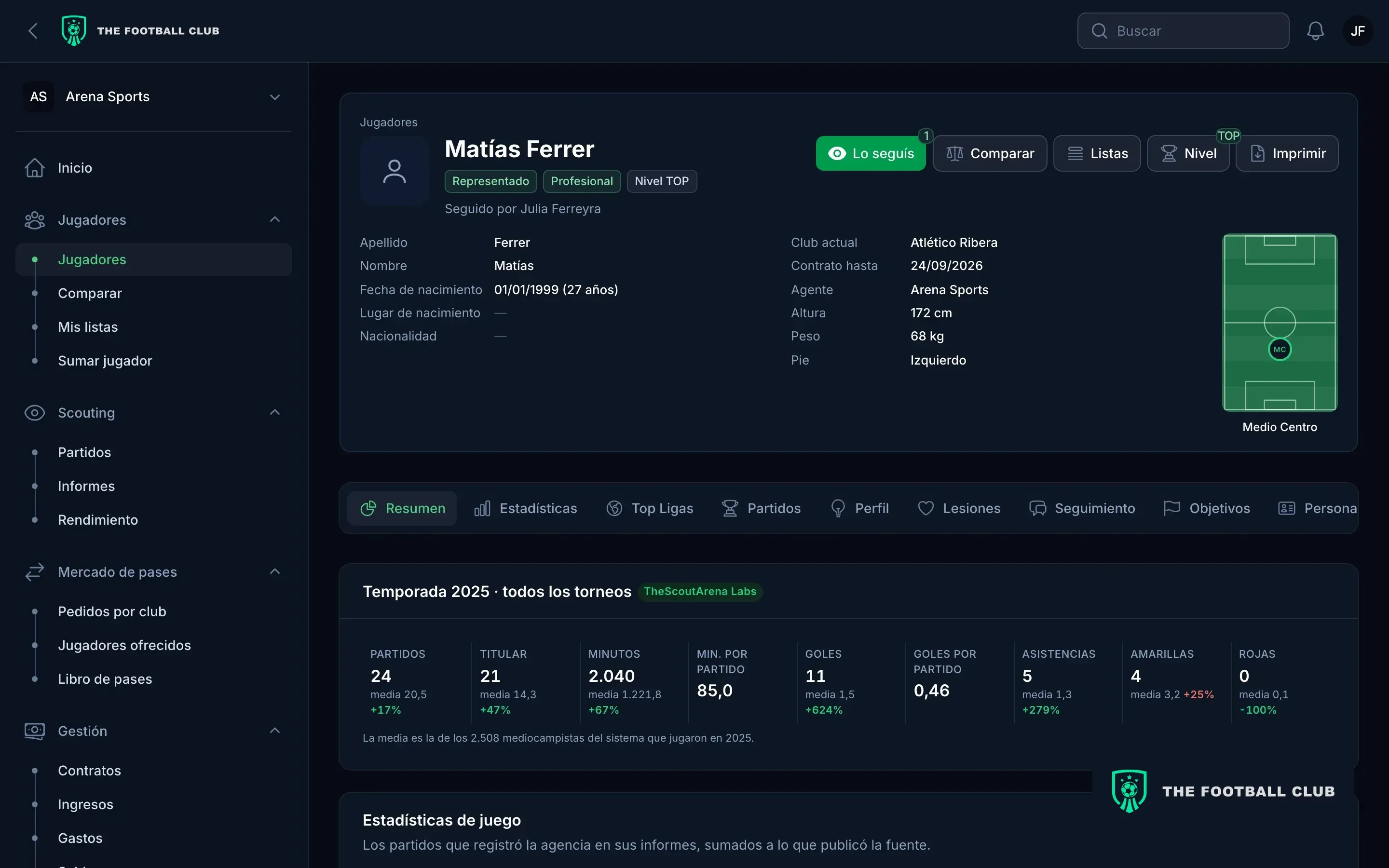
In The Football Club, the player profile keeps his club, contract and performance in one place, and the app for managing players shows how a full portfolio fits together.
In short
Rules change by competition and by season: before building or offering a roster, check the current regulations of that league. This article is current as of November 2026.