AI for soccer agents: what an assistant can answer today
By Mariano David Pérez Co-founder

AI for soccer agents is useful today for three jobs: drafting (a player presentation, an email to a club, a translation), querying the agency’s data in plain language, and watching your client list to tell you what has changed. How well an assistant answers depends less on how “smart” it is than on where its information comes from: if it cannot read your contracts and reports, any date or rule it gives you needs checking. This article sorts out what to ask it, what not to paste into it, and what the EU AI Act expects of anyone who uses it with their staff.
Updated November 2026. The regulatory points come from the FIFA Football Agent Regulations, the edition in force since 1 January 2025, and from Regulation (EU) 2024/1689 in its consolidated version.
What is AI actually useful for in a soccer agency?
It is useful for the work that eats hours without moving any negotiation forward: writing, looking things up and keeping an eye on things. An agency’s tasks split fairly neatly into three jobs, and each one asks something different of the tool:
| Job | Examples | What the AI needs to do it well |
|---|---|---|
| Drafting | A client presentation for a club, an email in another language, a summary of a long report | The player’s real data; otherwise it fills the gaps with generic phrases |
| Querying | What expires this month, what has been collected, how a player is doing | Access to what the agency has recorded, with each role’s permissions |
| Watching | Who has gained minutes, who is on form, whose contract is running out | Data that updates itself, every day |
What AI does not do is the core of the job: the conversation with a sporting director, a family’s trust, reading whether a club really wants the player. It helps you walk into that conversation with everything to hand; it does not have it for you.
What can a general assistant like ChatGPT answer?
A general assistant handles well anything that does not depend on your data or on a rule that changed recently. It is useful for a first draft of an email, translating a proposal, summarising a document you give it or explaining a concept. Where it fails is in what sounds certain and is not: dates, articles, amounts.
The agent regulations are the best example. FIFA approved the current edition on 10 December 2024 and it has applied since 1 January 2025 (article 28). An assistant trained on older texts can answer with outdated rules, or another country’s, in the same confident tone. Ask how long a representation agreement can last and the right answer is no more than two years, extendable only by a new agreement, with any automatic renewal clause null and void (article 12, paragraph 3); if it tells you something else, you have no way of noticing without going to the text.
The practical rule is simple: any fact that ends up in a contract, with a club or with a family gets checked at the source. If the assistant does not tell you where it got something, treat it as a draft.

What changes when the AI reads your agency’s data?
It stops guessing. An assistant connected to the agency’s system answers with what is on record: the contract and its end date, the report the scout filed on Saturday, the commission the club has not paid yet. You no longer have to explain who the player is or paste in a spreadsheet.
That brings two conditions worth demanding from any tool:
- It respects who sees what. If your scout cannot see commissions, the assistant should not show them either. AI must not become a back door to what a role is not allowed to see; how to split those permissions is covered in roles in a soccer agency.
- It saves nothing without your confirmation. If it can record as well as query — an expense, a note, a report — it should show you a summary and wait for your yes before saving.
The chat version of this assistant, with what it answers today and what it does not, is in the article on the chatbot for soccer agents.
What should you never paste into a general-purpose AI?
Nothing you would not email to a stranger. When you copy a contract or a medical report into a general assistant, you are handing it to a third party your agency has no agreement with about that data.
- Health data. Injuries, medical reports, scans. The European Commission points out that health data is a special category that may only be processed when a specific condition is met, such as the person’s explicit consent.
- Full contracts. Salaries, bonuses, clauses and a club’s signature. If you need a clause explained, copy just that clause, without names or figures.
- Minors’ data. A youth player’s documents, address and parents’ details.
- What you were told in confidence. A club’s interest that is not public yet, an offer still on the table.
An assistant that lives inside the agency’s system does not have this problem in the same way: it reads the data where it already is, under the permissions that already exist, instead of you taking it out to paste somewhere else.
What does the EU AI Act ask of an agency that uses AI?
It asks that the people using AI know how to use it. Article 4 of the AI Act, as amended, requires providers and deployers — here, the agency using it in its work — to take measures to support the AI literacy of their staff, taking into account their experience, training and the context of use. The same article states that this does not require them to guarantee any specific level of AI literacy of any individual. Under article 113, that chapter has applied since 2 February 2025.
For an agency of three or four people, in practice this looks a lot like sitting down once with the team and agreeing three things: what AI is used for, which data never goes into it, and what gets checked before anything is sent. If the agency works with players or clubs in the European Union, it is worth putting that in writing too.
The other rule — telling people when a system talking to them is an AI — is covered in the chatbot article: it matters if you ever set up an assistant to reply to players or clubs.
How do you use it without it making things up?
Ask it for what it can know and check what it cannot. Five habits are enough:
- Give it the data; don’t ask it to remember. “Draft the presentation with these minutes and this rating” beats “introduce this player”.
- Ask for the source. If it cites a regulation, it should name the article and edition; then you open it.
- Check every number. Dates, amounts and percentages are the first things to be invented and the last to be noticed.
- Nothing goes out without a human read. An email to a club with an AI error still carries your name.
- Record what happens. The agency’s AI is only as good as what the agency writes down; without the habit of recording, no assistant helps. That is where how to organize a soccer agency starts.
How The Football Club handles it
The Football Club is the software we built for player representation agencies, and its AI works on the same data and permissions as the rest of the platform.
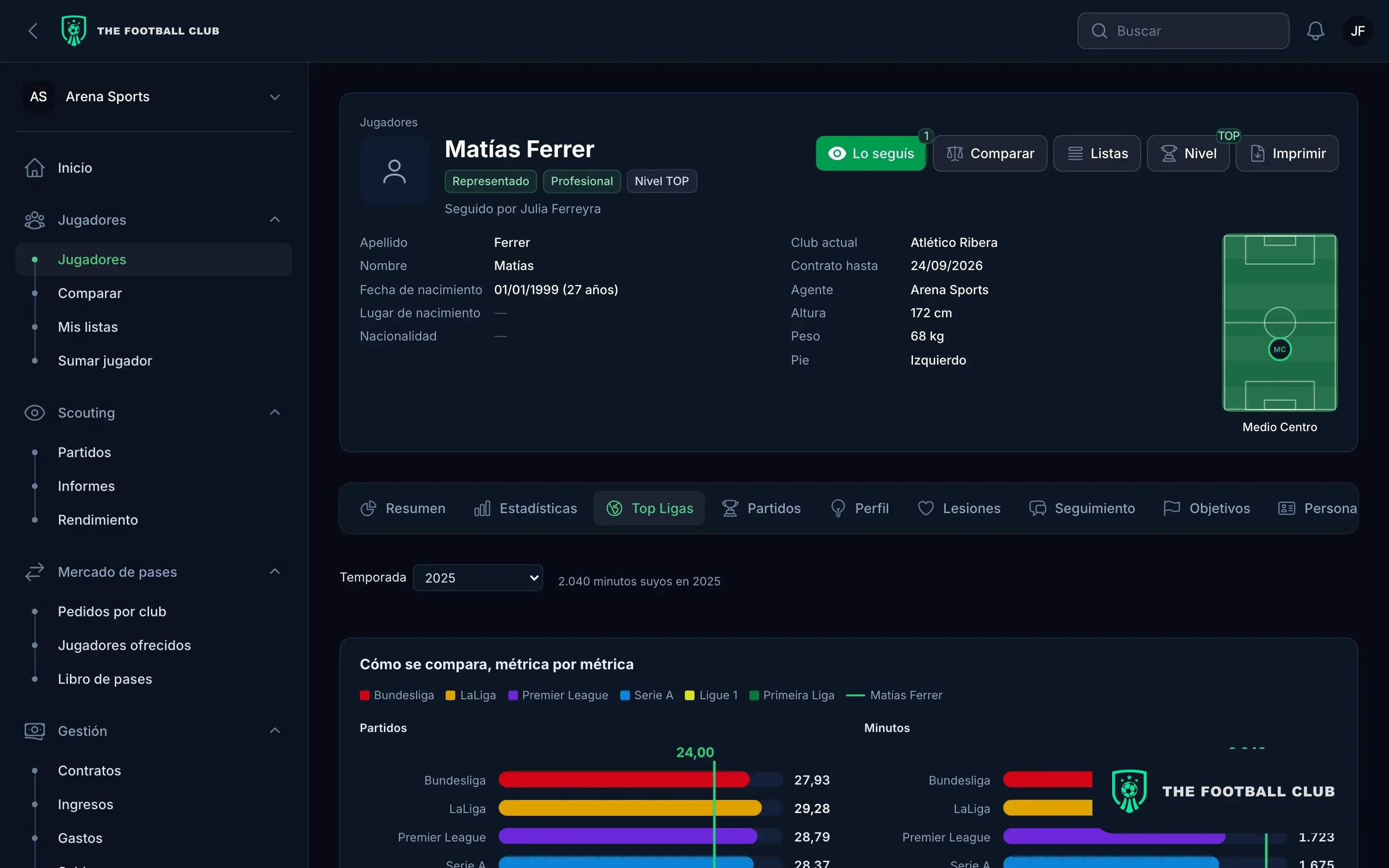 The comparison against the position that the written summary will draw on is already in the profile. Data from a demo agency.
- Today: the WhatsApp assistant. Ask about a client and it sends back their profile; ask what is expiring or how the month is going. It records expenses, notes, reports and tasks, always with a summary before saving, and it can never do more than the person using it.
- Coming soon: the written player summary. It pulls together minutes, goals, percentile against the position and what your scouts noted, and drafts the text to present the player to a club. You edit it before sending.
- Coming soon: alerts on standout players. Every day it watches the list and flags who has jumped in minutes, who has moved into the top 10% for their position, or whose contract ends just as they are playing their best. The signals are calculated from recorded data; if there is nothing, it writes nothing.
Both upcoming pieces are listed as “coming soon” on the app for managing players, along with how each fits into the agency’s work. The comparison against the position they rely on is already in the player profile, and contract expiry alerts arrive by email every morning. You can book a demo to try it with your own questions.
In short
AI for soccer agents already saves time drafting, querying and watching, but it only answers well what it can read. A general assistant is fine for drafts and translations, not for regulations or dates you have not checked, and it is not the place for contracts or medical reports. If your team uses it, agree what it is for, what it never gets and what is checked before sending; that is also what the EU AI Act expects of anyone who deploys it.
This article is for information only and is not legal advice. The regulatory points were checked in November 2026 against the sources below.
Sources
Consulted in November 2026:
- FIFA Football Agent Regulations, in force since 1 January 2025 (PDF): articles 12.3 and 28.
- European Commission, AI Act Service Desk: article 4 (AI literacy, as amended) and article 113 (application) of Regulation (EU) 2024/1689.
- European Commission: legal grounds for processing personal data, including special categories.